
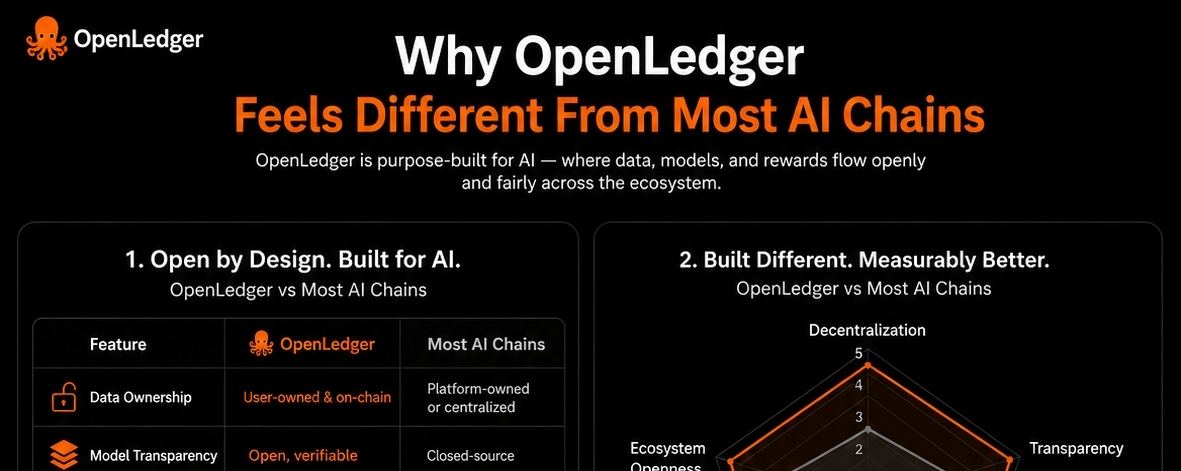
OpenLedger doesn’t feel like one of those projects that appeared because someone spotted a trend early and rushed to package it into a token. It feels more like something that came out of sitting inside the AI space too long and noticing how strange the whole thing has started to become once real usage entered the picture. Not the polished version people post online, but the actual behavior underneath it all.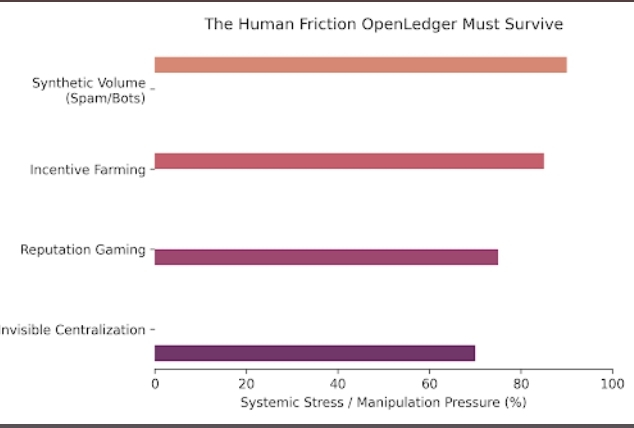
The longer AI systems stay around, the more obvious it becomes that almost everything valuable inside them comes from people continuously feeding them. Not just datasets in the technical sense, but constant interaction. Corrections. Habits. Patterns. Tiny behavioral signals repeated millions of times until a system slowly learns how humans think, respond, hesitate, or search for clarity. Most users do this unconsciously now. They interact with models the same way people once casually handed entire lives over to social media platforms without thinking too hard about where the information was going.
At some point the industry stopped talking about users and started talking about “inputs.” That shift says more than people realize.
OpenLedger seems built around that exact discomfort. Not in a dramatic way. More like a quiet reaction to watching AI infrastructure become increasingly centralized while the people generating value remain mostly invisible inside the process. Everyone celebrates model breakthroughs, but very few conversations focus on where the intelligence actually accumulates from over time.
That part stays strangely ignored.
And maybe that’s because the answer is uncomfortable. AI doesn’t just come from compute or architecture. It comes from endless human interaction layered into systems until those systems become commercially powerful enough to close themselves off. The cycle keeps repeating everywhere now. Open platforms become ecosystems. Ecosystems become businesses. Businesses eventually protect extraction points. Then suddenly openness starts shrinking once enough value exists to defend.
Crypto was supposed to make people more aware of these patterns, but honestly it developed plenty of its own blind spots. The space spent years obsessing over ownership while somehow missing how much informational value remained trapped inside centralized systems. Tokens became liquid immediately. Human contribution didn’t. Attention got monetized. Speculation got monetized. But data itself mostly stayed locked behind corporate infrastructure even while AI companies quietly built trillion-dollar leverage from collective participation.
That’s probably why OpenLedger keeps resurfacing in conversations even when people are exhausted by AI narratives. Underneath the branding and terminology there’s a real irritation sitting there. A growing sense that users are continuously enriching systems they have almost no long-term relationship with beyond access fees and interfaces.
And people are starting to notice.
Not loudly yet. More subtly. You can feel it in the way users have become more protective of workflows, prompts, datasets, private communities, even personal behavioral patterns online. The internet used to reward openness naturally because sharing felt harmless. AI changed that atmosphere. Now information feels extractive in a way it didn’t before. Every interaction looks potentially valuable to someone else’s system.
That changes how trust behaves.
Watching OpenLedger from the outside, it doesn’t really feel like a project trying to sell technological utopia. If anything, it feels shaped by the realization that AI economies already exist whether people understand them or not. Data has become infrastructure. Models have become assets. Agents are slowly becoming labor. But the ownership around those layers still feels unfinished and uneven.
The industry acts like intelligence simply appears through innovation, but most of it is accumulated participation disguised as product development.
That’s the strange truth sitting underneath modern AI.
And once you notice it, the current structure starts looking unstable in ways people rarely admit publicly. Everyone says they want decentralized intelligence until they confront the actual messiness of human incentives. Because decentralization sounds beautiful right until money enters the room. Then systems start warping immediately.
Crypto already learned this repeatedly.
People farm incentives. They spam networks. They optimize visibility over usefulness. Reputation systems become games. Governance becomes theater. Large operators quietly absorb influence while smaller participants slowly lose relevance. Every open economic system eventually collides with manipulation pressure because humans adapt faster than architectures expect them to.
That’s where projects like OpenLedger will probably face their real test.
Not whether the ideas sound compelling, but whether the system can survive scale without collapsing into low-quality noise or invisible centralization. Because once data and AI outputs become monetizable at network level, contribution itself changes. People stop behaving naturally. Incentives reshape participation. Useful intelligence competes against synthetic volume generated purely to capture rewards.
And honestly, the AI space already feels dangerously close to drowning in synthetic behavior.
There’s something almost exhausting about scrolling through modern internet spaces now. Bots replying to bots. AI-generated summaries of AI-generated articles. Automated engagement loops pretending to be communities. Information moving faster while somehow feeling emptier at the same time. Quantity increasing while trust deteriorates quietly underneath.
OpenLedger exists inside that environment too. It won’t escape those pressures just because the architecture sounds cleaner on paper.
Still, there’s something worth paying attention to here because the project seems connected to a real shift happening underneath the surface of the internet itself. People are beginning to realize that intelligence has become an economy. Not metaphorically. Literally. Human reasoning, preferences, conversations, corrections, and interactions are being transformed into economic assets at massive scale.
And economies eventually force difficult questions.
Who owns contribution?
Who benefits from accumulated intelligence?
What happens when the systems learning from humanity become more economically powerful than the humans feeding them?
The industry still doesn’t have stable answers for any of this.
Most companies avoid the conversation entirely because the current imbalance remains profitable. But projects like OpenLedger seem to emerge from the growing realization that the imbalance may not stay socially invisible forever. Eventually people start asking where the value went. Eventually contributors notice they became infrastructure without realizing it.
That awareness changes things slowly at first.
Then all at once.
Maybe OpenLedger succeeds. Maybe it struggles under the same pressure every decentralized system eventually faces. Maybe incentive structures break in ways nobody fully predicts yet. That part feels impossible to know early. Real stress exposes truths whitepapers never can.
But the reason the project keeps pulling attention back isn’t because of hype. It’s because it feels connected to something people increasingly sense but rarely articulate clearly yet: AI systems are not just technology anymore. They are extraction systems, coordination systems, labor systems, and ownership systems all forming simultaneously.
And right now, nobody really knows what happens once those layers fully collide.