

For a long time, honestly, I used to think most of the conversation around AI and crypto was just noise. Big ideas, complex language, and grandiose promises that sounded impressive on a slide deck but didn't feel real in practice. Everything seemed obsessively focused on the future, while very little felt usable in the present.

But recently, I realized something feels different. Not louder or more dramatic quieter and that quietness is exactly what makes it feel real.
The shift is simple: the focus is moving away from what AI agents could do in theory, and toward how these systems behave in live environments. Not in curated demos or isolated experiments, but under real pressure real users, unpredictable workloads, and actual on-chain consequences when things fail. This is where the conversation stops being about speculative hype and starts becoming about infrastructure.
Moving Past the Fragility of "Smart Agents"
Infrastructure rarely gets the spotlight because it doesn't create viral narratives. But in practice, it decides whether anything works at scale. A system can be intelligent and innovative, but if it cannot handle growth and constant demand, it breaks. And once the infrastructure breaks, the "intelligence" becomes meaningless.
We saw this with early crypto trading bots and automation tools. At first, they felt powerful. They could execute basic strategies and react quickly. But real-world usage exposed their fragility. Scaling was difficult, performance was inconsistent, and too much manual intervention was still required.
If AI agents are going to move beyond experimentation and begin interacting directly with data, execution protocols, and real-time environments, reliability is non-negotiable. Failure is no longer just an application bug; it becomes a completely broken decision chain.
The Reality of Built-for-Purpose Infrastructure: OpenLedger
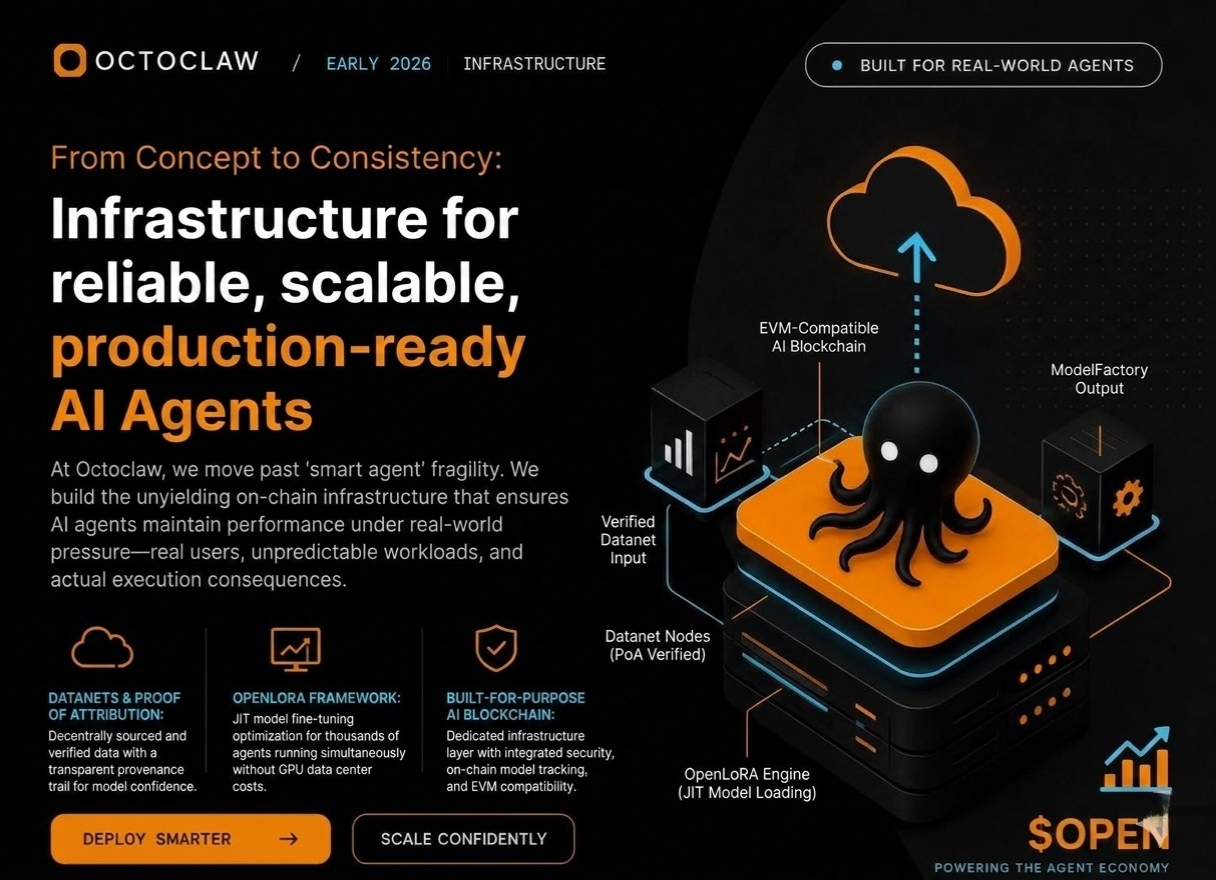
This structural necessity is exactly why I’ve been tracking OpenLedger ($OPEN). Instead of trying to build isolated "smart agents" and hoping they don't break, OpenLedger approaches this from the data and hosting layer up, operating as a dedicated, EVM-compatible AI blockchain.
When you look past the typical marketing, their architecture is addressing the exact scaling and reliability bottlenecks that make production-grade AI so difficult to deploy:
• Datanets & Proof of Attribution (PoA): Reliable AI requires reliable, specialized data. OpenLedger uses decentralized "Datanets" where data contribution and model refinement are recorded directly on-chain. Through Proof of Attribution, the network establishes a transparent provenance trail, validating data quality and ensuring that ownership and credit are mathematically traceable rather than just assumed.
• OpenLoRA Framework: In standard cloud infrastructure, spinning up thousands of distinct, fine-tuned models requires an immense, cost-prohibitive amount of isolated GPU compute. OpenLedger's OpenLoRA layer acts as an infrastructure optimization engine, allowing thousands of low-rank adaptation (LoRA) models to run simultaneously on a single GPU by loading adapters just-in-time. This is how you maintain performance and keep latency low under heavy, concurrent user pressure.
Tying Token Utility to Network Behavior
This is also where the utility of the native token, OPEN, becomes interesting. In a sustainable ecosystem, a token shouldn't rely on temporary narrative hype; its value must be structurally tied to actual network behavior.
Within OpenLedger, OPEN operates as the literal gas mechanism for this specialized infrastructure. It isn't just a speculative vehicle—it is actively consumed to process on-chain data coordination, pay for model training via the ModelFactory, and handle real-time inference fees. Furthermore, the token powers AI Agent Staking, meaning agents must stake $OPEN to operate on the network. If an agent underperforms, breaks its decision chain, or acts maliciously, its stake can be slashed.
[Data Contributors] + [Model Developers] + [Validators]
│
▼ (Powered by $OPEN Gas & Inference Fees)
┌───────────────────────── │ OpenLedger AI Blockchain │
│ (Proof of Attribution & OpenLoRA) │
└────────────────────────┘
▲
│ (Requires $OPEN Staking)
[AI Agents]
By linking the token directly to data verification, compute efficiency, and economic accountability, the incentive model aligns with long-term network stability rather than short-term market noise.
Progress in this space doesn’t feel like a sudden, miraculous breakthrough anymore. It feels like stabilization. Systems are becoming smoother, workflows are less chaotic, and tools that once felt fragile are gradually becoming usable. You don’t always notice that kind of change immediately. But over time, you realize the things that used to break constantly now simply work.
The industry is finally waking up to a hard truth: The future of decentralized AI won't be won by the loudest narrative, but by the boring, unyielding infrastructure that refuses to break under pressure.
Disclaimer: This post is for informational and educational purposes only. It does not constitute financial, investment, or trading advice. Cryptocurrencies and Web3 assets involve high risk, volatility, and market unpredictability. Always conduct your own thorough research (DYOR) before participating in any blockchain ecosystem.