
@OpenLedger | $OPEN | #OpenLedger
I want to be honest about something before I get into this.
I'm not a skeptic by default. I came into @OpenLedger genuinely curious — maybe even slightly optimistic. The idea that data contributors could finally get paid for the AI value they actually create felt like something worth believing in. I spent real time going through the architecture. The Proof of Attribution whitepaper. The January 2026 attribution engine update. The Infini-gram technical framework. The Datanets documentation.
And I kept running into the same wall.
Not a flaw in the idea. A gap in the disclosure.
Let me explain what I mean. 👇
The mechanism makes sense — until it doesn't
OpenLedger's Proof of Attribution maps which data influenced a specific output, then routes rewards accordingly. The whitepaper describes two approaches: influence-function approximations for smaller models, and suffix-array-based token attribution for LLMs — checking output tokens against compressed training corpora to detect memorized spans. That influence score becomes the basis for inference-level payouts. (99Bitcoins)
On paper, that's elegant. Your data influences a model. The system measures how much. You get paid proportionally when someone uses that model.
I kept reading. Then I hit the part nobody seems to be talking about.
The January 2026 attribution engine update was specifically described as "ensuring data-output links remain intact even as AI models are updated and fine-tuned." (Fortune)
"Remain intact." That phrase bothered me.
Because there's a version of "intact" that means protected — and a version that just means tracked. Those are very different things. One compensates early contributors. The other just gives you a cleaner view of how much their share has shrunk.
Here's the specific problem I couldn't stop thinking about
AI models don't stay static. You know this already. They get fine-tuned. Layered. Updated. Each cycle incrementally shifts the model's behavior away from what the original training data produced.
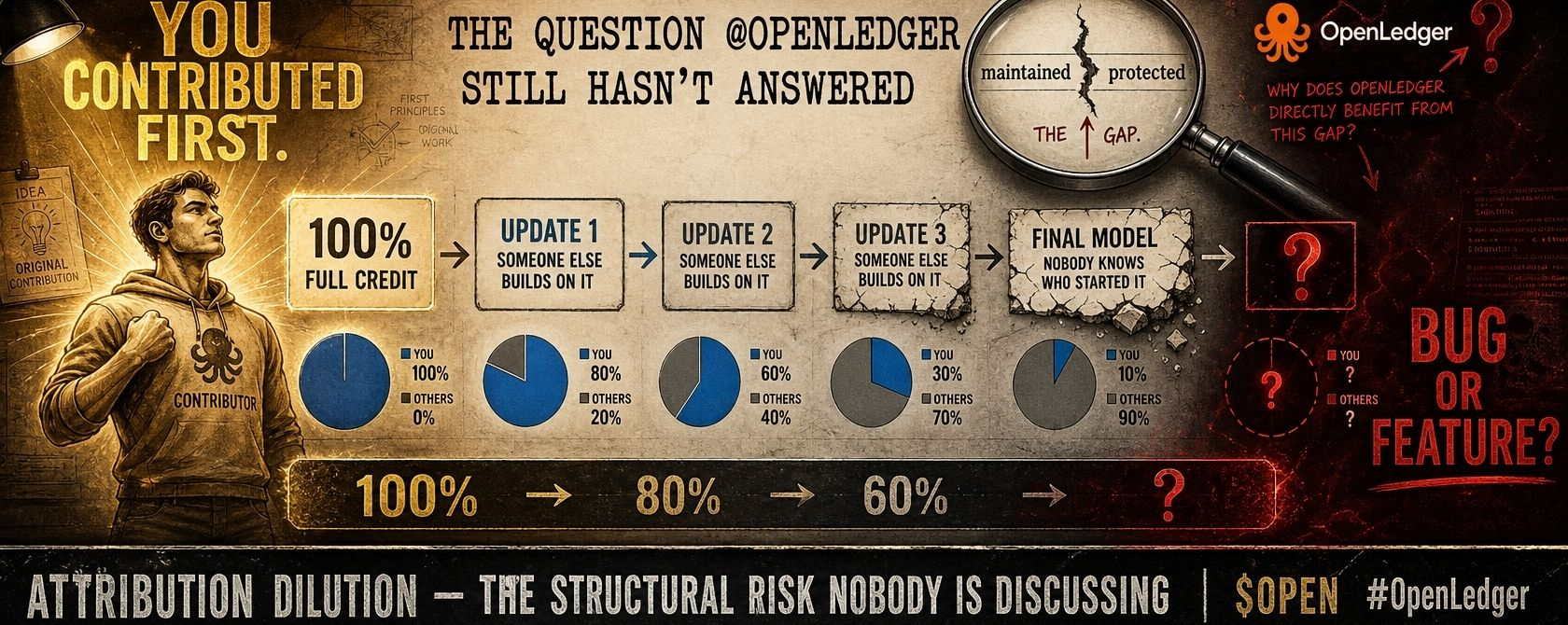
Look at the diagram above. 100% credit at launch. Then an update comes. Then another. By the third fine-tuning cycle, the original contributor's influence score has drifted to 60% — maybe less — not because their data got worse, but because the model got better around it.
OpenLedger's own whitepaper notes that as scale increases, traditional attribution mechanisms fail to meet the requirements of efficiency, precision, and interpretability — which is exactly why they adopted Infini-gram. (Binance) Fair enough. But Infini-gram tracks token-level memorization. It's measuring what the model literally remembers from training data. As fine-tuning layers accumulate, that memorization pattern shifts. New data overwrites old signals. The suffix-array comparison finds fewer matches to earlier contributions.
So the architecture creates a natural dilution dynamic. I can't find anywhere in the documentation that explicitly addresses how this is mitigated for early contributors over successive fine-tuning cycles.
That's the gap.
I've seen this shape before
DeFi summer. Early liquidity providers took the most risk. They provided capital before the pools had meaningful volume, before the execution quality was good, before the impermanent loss math worked in their favor. They built the foundation.
Then volume arrived. Later LPs entered at better prices with less risk and captured a disproportionate share of fee revenue. The people who showed up after the hard part was already done walked away with more than the people who made it possible.
Being early wasn't rewarded. It was diluted.
OpenLedger's primary goal is to create a transparent, community-driven AI economy by tracking data contributions, model training, and value distribution on-chain. (Twelve Data) I believe that's genuinely what the team is trying to build. But transparent tracking and protected attribution aren't the same thing. You can track a shrinking number with perfect precision.
That's the distinction I'm not yet convinced has been resolved.
What actually gives me some confidence
The most technically sophisticated piece on the OpenLedger stack isn't the attribution system itself — it's something called x402, a payments protocol built and open-sourced in February 2026. It leverages the unused HTTP status code 402 to allow any API endpoint, dataset, or compute resource to express its price in OPEN tokens and automatically settle when another machine accesses it. No human approval. No invoice. (CoinMarketCap)
That's genuinely impressive infrastructure thinking. Machine-to-machine settlement with attribution embedded at the protocol level — that's not vaporware. That's a real technical decision with real implications.
The Story Protocol collaboration in January 2026 adds another layer — machine-readable ownership definitions, licensing terms, and permissions for derivatives. OpenLedger actually enforces those licenses when data is used for training. (CoinMarketCap)
So the team is clearly thinking about the hard problems. They're not just building attribution theater.
Which makes the gap in disclosure more frustrating, not less. If the infrastructure is this sophisticated, the answer to my specific question — what happens to early contributor attribution shares across successive fine-tuning cycles — has to exist somewhere internally. I just can't find it publicly.
The real risk isn't a crash. It's a slow drain.
$OPEN is currently trading 91.6% below its all-time high. Token unlocks begin December 2026 — 12-month cliff, 36-month linear vesting. Until adoption improves ahead of that supply increase, structural pressure builds. (CoinMarketCap)
That's the market-level risk. Fair. Priced in.
The deeper risk is different. If attribution dilution compounds quietly over time, the datanets fill up, contribution volume looks healthy on-chain, and from the outside everything reads as progress. Underneath that surface, the earliest contributors — the ones whose data shaped the model's foundational capabilities — earn less and less with every update cycle. Not because they did anything wrong. Because the system improved around them without protecting their position.
That's not a catastrophic failure. It's a structural one. The kind that doesn't appear in dashboards until the contributors who noticed it have already quietly left.
What I actually want to see
Not a whitepaper section. Not a documentation update. Real on-chain data from a live datanet showing what happened to early contributor rewards after the model was fine-tuned. Attribution share at launch. Attribution share after update one. Attribution share after update three.
That specific disclosure — actual numbers, actual outcomes — tells me whether the January attribution engine update solved the dilution problem or just gave it better lighting.
Proof of Attribution maintains an immutable record of contributions, ensuring contributors receive credit based on the impact of their data. (Investing.com)
Impact is the word I keep circling. Impact measured at launch, or impact measured dynamically as the model evolves? Those two definitions produce completely different reward structures for early contributors.
Until I see the data, I'm watching fine-tuning activity on active datanets more carefully than any other signal from this protocol.
The diagram says it simply: 100% → 80% → 60%.
@OpenLedger needs to tell us whether that trajectory is a bug they fixed — or a feature they designed. 👁️
Not financial advice. Personal analysis only. DYOR.
💬 Should early AI data contributors be protected from attribution dilution as models improve — or is dilution an acceptable tradeoff for a better model?
Drop 🛡️ — protect early contributors fully
Drop ⚖️ — some dilution is fair, later work adds value too
Drop 🔍 — need the on-chain data before deciding anything
🪙 Every comment = coins earned on Binance Square right now!
🪙 LIKE if this raised questions you hadn't considered!
🪙 SHARE — every $OPEN holder and AI contributor needs this analysis!
🪙 FOLLOW for deep AI + crypto research — free, daily!
#OpenLedger #OPEN #AIBlockchain #ProofOfAttribution #DeFAI #Web3AI #BinanceSquare #CryptoResearch #AIAttribution #Crypto2026 🪙