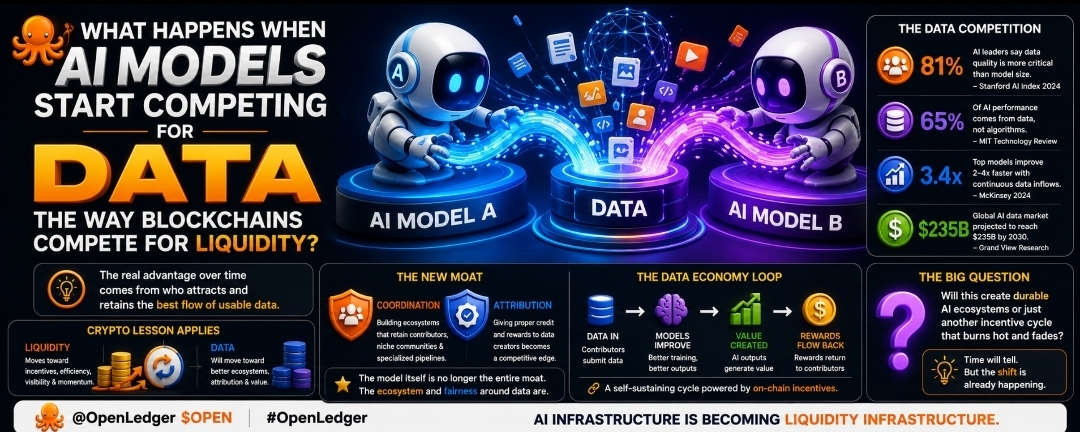
Lately I’ve been thinking about something that doesn’t get discussed enough in AI conversations. Most people focus on the visible side of things — model rankings, benchmark scores, speed, or how powerful a system looks compared to others. Those things matter, but I’m not sure they explain where long-term advantage really comes from.
The more I think about it, the more it feels like useful data may become the real battleground.
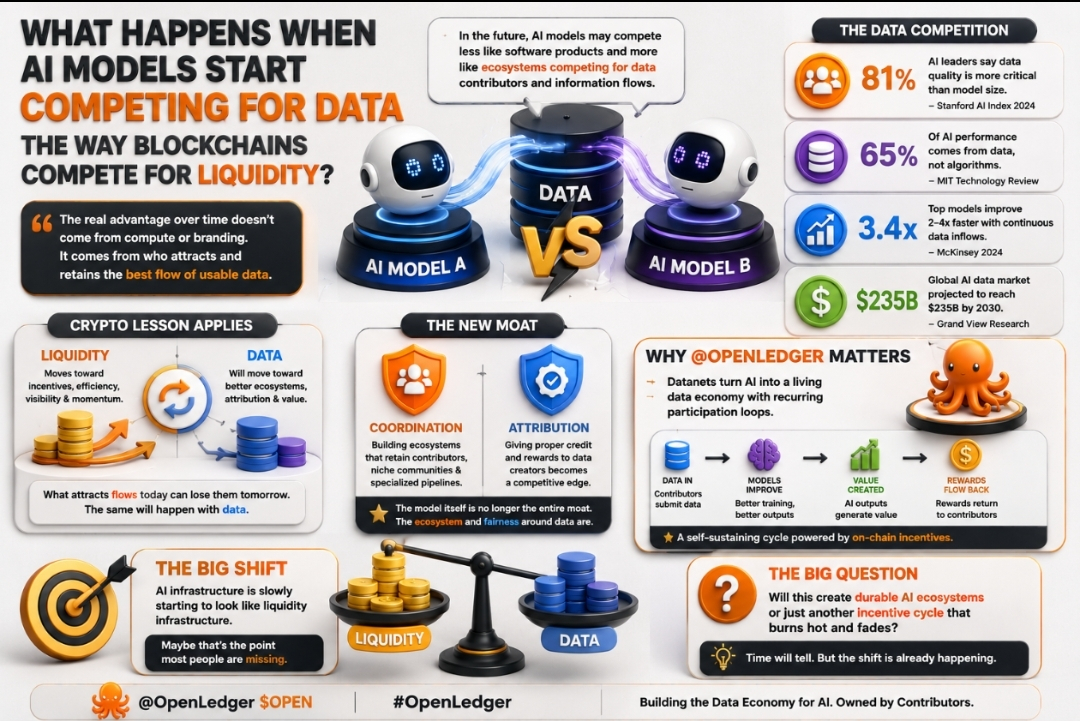
Crypto already gave us a similar example. Liquidity rarely sits in one place forever. It moves toward better incentives, stronger ecosystems, and places where participants see more value. Data could start behaving in a similar way.
If that happens, AI models may stop competing like normal software products. Instead, they could begin competing like ecosystems trying to attract communities, contributors, and unique information sources. Suddenly the model itself may no longer be the biggest advantage.
Coordination becomes important.
Attribution becomes important too.
That is partly why projects like @OpenLedger catch my attention. Their Datanets concept feels less like a one-time training process and more like a system built around recurring participation. Data enters the network, models improve, value gets created, contributors receive rewards, and the cycle keeps moving.
Of course, there is still a big question here. Crypto has seen incentive systems become extremely popular before cooling down once rewards disappear.
But the shift itself feels difficult to ignore.
AI infrastructure slowly starting to resemble liquidity infrastructure might end up being the bigger story.