
For decades, international money transfers have been slow, expensive, and heavily dependent on traditional banking systems. Sending money across borders often takes days, involves high fees, and passes through multiple financial institutions before reaching its destination. In a world driven by instant technology, the global payment system remained surprisingly outdated. Then came $XRP a digital asset designed to modernize the movement of money itself.
$XRP was created by Ripple with a vision far different from many other cryptocurrencies. While several blockchain projects focused mainly on decentralization and digital ownership, Ripple aimed to solve a real-world financial problem: making global payments faster, cheaper, and more efficient.
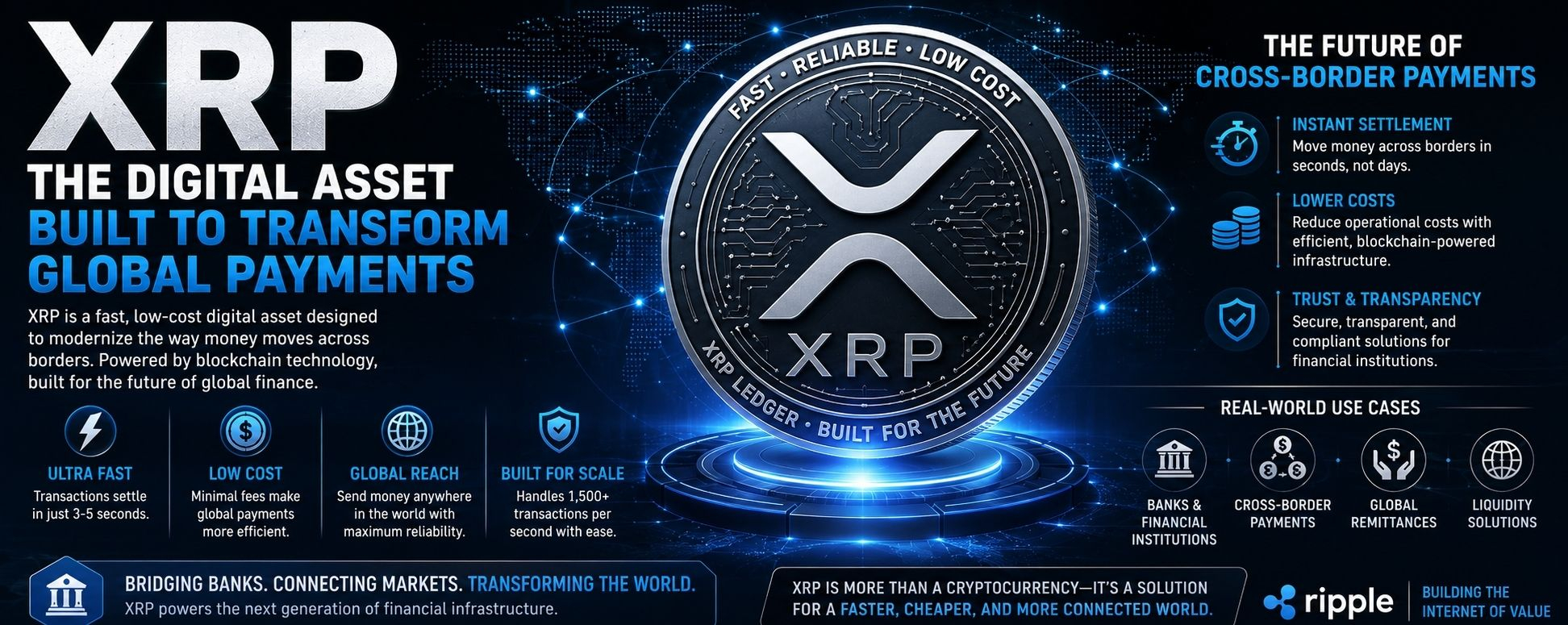
Traditional international banking systems rely on networks like SWIFT, where transactions can take several days to settle. XRP introduced an alternative approach by enabling transactions to settle within seconds. Instead of waiting for multiple banks and intermediaries to process payments, XRP allows value to move almost instantly across borders with minimal fees.
One of XRP’s biggest strengths is speed. Bitcoin transactions can sometimes take minutes or longer during network congestion, while XRP transactions usually settle in just a few seconds. This made XRP attractive not only to crypto investors but also to financial institutions exploring blockchain-based payment solutions.
Another major advantage is scalability. The XRP Ledger can process thousands of transactions per second, making it one of the fastest blockchain networks in the industry. Because of this efficiency, Ripple partnered with various banks, payment providers, and financial companies worldwide to test and integrate blockchain payment technologies.
Unlike many cryptocurrencies created through mining, all XRP tokens were pre-mined at launch. This unique structure has often been part of debates surrounding the project. Supporters argue that it provides efficiency and stability, while critics believe it raises concerns about centralization and control.
Regulation has also played a major role in XRP’s history. Ripple faced one of the most closely watched legal battles in crypto when regulators questioned whether XRP should be classified as a security. The case created uncertainty across the market and heavily impacted XRP’s price and adoption. However, despite years of legal pressure, XRP remained one of the most recognized and actively traded cryptocurrencies globally.
Supporters believe XRP could become a key bridge asset for the future of global finance. Instead of replacing banks, Ripple’s vision focuses on upgrading the financial infrastructure already used around the world. This approach separates XRP from many blockchain projects that aim to completely disrupt traditional systems.
Beyond banking, $XRP has also gained popularity among investors and crypto communities because of its strong global presence and long-term survival through multiple market cycles. Even during periods of heavy criticism and regulatory challenges, the XRP ecosystem continued expanding.
Today, XRP represents more than just another cryptocurrency. It symbolizes the merging of blockchain technology with real-world financial systems. Its mission is not simply about creating digital money but about transforming how money moves worldwide. #crypto #market
As the world becomes increasingly connected through digital finance, XRP continues positioning itself as one of the leading technologies attempting to reshape international payments. Whether it eventually becomes a major part of the future banking system or remains a powerful blockchain payment network, XRP has already secured its place as one of the most influential projects in the history of cryptocurrency