I’ve been thinking a lot lately about how strange the internet economy has quietly become. Every day, people create data without even noticing it. Conversations, searches, preferences, trading patterns, browsing habits, creative work, AI prompts — all of it flows endlessly across platforms like invisible currency. Yet somehow, the people generating most of this value rarely own any meaningful part of it. The system almost feels upside down. The raw material of the modern digital economy is human intelligence and interaction, but the monetization layer mostly belongs to centralized platforms sitting in the middle. And somewhere in the middle of all this noise, projects like OpenLedger are trying to ask a bigger question: what if data itself became a liquid, ownable asset inside an AI-driven blockchain economy?
At first, I honestly thought the idea sounded a little too ambitious. AI, blockchain, data ownership, liquidity, agents — yeh sab ek saath suno toh it almost feels like another over-engineered crypto narrative trying to combine every trending keyword into one ecosystem. But the more I looked into the broader direction of AI infrastructure, the more the concept started making practical sense in a weirdly inevitable way. Artificial intelligence today runs on data the same way industrial factories once ran on oil or electricity. Without constant streams of information, models become stale, disconnected, and less useful over time. Yet most data contributors remain invisible participants in the system.
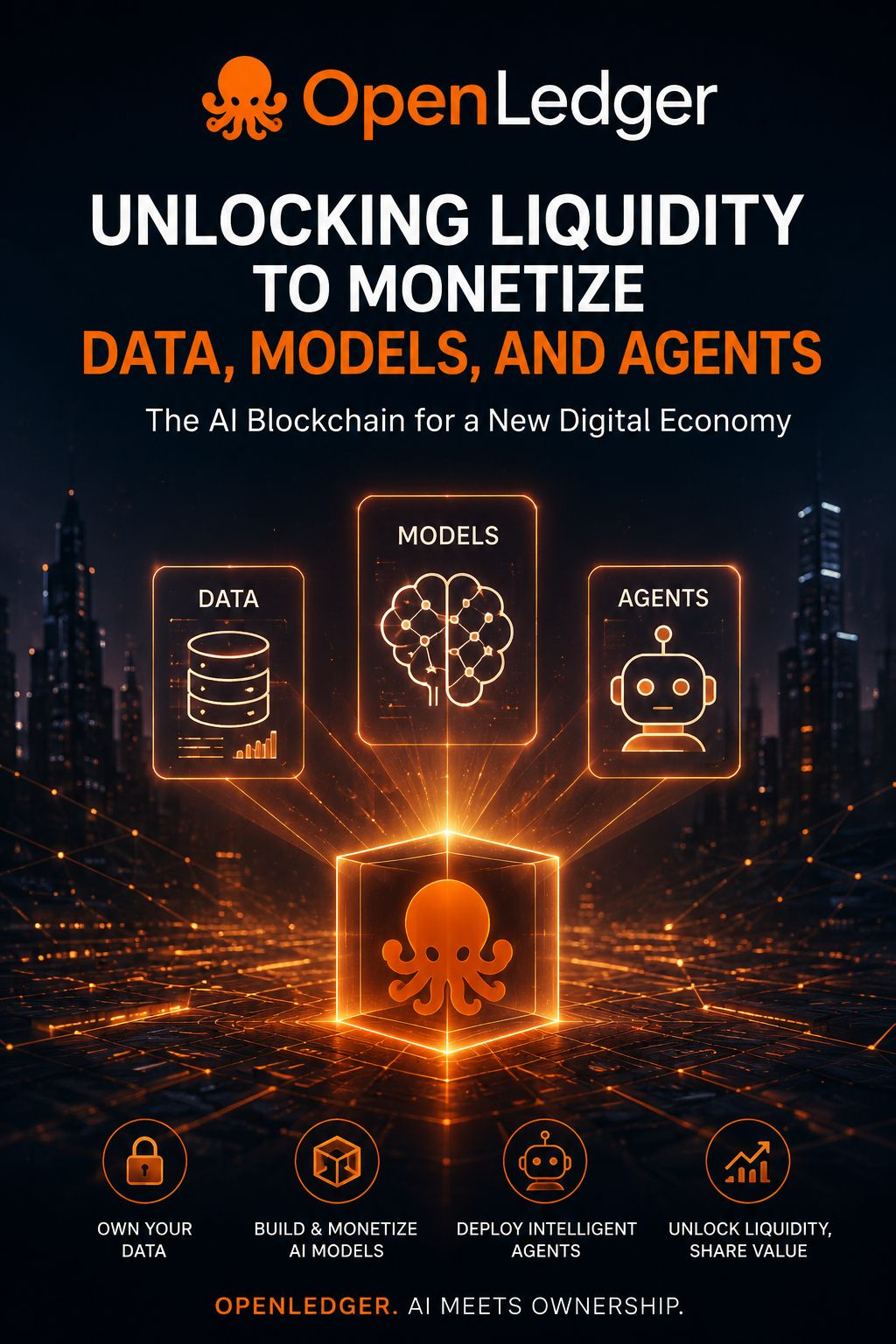
That imbalance is where OpenLedger seems to position itself differently. Instead of treating AI as something owned entirely by large corporations or closed platforms, the idea leans toward building an economy where datasets, AI models, and autonomous agents can become productive digital assets on-chain. In simple terms, it imagines a system where people who contribute useful information, train valuable models, or create functional AI agents can potentially monetize their contributions directly rather than handing them over for free.
The interesting part is not just the blockchain itself, but the idea of liquidity around intelligence. Usually when people hear the word liquidity, they think about tokens or financial assets. But OpenLedger appears to be exploring something broader — making data and AI resources tradable, composable, and economically active in the same way cryptocurrencies became programmable money. That shift feels important because AI is slowly moving from being just a software tool into something more autonomous and economically interactive. AI agents are already starting to execute tasks, analyze markets, automate workflows, and even communicate with other systems independently. If those agents generate value, who owns that productivity? The company? The developer? The data contributors? The users? Honestly, nobody fully knows yet.
Sometimes I think about it like a digital city that nobody fully controls anymore. Data becomes the raw resource, models become factories processing that resource, and agents become workers operating continuously across the network. OpenLedger’s thesis seems to revolve around creating economic rails for that entire ecosystem. Not just storing information on-chain for the sake of decentralization, but enabling value exchange between all these moving pieces in a transparent way.
Still, there’s a huge gap between concept and real-world adoption. That’s the part people in crypto communities often ignore because narratives move faster than infrastructure. Building an AI blockchain is one thing. Creating actual demand for decentralized data economies is another. Most businesses today still rely heavily on centralized cloud systems because they are fast, familiar, and easier to manage. Enterprises care about efficiency more than ideology. If decentralized AI networks cannot compete on speed, scalability, or reliability, adoption becomes difficult no matter how visionary the idea sounds.
And then there’s the question of data quality. This is where things become complicated very quickly. AI systems are only as useful as the information feeding them. In open ecosystems, how do you verify authenticity? How do you prevent manipulation, spam, or low-quality contributions designed only to farm rewards? Traditional social platforms already struggle with fake engagement and algorithm gaming. Imagine similar problems inside AI training economies where financial incentives are directly attached to data generation. The challenge isn’t only technical — it’s deeply human.
At the same time, though, there’s something undeniably powerful about the direction itself. We are entering a phase where AI models are becoming increasingly dependent on continuous interaction and real-time learning. Closed systems may eventually face bottlenecks because proprietary datasets alone might not scale with the complexity of global human behavior. Decentralized contribution models could theoretically unlock broader participation. A researcher in Karachi, a developer in Seoul, and a creator in Lagos could all contribute to an AI ecosystem and potentially share in the economic value created from it. That changes the conversation from simple platform usage to actual digital ownership.
I also keep noticing how the relationship between humans and AI is quietly shifting. A few years ago, AI felt like a passive tool. You asked a question, it answered. Now AI agents are starting to behave more like independent participants in digital environments. They trade, monitor systems, automate decisions, generate content, and coordinate tasks. OpenLedger’s framing of “models and agents” as monetizable assets almost acknowledges this transition directly. It treats AI not just as software but as an economic actor inside a network.
But there’s another side to this conversation that deserves honesty too. Tokenizing everything does not automatically solve structural problems. Blockchain projects often assume financial incentives alone can create healthy ecosystems, but human behavior is rarely that simple. Speculation can overshadow utility very quickly. Communities may focus more on token prices than long-term infrastructure development. We’ve seen this happen repeatedly across crypto cycles. So the real test for OpenLedger may not be technological innovation alone, but whether it can create genuine utility that survives beyond market hype.
And honestly, that might take years.
The internet itself did not become economically transformative overnight. Early websites looked chaotic, fragmented, and impractical before eventually becoming foundational infrastructure for everyday life. AI economies may follow a similar path. Right now, many decentralized AI projects still feel experimental, almost like early sketches of something larger that hasn’t fully arrived yet. But sometimes the early sketches matter because they reveal the direction culture and technology are moving toward before mainstream adoption catches up.
What keeps pulling my attention back to OpenLedger is not necessarily the promise of profit or the excitement of another blockchain ecosystem. It’s the broader philosophical shift underneath the idea. The project quietly raises a deeper question about ownership in the age of artificial intelligence. If human knowledge becomes the fuel powering global AI systems, then who should benefit from that value creation? A handful of centralized platforms? Or the people collectively generating the intelligence layer itself?
Maybe the answer won’t come from one protocol or one blockchain. Maybe the future becomes a messy hybrid system where centralized and decentralized AI infrastructures coexist for a long time. But even asking these questions feels increasingly important now because AI is moving from novelty into infrastructure surprisingly fast. And once infrastructure solidifies, power structures become much harder to reshape later.
So when I look at OpenLedger, I don’t really see a finished solution yet. I see an evolving attempt to rethink how intelligence, ownership, and value might interact in a world where AI becomes deeply woven into everyday economic activity. Some parts of the vision feel incredibly forward-looking. Other parts still feel uncertain, experimental, maybe even fragile. But perhaps that uncertainty is exactly what makes this moment interesting. We’re watching the foundations of a new digital economy being negotiated in real time, and nobody fully knows which models will survive, which ideas will fail, or which systems people will ultimately trust. The conversation itself is still unfolding, and maybe that unfolding matters just as much as the final outcome.