

OpenLedger is in that uncomfortable part of the cycle where the market stops clapping just because a project has a name people recognize.
I’ve watched this happen too many times. First comes the attention. Then the listing noise. Then the chart starts grinding, the feed gets quieter, and everyone suddenly becomes a “long-term believer” because the easy exit has already passed.
That is where OpenLedger is now trying to prove itself.
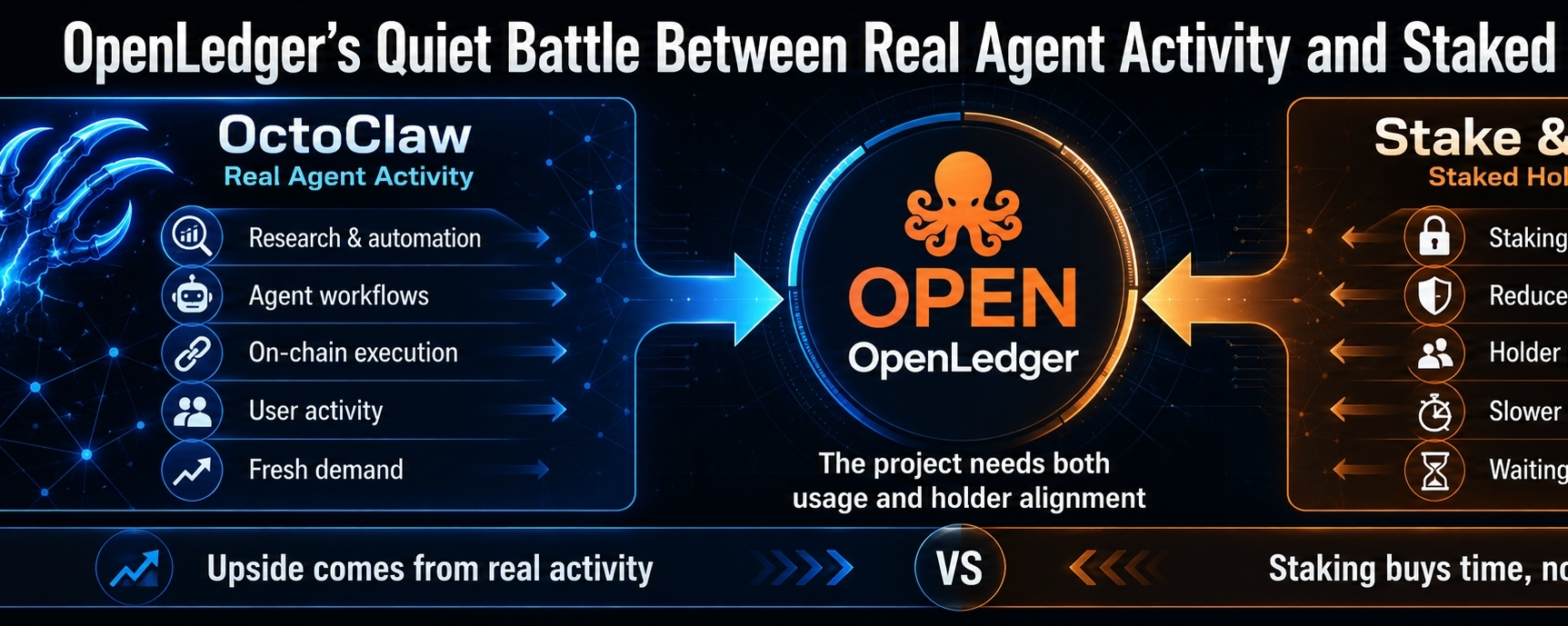
And honestly, that is why the OctoClaw versus Stake & Sleep discussion is worth taking seriously. Not because it is some clean battle between two features. Crypto people love forcing clean comparisons where the market is actually messy. This is not really feature versus feature. It is activity versus patience. Motion versus lockup. One side says OpenLedger still has something to do. The other side says holders need a reason not to panic every time liquidity thins out.
OctoClaw is the part I’m watching more closely, because that is where OpenLedger either becomes useful or starts sounding like every other project recycling the AI-agent script. I’m tired of that script. Everyone has an agent now. Everyone has automation. Everyone has some nice phrase about data, intelligence, workflows, and execution. Most of it turns into noise after two weeks.
The real test, though, is whether OctoClaw gives users a reason to touch the ecosystem when there is no campaign pushing them there.
That is where projects usually break.
If OctoClaw can actually create behavior inside OpenLedger — research, automation, task execution, agent workflows, anything that feels like repeated use rather than one-time curiosity — then OPEN has a better story. Not a perfect one. Just a better one. The token starts looking less like a floating market object and more like something tied to a working system.
But I’m not handing out credit early. I’ve seen too many polished product layers that looked sharp from the outside and empty once the first wave of users got bored. Crypto is full of beautiful dashboards nobody opens twice.
Stake & Sleep is different. Less exciting. Maybe more honest.
It does not pretend to be the spark. It is more like a pressure valve. Holders stake because they want yield, yes, but also because they want distance from the daily grind. The candle noise gets exhausting. Every small pump feels like a decision. Every dip feels like punishment. Staking gives people a way to stop touching the wound.
That has value.
Loose supply is dangerous after a project’s early hype cools down. I’ve seen decent setups get ruined because too many tokens were sitting fully liquid, waiting for any green candle to become exit liquidity. A project can announce something useful and still get sold into the ground if the holder base is tired enough.
Stake & Sleep helps with that. It slows the reflex. It makes selling less immediate. It gives holders a reason to stay parked while OpenLedger tries to build something with more weight behind it.
But here’s the thing: staking can also become a hiding place.
That is the part people do not like saying out loud. Sometimes staking is conviction. Sometimes it is just delay. A softer way to admit you do not know what else to do with the token. Yield can calm people down, but it cannot create real demand by itself. If OpenLedger’s product side does not pull users in, then Stake & Sleep becomes a waiting room with rewards attached.
I’ve seen that movie. It drags.
So when I look at OpenLedger, I do not see OctoClaw and staking as equal pillars. That sounds too neat. I see OctoClaw as the part that has to earn fresh attention, and Stake & Sleep as the part that tries to keep the base from leaking while that attention is earned.
One is the harder job.
OctoClaw has to prove OpenLedger is not just borrowing energy from the AI-agent trend. It has to show that the project can create actual activity, not just content. Not just announcements. Not just people repeating the same few lines in slightly different wording. Actual use. Something with friction. Something people return to because it saves time, unlocks a workflow, or makes the ecosystem feel less theoretical.
That word matters: theoretical.
A lot of crypto projects live there. They describe what could happen. They map out a system. They talk about users, builders, incentives, agents, data, and value loops. Then months pass and the only real activity is token speculation.
OpenLedger needs to avoid that trap.
Stake & Sleep cannot save it from that. It can buy time. It can tighten supply. It can help committed holders feel less exposed. But it cannot replace the need for a live product pulse. If OctoClaw does not become something people actually use, staking just makes the silence more comfortable.
Maybe that sounds harsh. It should.
This market has no patience left for soft promises. Liquidity rotates faster now. Narratives get recycled until they are thin enough to see through. AI had its moment, then agents had their moment, and now every project trying to wear that label has to fight through suspicion before it earns attention. The bar is higher because the crowd is tired.
I’m tired too.
That is why I care less about how OpenLedger describes OctoClaw and more about whether users start building habits around it. Can it create repeat usage? Can it make OPEN feel connected to something active? Can it pull builders, testers, or power users into the system without needing constant reminders from the project account?
If yes, then OpenLedger has something to work with.
If not, the project starts leaning too hard on staking, and that is not where you want to be. A token whose strongest story is “lock it and wait” is already fighting gravity. Maybe it survives. Maybe it chops. Maybe it becomes one of those names people keep in their wallet because selling feels worse than forgetting.
Nobody wants to say that, but plenty of portfolios are built that way.
The better version of OpenLedger is clear enough. OctoClaw creates motion. Stake & Sleep reduces panic. OPEN sits between them, reflecting whether the ecosystem is becoming more active or simply more patient. That is the line I’m watching.
Not the cleanest graphic. Not the loudest thread. Not the safest explanation.
I want to see whether OctoClaw can make OpenLedger feel alive when the market is bored. I want to see whether staking creates real holder alignment or just hides fatigue under an APY number. I want to see whether OPEN starts reacting to usage instead of just waiting for another wave of attention.