
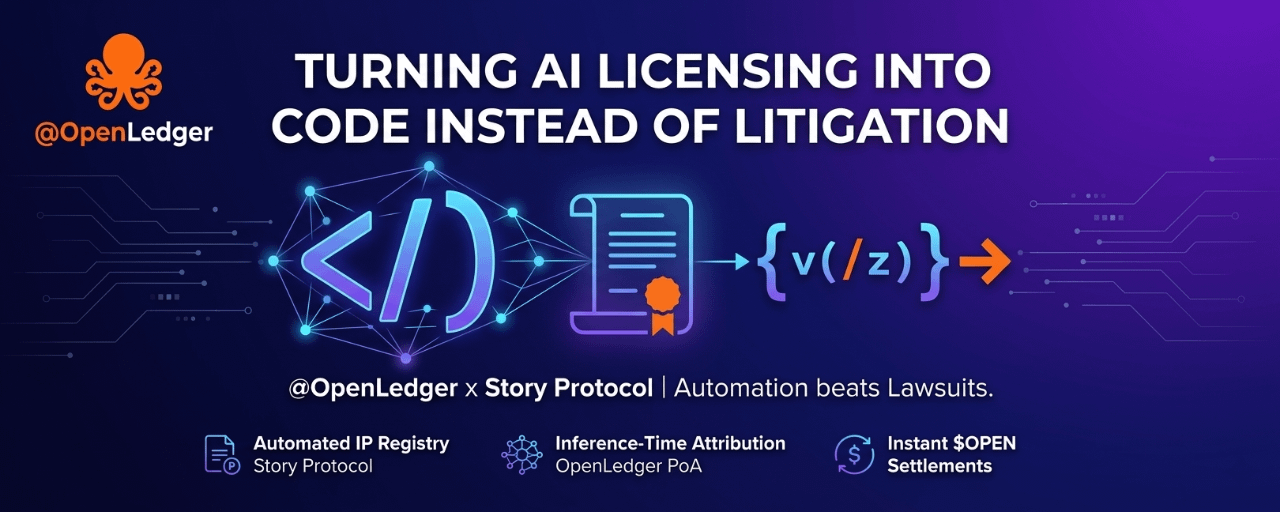
Right now, every major AI copyright dispute follows the same shape. NYT sues OpenAI. Getty sues Stability AI. Reddit and the New York Times sign settlement deals. The pattern is reactive. Lawyers fight, models keep training, money flows or doesn't depending on who can afford the fight.
The integration @OpenLedger announced with Story Protocol on January 30, 2026 attempts to change the unit. Not the players. The unit.
Here's what the mechanism actually does. A rights holder registers IP on Story Protocol with specific license terms attached. Those terms include AI training permission, commercial usage rules, payment splits. When an AI model trained on @OpenLedger touches that IP during inference, PoA logs the lineage on-chain. The license terms execute as code. The $OPEN payout settles to the rights holder automatically.
No lawyers in the loop. No demand letters. No discovery process to figure out what training data was used. The receipt is the enforcement.
That's a different category of legal infrastructure than anything currently in production. NYT vs OpenAI took two years of litigation to settle for an undisclosed sum. A Story Protocol + @OpenLedger pipeline would have produced an automatic payment stream for the same content from day one....
Look at the stack pieces. Story Protocol handles registration and ownership. OpenLedger's PoA handles the inference-time attribution. Datanets carry the training data with licensing metadata baked in. ModelFactory respects those terms during fine-tuning. The EVM Bridge moves the $OPEN settlements to the rights holders' wallets. OctoClaw can be configured to refuse inferences against unlicensed IP entirely.
The system has to clear several gaps before it matters.
Standards adoption is slow. Story Protocol has been live since 2024 but the volume of IP registered remains a small fraction of what's actually being used to train AI. Major rights holders, Getty, Universal Music, the Big Three publishing houses, haven't registered their catalogs onto programmable IP standards. Without them the system enforces against marginal cases, not the major disputes.
The legal framework underneath isn't tested either. A US court has never ruled that an on-chain license is enforceable. EU AI Act treats AI training data provenance as a documentation requirement, not a programmable license. The first time someone tries to enforce a Story Protocol license against an AI provider who ignored it, the legal infrastructure either holds or it doesn't.
But the directional shift is what matters. Litigation as the primary AI licensing mechanism doesn't scale to billions of inferences per month. Some form of programmable enforcement will replace it. The question is whether @OpenLedger and Story Protocol assembled the right pieces early enough to define that standard.
The Jan 30 2026 announcement isn't the end of that question. It's the start of a multi-year test on whether code beats lawyers for AI IP enforcement....
