
There is something strangely fragile about the way the AI economy is being built right now.
The systems shaping the future are absorbing the work, creativity, behavior, and knowledge of millions of people, yet almost none of those people will ever share in the value being created from it. Their words become training data. Their habits become signals. Their corrections improve outputs. Their lives quietly sharpen the intelligence of machines they do not own and will never profit from.
Most people accept this as inevitable. OpenLedger does not.
That is what makes the project worth paying attention to.
Beneath the usual crypto language and AI branding is a much deeper idea about ownership. Not ownership in the legal sense alone, but economic presence. The project is built around a simple but uncomfortable question. If human knowledge is powering the next generation of intelligence, why does the value disappear the moment it enters a model
That question sits underneath almost every breakthrough in artificial intelligence right now.
The internet trained modern AI long before AI became a product. Every post, search, image, conversation, review, and interaction became raw material for systems now worth unimaginable amounts of money. Yet the people who helped create that intelligence layer remain economically invisible. The model absorbs the contribution and the trail goes cold.
OpenLedger is trying to stop that trail from disappearing.
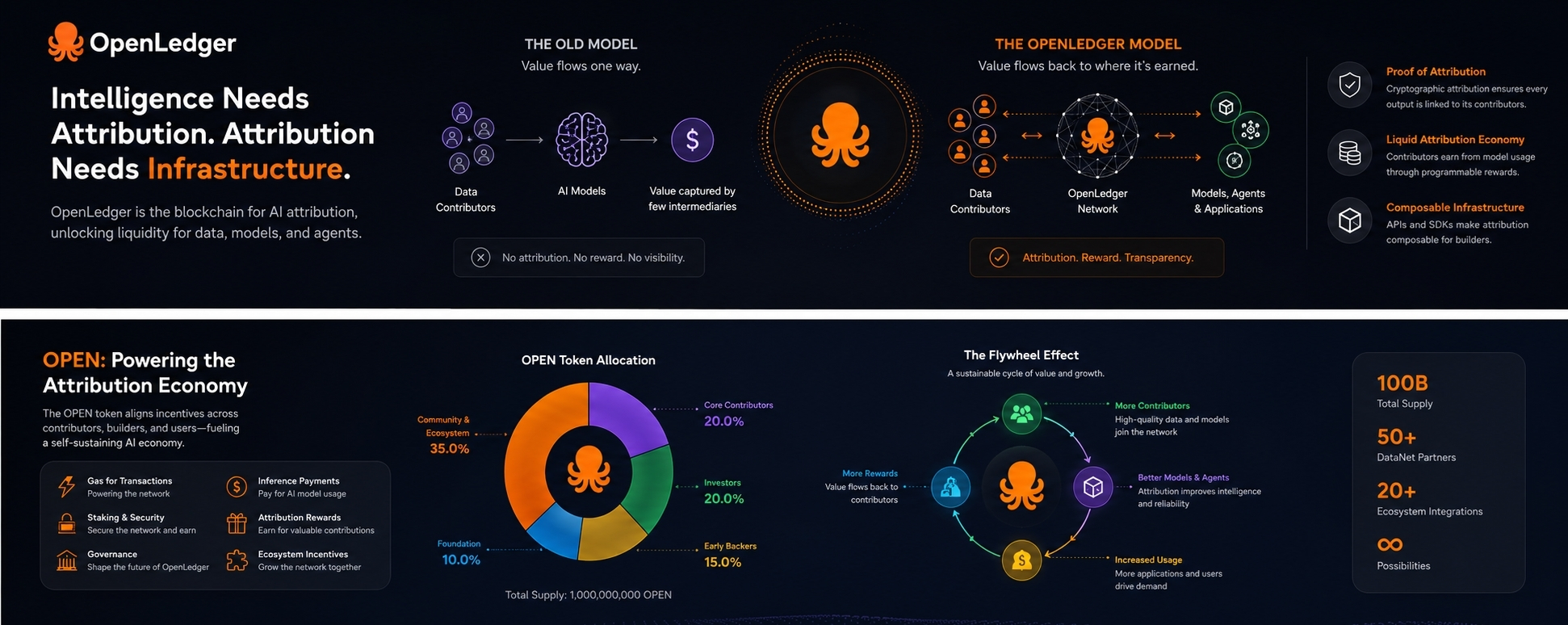
Not by competing with the biggest AI companies head on, and not by pretending decentralization alone magically fixes the problem. The real ambition is more subtle than that. The network is attempting to make intelligence financially traceable. To create a system where value can flow backward through the chain of creation instead of only upward toward the companies controlling distribution.
That changes the entire shape of the conversation.
Most AI projects focus on generating intelligence. OpenLedger is focused on accounting for it.
And strangely enough, that may end up being the more important layer.
Because intelligence itself is becoming cheaper. Models are improving faster than most businesses can adapt. Open source ecosystems are catching up at a pace that would have sounded impossible two years ago. The moat around raw model capability is already starting to weaken. When that happens, value shifts elsewhere.
Not toward who has the smartest model, but toward who can prove origin, ownership, trust, and contribution.
That is where OpenLedger begins to make more sense.
The project avoids one of the biggest mistakes in crypto AI. It does not try to rebuild the entire technological universe from scratch. It is not chasing some fantasy of replacing every centralized AI company on earth. Instead, it narrows the problem down to something more specific and arguably more realistic.
Attribution.
That focus matters because attribution is incredibly difficult once models become large enough. It is easy to say contributors should be rewarded. It is much harder to determine which data actually influenced an output in a meaningful way. Inside large models, information blends together until individual contribution becomes almost impossible to isolate cleanly.
That is the invisible wall most people never think about.
OpenLedger’s architecture seems built around the belief that this problem becomes manageable once intelligence becomes more specialized. A domain specific legal model, healthcare system, or financial agent is easier to track, benchmark, and economically organize than a universal model trained on the entire internet.
And honestly, that may be the smartest part of the entire design.
Because the future of AI probably does not belong entirely to giant universal models. Some of the most valuable systems will likely be narrow, deeply specialized, and trusted within specific industries. In those environments, provenance matters more. Accountability matters more. Knowing where intelligence came from becomes commercially important, not just philosophically interesting.
That creates an opening OpenLedger is trying to step into before the market fully notices it.
Still, there is a tension running through the entire system that cannot be ignored.
Every economic network eventually becomes a behavioral network. The moment contribution becomes monetized, people start optimizing for rewards instead of usefulness. The internet has already shown this pattern over and over again. Engagement farming distorted social media. SEO distorted search. Recommendation systems distorted culture itself.
Attribution systems will face the same pressure.
Once people realize influence inside a model can generate economic value, some contributors will inevitably try to manipulate the process. The network will eventually have to answer a difficult question. Does it reward measurable influence or actual quality
Those are not always the same thing.
A dataset can heavily shape a model while still making it worse. Noise can spread just as effectively as intelligence. That means OpenLedger’s long term survival depends less on token hype and more on whether its validation systems are strong enough to resist exploitation over time.
That is where the project becomes far more serious than most market narratives around AI crypto.
Because this is not really a bet on speculation. It is a bet on whether the future AI economy can function without transparent attribution systems.
The token itself reflects both the strength and fragility of that vision. OPEN is designed to connect everything inside the ecosystem. Payments, governance, incentives, staking, rewards, and participation all flow through the same asset. In theory, that creates alignment. In practice, it also creates pressure from every direction at once.
If speculation overwhelms utility, the economy becomes hollow. If the token weakens, contributor motivation fades. If the token becomes too expensive, usage slows down. The system only works if real activity emerges fast enough to support the economic structure underneath it.
And that is harder than people think.
Crypto has produced countless ecosystems that looked alive only because incentives temporarily kept them moving. OpenLedger cannot survive as a closed financial loop rewarding itself forever. The network eventually needs developers, businesses, and users who participate because the attribution layer genuinely solves a problem they cannot solve elsewhere.
That is the real test.
And there is one possibility most people in the market still underestimate.
OpenLedger may not matter because decentralized AI defeats centralized AI. It may matter because governments, institutions, and industries eventually force transparency into the AI stack itself. Once regulation enters the picture, provenance stops being optional. Companies may need to prove where training data came from. Institutions may need explainable intelligence systems. Entire sectors may require auditable contribution layers before AI can be trusted at scale.
If that happens, OpenLedger suddenly looks less like a speculative blockchain project and more like infrastructure that arrived early.
That is the part that stays with me.
The internet created infinite information, but the real empires were built around controlling distribution, monetization, and ownership. AI may follow the exact same path. The companies shaping the next decade may not be the ones producing the most intelligence.
They may be the ones building the economic system underneath intelligence itself.
And that is the future OpenLedger is quietly trying to position itself inside.
