
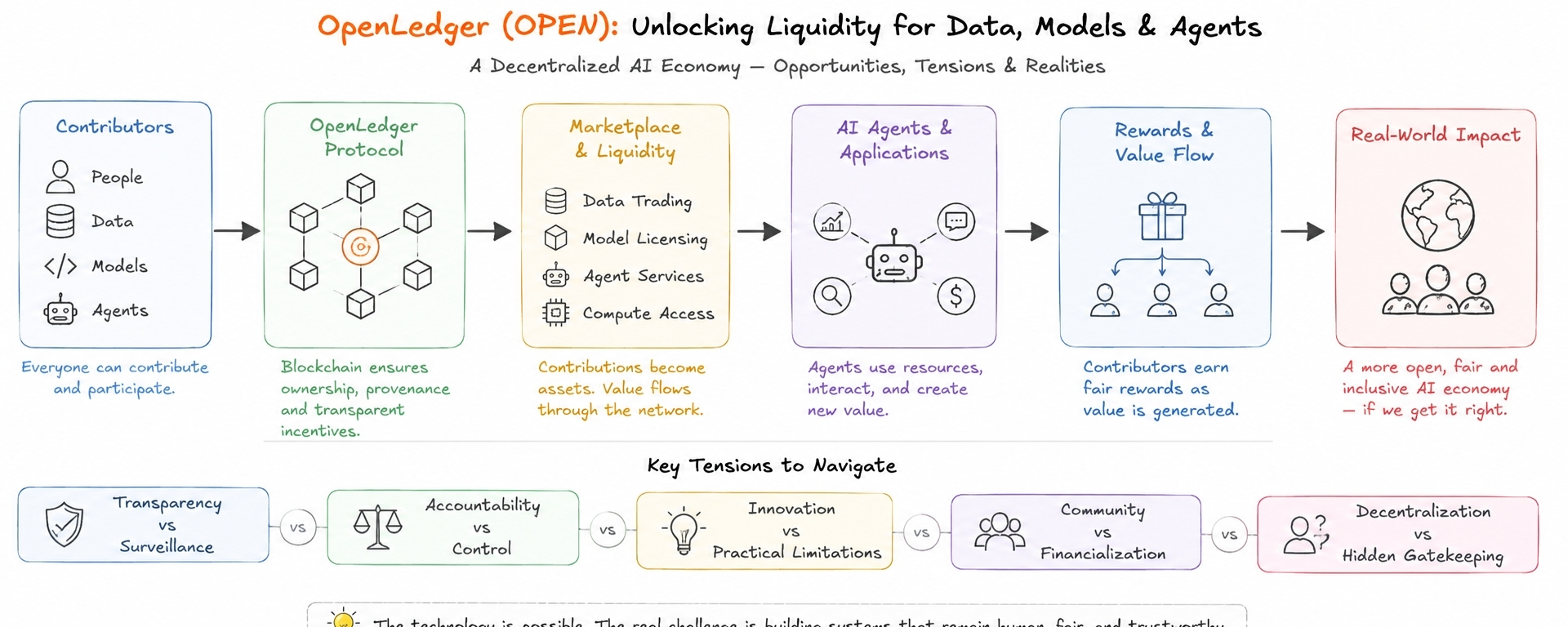

OpenLedger is interesting to me less because of what it claims to do, and more because of what it assumes people will eventually accept. The whole idea seems built on the belief that AI is moving toward an economy where everything becomes measurable data, models, interactions, even human attention itself. And maybe that’s true. But I keep wondering whether people actually want to live inside systems where every contribution has a price attached to it.
The part that sounds attractive is obvious. Right now, most AI companies quietly absorb enormous amounts of public behavior, conversation, creativity, and data without most people seeing any direct value back. So the idea of a protocol where contributors can actually monetize what they provide feels fair on the surface. It taps into a real frustration people already have with the current AI landscape.
Still, there’s something uncomfortable about reducing participation into transactions. Once money enters the equation, people stop behaving naturally. They start optimizing. Data becomes something produced for rewards instead of something generated organically. And eventually the system has to decide what counts as “valuable” contribution, which usually means some invisible layer of control forms underneath the promise of decentralization.
That’s the contradiction I keep running into with projects like this. They talk about openness and distributed ownership, but maintaining any large network always requires gatekeeping somewhere whether it’s reputation systems, validation layers, governance votes, or incentives steering behavior in specific directions. Decentralization often shifts control rather than removing it.
I also think people underestimate the social side of transparency. Blockchain systems love the idea of permanent records because they create accountability and traceability. In theory, that sounds healthier than the black-box systems dominating AI today. But when every interaction becomes trackable forever, transparency slowly starts resembling surveillance. AI already learns by observing behavior. Blockchains preserve behavior permanently. Together, they create systems that remember everything long after humans naturally would have let things disappear.
And honestly, I’m not fully convinced society has figured out what accountability even means once AI agents start operating economically. These protocols imagine a future where autonomous systems exchange value independently, interact with datasets, pay for services, maybe even make decisions without direct human involvement. Technically it sounds futuristic. Practically it raises messy questions nobody really answers clearly. If an autonomous agent causes harm, manipulates information, or exploits a system, responsibility becomes strangely blurry. Everyone is involved enough to benefit, but distant enough to avoid blame.
What makes OpenLedger feel different from some empty AI-token projects is that it’s at least reacting to a real imbalance. There genuinely is a growing divide between the people generating value and the companies capturing most of it. But I think there’s a difference between solving exploitation and financializing everything. Not every layer of human activity improves once it becomes an incentive market.
Maybe that’s the bigger tension underneath all of this. The tech world tends to assume efficiency is automatically progress. But systems optimized too aggressively around incentives eventually change human behavior in ways that are hard to reverse. Communities become economies. Participation becomes labor. Curiosity becomes output.
I don’t think projects like this fail because the technology is impossible. If anything, the technology is probably the easiest part. The harder question is whether people will still feel human inside systems where intelligence, identity, and contribution are constantly being measured, scored, and monetized.