
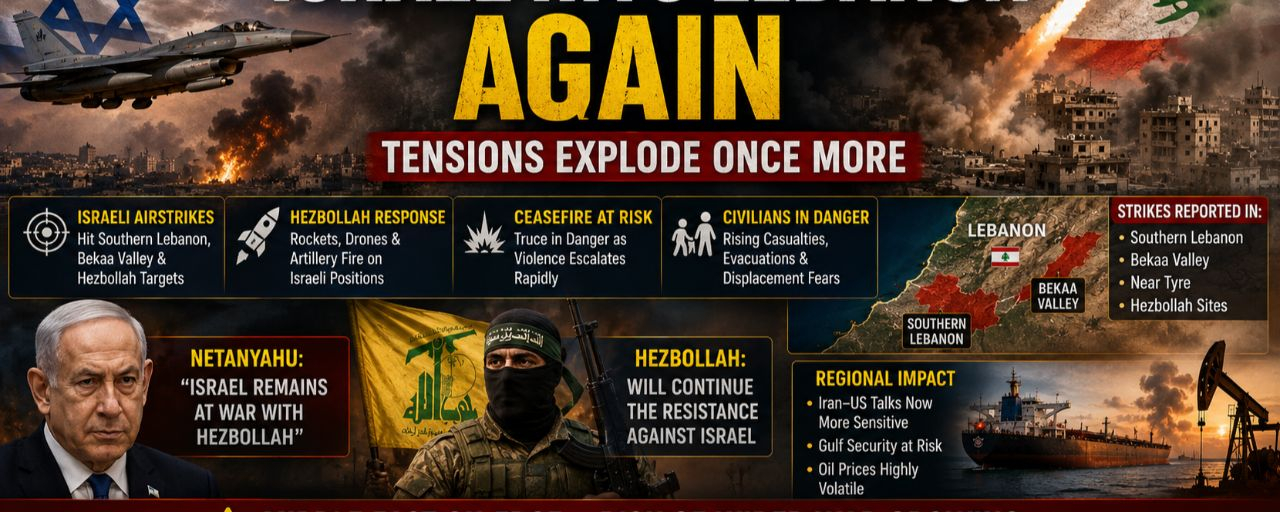
May 26, 2026 is now seeing another dangerous escalation in the Middle East as Israel intensifies military operations across Lebanon following renewed clashes with Hezbollah forces near the southern border. Multiple international reports now confirm that Israeli airstrikes have expanded significantly despite previous ceasefire attempts earlier this year. (The Guardian)
⚠️ What Happened?
According to regional and international media reports, Israel launched heavy strikes across: ▪️ southern Lebanon ▪️ the Bekaa Valley ▪️ areas near Tyre ▪️ Hezbollah-linked infrastructure zones
Israeli Prime Minister Benjamin Netanyahu publicly stated that Israel would “intensify strikes” against Hezbollah as cross-border attacks continue escalating. (Reuters)
At the same time, Hezbollah reportedly responded with: ▪️ rockets ▪️ artillery fire ▪️ explosive drones ▪️ attacks on Israeli military positions
The situation is now threatening the fragile ceasefire framework established earlier in April. (AP News)
🇱🇧 Lebanon Facing New Pressure
Lebanon is once again entering a highly unstable phase.
Reports suggest: ⚠️ civilian casualties are rising ⚠️ evacuation warnings have expanded ⚠️ southern cities remain under heavy tension ⚠️ more displacement fears are growing
Some reports indicate that Israeli operations are now pushing deeper into southern Lebanese territory beyond previously established buffer zones. (Reuters)
🇮🇱 Why Israel Says It Is Escalating
Israeli leadership claims Hezbollah continued violating ceasefire understandings through: ▪️ drone launches ▪️ rocket attacks ▪️ military buildup near the border
Netanyahu has now openly declared that Israel remains “at war with Hezbollah” despite diplomatic efforts happening elsewhere in the region. (Wall Street Journal)
Inside Israeli politics, hardline ministers are also reportedly pushing for even broader military action, including potential operations closer to Beirut. (Middle East Monitor)
🇮🇷 Iran Factor Still Extremely Important
The Lebanon front is no longer isolated from the larger Iran–US crisis.
Iran continues publicly supporting Hezbollah while ongoing nuclear and ceasefire negotiations with Washington remain fragile. (The Guardian)
This creates a highly dangerous situation because: 🌍 Lebanon tensions 🌍 Iran negotiations 🌍 Strait of Hormuz stability 🌍 Gulf security 🌍 oil markets
are now deeply connected together.
🌍 Why Global Markets Are Watching
The Middle East situation is becoming increasingly sensitive for: 🛢️ global oil prices 📈 investor confidence 🚢 shipping routes ⚡ energy markets 🌍 geopolitical stability
Any major escalation between Israel and Hezbollah could quickly affect international markets again.
Final Analysis
Right now, the biggest concern is not only the airstrikes themselves.
The real concern is that: ⚠️ multiple regional conflicts are starting to overlap simultaneously.
The Iran–US negotiations, Hezbollah conflict, Gulf tensions, and Israel’s military operations are now all influencing each other at the same time.
That makes the current Middle East environment one of the most fragile geopolitical situations seen in years.
And despite ongoing diplomacy, the risk of wider escalation remains very real.