
The internet has changed many times over the last two decades. First, it was mostly about information. Then it became about platforms, social networks, cloud services, and digital economies. Now another shift is happening quietly in the background. Intelligence itself is becoming infrastructure. Artificial intelligence is no longer just a feature inside applications. It is slowly becoming part of how the digital world operates every day. Search engines depend on it, businesses depend on it, software depends on it, and increasingly people depend on it without even realizing how deeply connected it already is to modern life.
That is why projects like OpenLedger are becoming interesting to watch. Not because AI is trending, and not because blockchain projects need new narratives, but because the relationship between intelligence, ownership, and digital infrastructure is becoming one of the biggest questions of the next internet era.
Most AI systems today are built inside centralized environments. Large companies collect huge amounts of user data, train models privately, and turn those systems into products that millions of people use every day. The process is efficient, but it also creates concentration. The data comes from users, the activity comes from users, the interactions come from users, yet the long term ownership and economic power remain concentrated inside a small number of organizations. OpenLedger is trying to explore another direction where intelligence can exist inside an open network instead of only inside closed corporate systems.
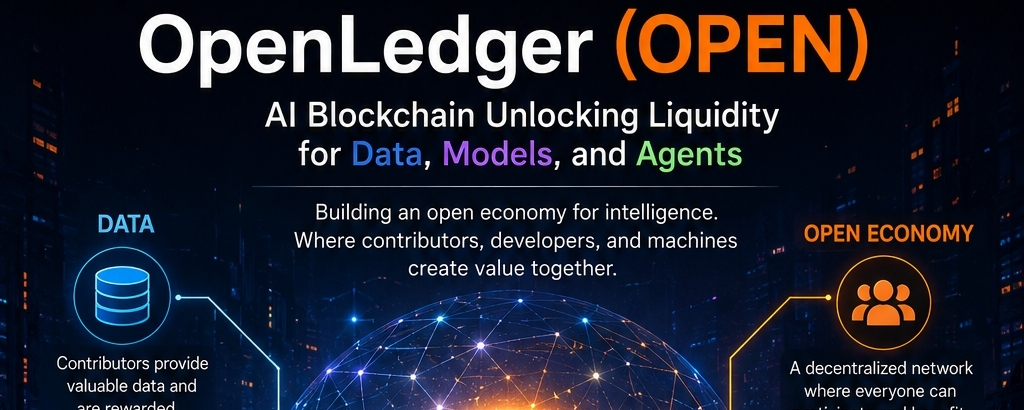
The deeper idea behind OpenLedger is actually very human. It asks whether the people contributing value to AI systems should have a more direct role in the economies forming around those systems. Data is valuable. Models are valuable. Autonomous agents performing digital tasks are valuable. But most of these assets remain locked inside isolated ecosystems where ordinary contributors never really participate in the upside they help create. OpenLedger is trying to build infrastructure where data, models, and agents can move through a decentralized economy with transparent incentives attached to them.
At its core, OpenLedger is less about speculation and more about coordination. Artificial intelligence requires enormous amounts of data, computation, validation, updates, and interaction. Traditional companies coordinate all of this internally through ownership and hierarchy. OpenLedger is experimenting with whether blockchain systems can coordinate the same process through incentives instead of centralized control. The blockchain becomes the layer that records contributions, manages settlement, distributes rewards, and creates trust between participants who may never know each other personally.
What makes this important is not just technology. It is the economic structure forming underneath technology. AI is becoming one of the most powerful resources in the digital world. Whoever controls the intelligence layer of the internet may end up controlling massive parts of communication, automation, commerce, and decision making. That concentration of power worries many people because the internet was originally imagined as an open environment, not one controlled by a few intelligence monopolies.
OpenLedger exists inside that tension. It is trying to create an alternative structure where intelligence can grow through distributed participation instead of pure centralization. Whether that vision fully succeeds is uncertain, but the direction itself reflects a much larger movement happening across crypto and Web3.
One of the most important ideas inside OpenLedger is liquidity, but not only in the financial sense people usually think about. Normally liquidity refers to how easily assets can move in markets. Here the idea is broader. Data is usually trapped inside databases. AI models are often locked behind company APIs. Intelligent agents operate inside isolated systems. OpenLedger is trying to make these resources economically active inside an open network where value can flow more freely between contributors, developers, validators, and users.
This creates a very different relationship between people and digital infrastructure. Instead of users existing only as consumers, they can theoretically become participants inside the system itself. Someone contributing useful data could potentially be rewarded. Developers building models could interact with an open marketplace instead of depending entirely on centralized platforms. Autonomous agents could perform useful work while interacting with transparent settlement systems underneath.
The blockchain side matters because decentralized systems cannot depend on trust alone. They need economic incentives to function. That is where the OPEN token becomes important. The token acts as a coordination mechanism between different parts of the network. Validators may stake tokens to help secure the system. Contributors may earn rewards for useful participation. Developers may use tokens to access infrastructure or services. Governance decisions may also evolve around token participation over time.
But this is also where things become difficult.
Designing incentives for AI systems is far more complicated than designing incentives for simple payment networks. In traditional blockchains, it is relatively easy to verify whether a transaction happened. In AI ecosystems, value is much harder to measure honestly. A dataset may appear useful but actually contain poor quality information. A model may perform well in one situation and fail badly in another. An autonomous agent may manipulate metrics to maximize rewards without creating meaningful value for the network.
This means OpenLedger is dealing with a problem much deeper than transaction processing. It is trying to coordinate intelligence itself, and intelligence is messy. It depends on context, reliability, trust, quality, and long term usefulness. That is why validation systems become extremely important. The network needs ways to determine which contributions are genuinely valuable and which are simply noise designed to exploit incentives.
Projects like OpenLedger only survive long term if the economic system remains healthy under pressure. During strong markets, many networks appear successful because capital flows easily and speculation creates activity. But difficult periods expose weaknesses quickly. If rewards decline, do contributors still participate. If market conditions weaken, does the ecosystem continue building. If AI outputs become unreliable, does trust inside the network disappear. These are the questions that matter more than hype because infrastructure only proves itself during stressful conditions.
Another challenge is hidden centralization. Even decentralized AI systems still depend heavily on computational infrastructure, and advanced hardware remains expensive. Access to GPUs, cloud services, and large scale computing power is still concentrated in relatively few hands globally. That creates a situation where decentralization at the blockchain layer may still depend on centralized realities underneath.
Regulatory pressure also remains uncertain. Governments are paying increasing attention to artificial intelligence, digital identity, privacy, and automated systems. Decentralized AI networks may eventually face difficult legal questions around ownership, accountability, and data rights. Because these systems operate globally, they may face multiple regulatory pressures at the same time.
Security risks become more complicated as well. Blockchain networks already deal with smart contract vulnerabilities and economic attacks. AI introduces additional layers of risk. Manipulated datasets, misleading outputs, malicious agents, automated misinformation, and adversarial behavior all become possible attack surfaces. Combining AI and blockchain creates powerful possibilities, but it also creates more complex failure scenarios.
Still, OpenLedger matters because it reflects something much larger than one project or one token. It reflects the direction the internet may be moving toward. Earlier crypto systems focused mainly on digital money. Later systems focused on decentralized finance and ownership. AI focused blockchains are beginning to focus on machine coordination, intelligence infrastructure, and autonomous digital economies.
That changes the role of blockchain itself. Instead of acting only as a ledger for payments, the chain becomes a coordination layer for intelligence. It manages incentives, ownership, validation, access rights, and settlement beneath systems that users may interact with every day without even noticing the blockchain operating underneath.
In many ways, OpenLedger is trying to answer a very important question. If intelligence becomes part of global infrastructure, should it remain controlled entirely by centralized institutions, or can open networks still play a meaningful role in shaping how that infrastructure operates. There is no guarantee decentralized systems will win. Centralized AI companies move quickly, control enormous resources, and operate with high efficiency. Open systems move more slowly because coordination between independent participants is naturally more difficult.
But resilience sometimes matters more than speed.
The strongest systems are usually not the ones that grow the fastest during easy conditions. The strongest systems are the ones that continue functioning when markets weaken, when incentives become difficult, and when trust is tested. OpenLedger is important because it is exploring whether intelligence economies can operate through distributed coordination instead of depending entirely on centralized ownership.
Maybe that experiment succeeds fully, maybe it evolves into something different, or maybe it struggles against the realities of infrastructure and economics. But the problem it is trying to solve is real. As AI becomes more deeply connected to everyday life, the question of who owns intelligence, who controls it, and who benefits from it will become increasingly important for the future of the internet itself.
