
Market felt kind of hollow today. That particular kind of flat where everything's technically green but nothing's actually moving. Volume thin, narratives recycled, the usual Tuesday energy where traders are half-watching charts and half-reading the same threads they read last week.
So I ended up going down a different path. Started poking around CreatorPad tasks and landed on OpenLedger. Didn't plan on spending two hours on it. But here we are.
I went in thinking this was another AI-plus-crypto story. You know the shape of it by now — layer the words "decentralized," "verifiable," "attribution" onto a pitch deck, raise some money from respectable names, launch a token. I've seen the format enough times that I almost closed the tab.
But something made me keep reading. And then something clicked that I haven't been able to shake since.
Here's the thing nobody's actually saying out loud:
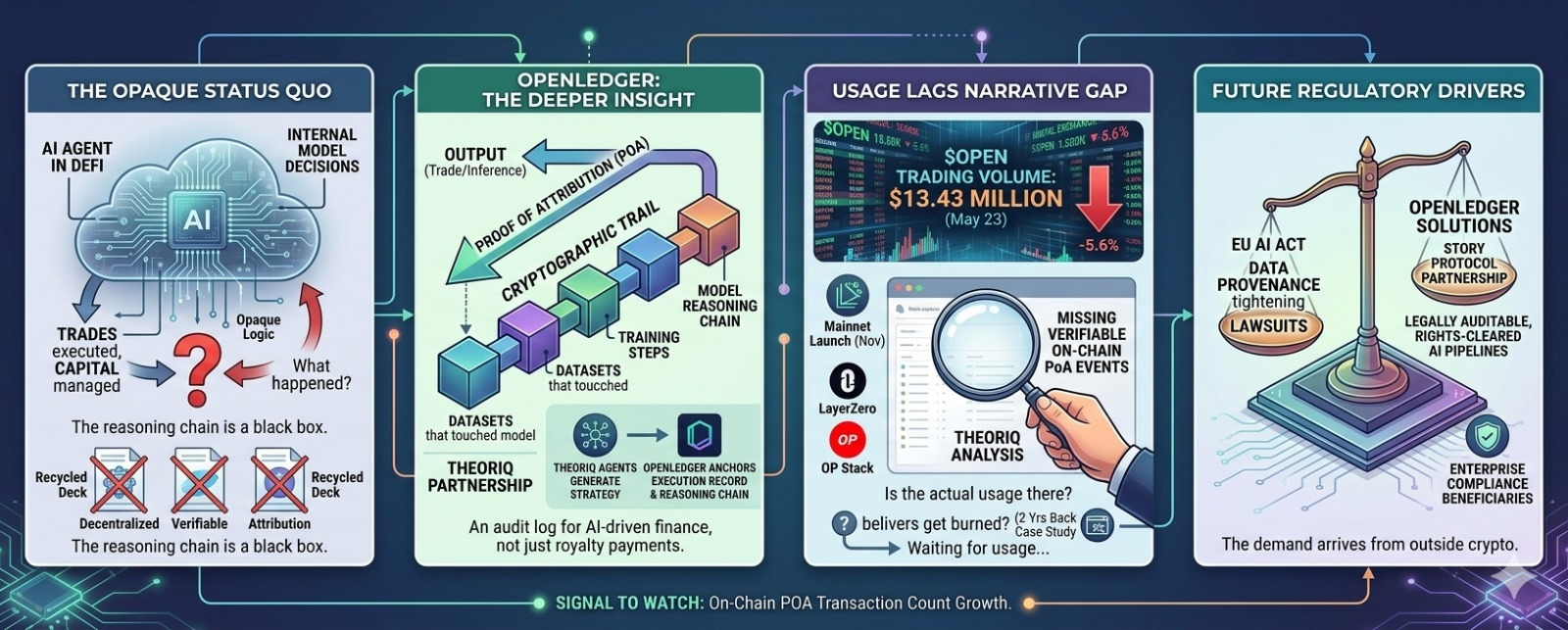
The problem OpenLedger is solving isn't really about paying data contributors. That's the surface story. The real problem — the one that's going to matter enormously in about eighteen months — is that AI agents are already managing real capital in DeFi, and nobody can explain what they actually did or why.
Think about that for a second. An AI agent executes a trade. Market moves against the position. Capital gets drained. Someone asks: what happened? And the honest answer, right now, in most systems, is… we're not entirely sure. The logic ran off-chain. The decision was made inside a model. The output was a transaction. The middle part? Opaque.
That's not a data attribution problem. That's a financial accountability problem dressed up as a data attribution problem.
What OpenLedger's Proof of Attribution actually does — when you look past the contributor payment angle — is create a cryptographic trail from AI output back to the inputs that shaped it. Every dataset that touched a model, every training step, every inference. On-chain. Anchored. The Theoriq partnership made this more concrete for me: Theoriq agents generate the strategies, OpenLedger anchors the execution record. Not just the trade. The reasoning chain that produced the trade.
I genuinely didn't expect to find that distinction. I thought I was looking at a royalty mechanism for data providers. Turns out I was looking at something closer to an audit log for AI-driven finance.
But here's the part that bothers me, and I'm going to say it plainly.
On May 23rd, $OPEN hit $13.43 million in single-day trading volume. The token was still down 5.6% on the day. That volume is almost entirely CEX trading — people buying and selling the token, not actually running AI agents through the attribution layer.
The mechanism exists. The mainnet launched in November. LayerZero integration is live. The OP Stack rollup is real. But when I tried to find clean data on how many Proof of Attribution events actually executed on-chain last week — actual AI inference records, actual agent traces — I couldn't surface it easily. Maybe I was looking in the wrong place. Maybe the dashboards just aren't there yet. But that gap between the infrastructure story and the verifiable usage story… I'm not ready to paper over that.
I thought about a similar situation with another L2 project two years back. Everything technically worked. The architecture was genuinely elegant. But the actual usage lagged the narrative by almost a year. And in that year, a lot of believers got burned.
I'm not saying that's what's happening here. I'm saying I don't know yet.
The part that still interests me is the timing angle. Regulatory pressure on AI training data is real and accelerating. The Story Protocol partnership — creating legally auditable, rights-cleared AI training pipelines — feels like positioning for a moment that's coming whether the market cares about it right now or not. EU AI Act, ongoing lawsuits against major AI labs, the general mood around data provenance tightening… OpenLedger could find itself in a position where the demand for what it built arrives from outside the crypto space.
That's either a very smart setup or a very patient bet. Possibly both.
Who actually benefits first? Probably not retail. Probably enterprises needing AI compliance infrastructure who find that blockchain attribution solves a legal problem they already have. The data contributor payments — the thing marketed most visibly — might matter less initially than the audit trail it creates for someone's legal team.
Anyway. $OPEN sitting around $0.18 right now. Market still looks shaky. September token unlocks are coming and that's a supply dynamic nobody's figured out yet.
I'll probably just keep watching the actual on-chain activity. If the Proof of Attribution transaction count starts growing independent of the token price — that's the signal I'll actually care about.