
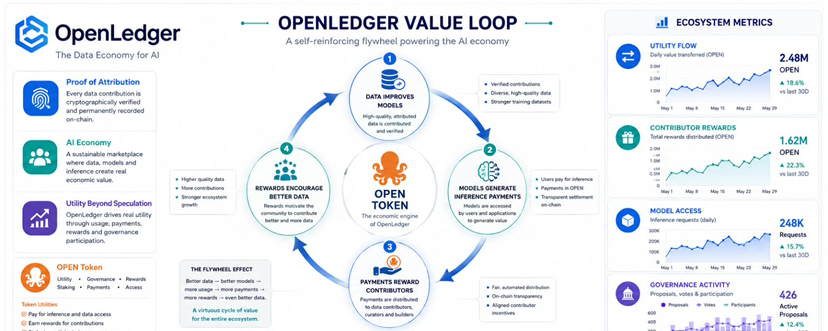
I sat at my desk after midnight with the OpenLedger material open and a quiet fan moving warm air across the room. My notebook had one question written at the top of the page. What gives OPEN value when I stop looking at it like a market ticker and start looking at it as part of the system?
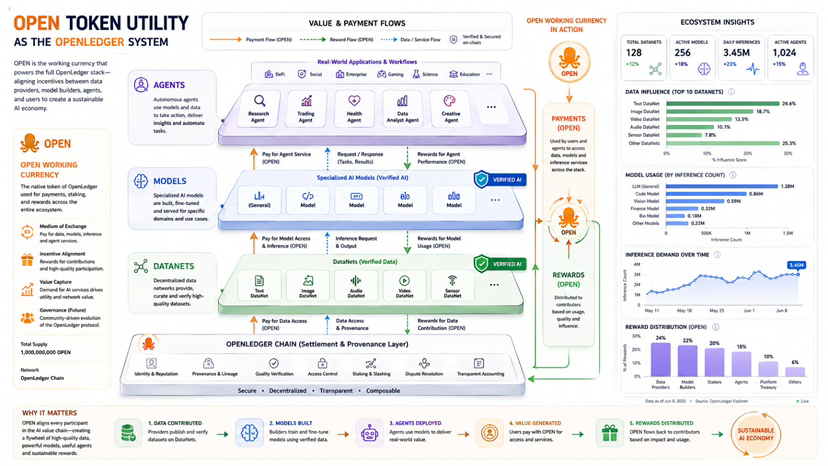
I think the clearest answer is utility. OPEN is designed as the working token inside OpenLedger’s verified AI economy. I do not see it only as a symbol for attention. I see it as the unit that connects data contribution model activity network actions and reward flow. That makes the token more practical to study because its role depends on what people actually do inside the network.
OpenLedger is built around the idea that useful AI contributions should not stay hidden. Its Proof of Attribution system is designed to track which data influences model behavior and reward the contributors behind that data in OPEN. I find that important because it moves the discussion away from vague ownership and toward measurable participation. If someone contributes useful data then the system is meant to recognize that influence and connect it to rewards.
That changes how I think about AI data. In many AI systems the data layer is treated as invisible once a model is trained. OpenLedger is trying to make that layer visible through attribution. OPEN becomes part of that visibility because it is used to reward contributors when their data has impact. The stronger idea here is not just payment. It is accountability. A network that can show how value moves has a better chance of building trust.
OPEN also functions as gas for OpenLedger network activity. It is used for actions such as model registration inference calls validator communication and governance triggers. I see this as the basic operating cost of using the AI blockchain. A network needs fees to run properly. In OpenLedger’s case those fees are tied to model actions and attribution events rather than generic activity alone.
The builder side adds another layer. Developers use OPEN to register train and publish models onchain. This matters because OpenLedger is not only focused on data storage. It is trying to support a full path from data to models to usable AI services. A model creator can publish a model and earn when that model is queried. That creates a more direct link between useful model work and economic reward.
Inference payments make the design easier to understand. When a user queries a model the payment is made in OPEN. That payment can move toward the model owner upstream data contributors core infrastructure and public goods. I like this part because it turns a simple AI answer into a value trail. The output is not treated as isolated. It is connected back to the people and systems that helped make it possible.
My view is still balanced. Utility on paper does not guarantee utility in practice. The network needs useful models real inference demand trusted attribution and steady contributor participation. If models are not used then payments stay limited. If attribution is unclear then contributors may lose trust. If data quality is weak then the models can suffer. OPEN’s role becomes meaningful only when the full loop works.
That loop is the real story for me. Data improves models. Models attract queries. Queries create payments. Payments reward builders and contributors. Rewards can encourage better data and better models. It is a simple idea but not an easy one. Execution will decide whether OPEN becomes an active part of AI infrastructure or remains mostly a market narrative.
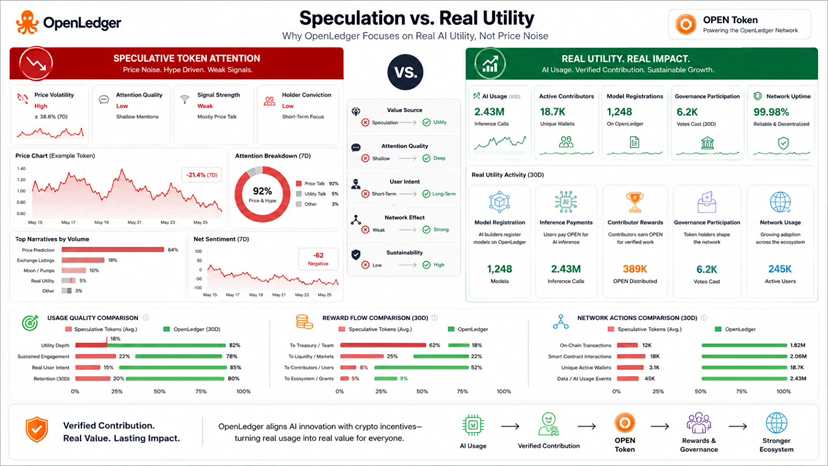
For practical analysis I would watch usage more than noise. I would look for model registration activity. I would look for inference demand. I would look for visible reward flows and strong contributor incentives. I would also watch whether governance becomes meaningful as the network grows. Those signs would tell me more than short term attention.
OPEN is not the entire OpenLedger story. It depends on DataNets Proof of Attribution specialized models validators builders and real users. But it gives those pieces a shared economic unit. That is why I see OPEN as the value trail behind verified AI rather than just another token story.
I am watching whether verified contribution can become lasting AI value.


