I used to think bridges in crypto were mostly background infrastructure.
Just technical rails.
Move assets from one chain to another, connect liquidity pools, reduce friction, and keep the ecosystem running.
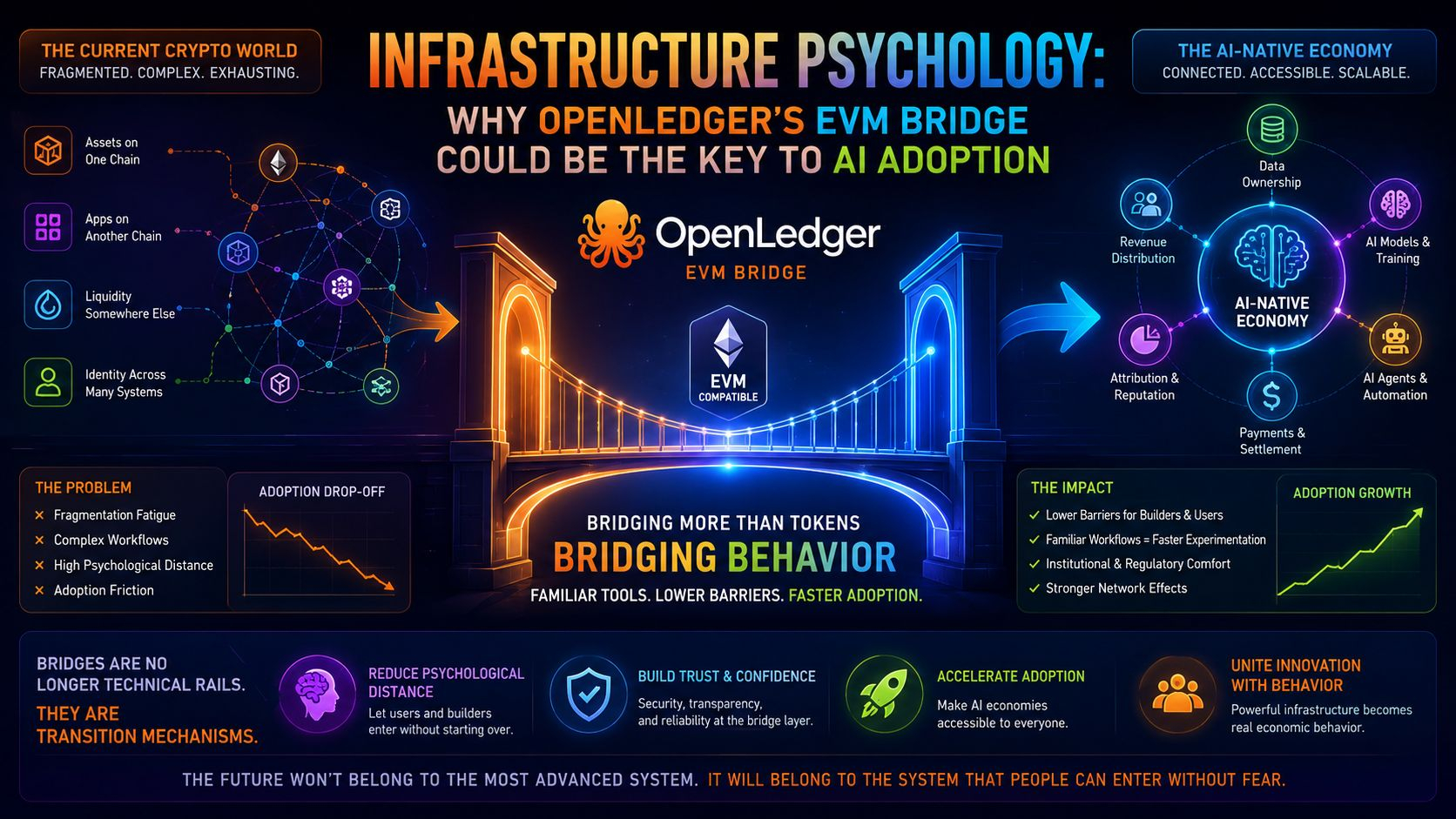
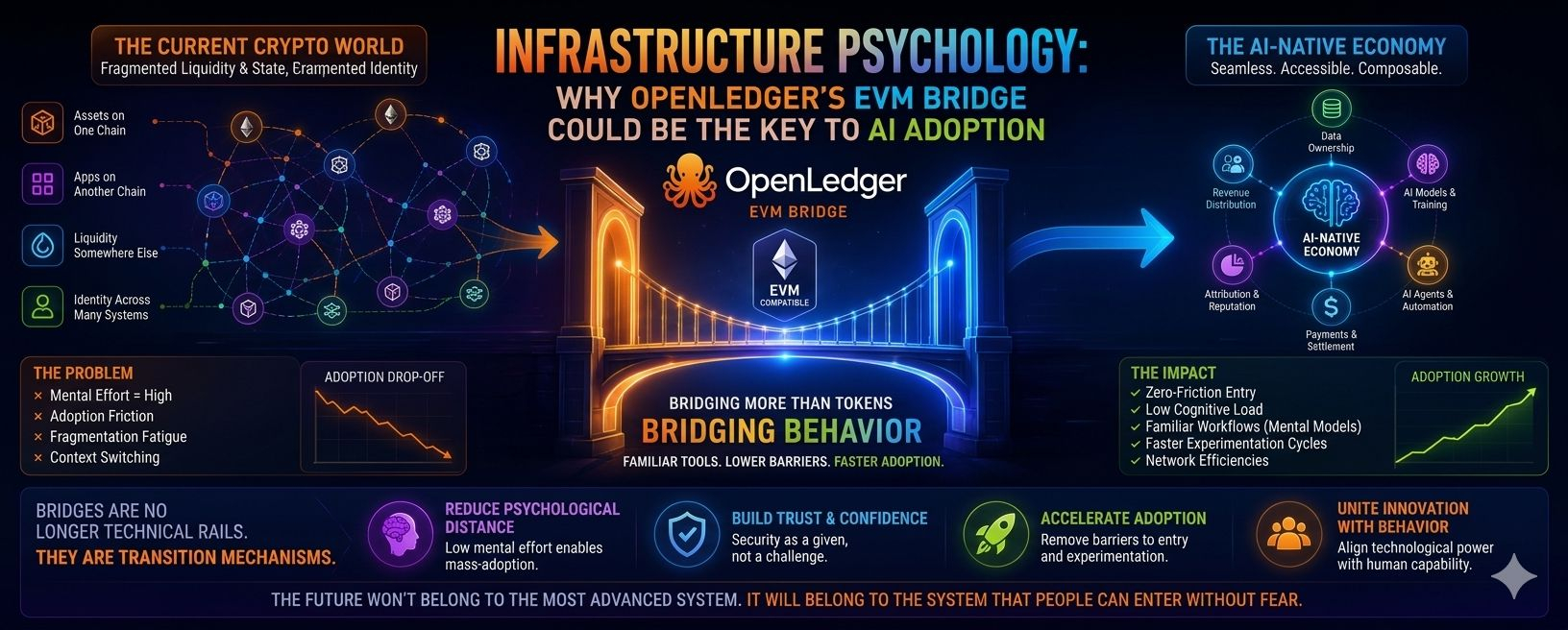
But lately, the more I watch AI and blockchain infrastructure evolve together, the more I think the real role of bridges has nothing to do with moving tokens.
It has everything to do with moving behavior.
That is why the EVM Bridge discussion around @OpenLedger caught my attention in a much bigger way than I expected.
Because the future AI economy is not only going to depend on powerful models or decentralized compute. It is going to depend on whether normal users, builders, institutions, and even regulators can enter these new systems without feeling like they must abandon everything they already understand.
And honestly, that part gets ignored too often.
Crypto already suffers from fragmentation fatigue.
Users hold assets on one chain, use apps on another, bridge liquidity somewhere else, and manage identity across multiple disconnected systems. Every ecosystem claims to be the future, but most still expect people to learn entirely new workflows just to participate.
AI infrastructure could easily make this problem worse.
Imagine a future where data ownership exists on one network, AI agents operate somewhere else, model attribution happens in another environment, and payments settle through separate systems entirely. Technically, that may work. Practically, it becomes exhausting.
That exhaustion matters more than people think.
Most adoption failures do not happen because technology is weak.
They happen because complexity quietly pushes people away.
People do not abandon familiar systems because a whitepaper says something is better.
They move when the transition feels safe, understandable, and worth the effort.
That is why I think EVM compatibility matters so much for projects like OpenLedger.
Ethereum did not only build liquidity.
It built habits.
Developers already know how to deploy contracts in EVM environments.
Users already trust familiar wallet flows.
Institutions already built compliance procedures, custody systems, transaction monitoring tools, and operational frameworks around EVM infrastructure.
That creates gravity.
Whether people love Ethereum or criticize it does not really change the fact that an enormous part of crypto behavior now revolves around EVM familiarity.
Markets rarely move toward the most advanced system first.
They move toward the system that feels least disruptive.
So when I look at OpenLedger, I do not only see another blockchain project trying to connect chains.
I see a project trying to reduce psychological distance.
And that is important because OpenLedger’s larger vision is not small.
The platform is positioning itself around AI-native economies where data, models, agents, and machine-generated output become monetizable assets. That creates entirely new financial flows.
Who contributed the data?
Who improved the model?
Which agent generated value?
How should revenue be distributed?
How do contributors receive compensation transparently?
These questions become much harder when infrastructure remains isolated.
An EVM Bridge cannot solve every challenge, but it can lower the barrier between existing crypto behavior and emerging AI economies.
That changes the adoption equation.
A builder who already operates in EVM ecosystems may experiment faster because integration feels manageable.
A user may explore AI-related services without needing completely unfamiliar tools.
Institutions may evaluate OpenLedger more comfortably because operational pathways resemble systems they already understand.
That is why I no longer see bridges as technical side features.
They are transition mechanisms.
And honestly, transitions decide markets more than innovation alone.
The best infrastructure in history usually did not win because it was the most advanced.
It won because it reduced resistance.
At the same time, I think the risks here are very real.
Bridges carry baggage.
Crypto users have seen bridge exploits, liquidity fragmentation, poor UX, and operational confusion for years. If trust breaks at the bridge layer, adoption slows immediately. Institutions become cautious. Regulators become skeptical. Users hesitate.
Even technically successful bridges can fail behaviorally if they feel confusing or unsafe.
That means OpenLedger’s challenge is not only building functionality.
It is building confidence.
And confidence in crypto is incredibly hard to earn.
Still, this is the part of the AI-blockchain conversation I find most interesting right now.
Not hype.
Not speed.
Not marketing.
Infrastructure psychology.
Because I think the next phase of crypto adoption will belong to projects that understand one simple reality:
People rarely move into new systems all at once.
They move gradually through familiar doors.
And in many ways, the EVM Bridge may become one of those doors for OpenLedger.
Not because bridges are exciting by themselves.
But because they determine whether powerful infrastructure remains isolated… or becomes part of real economic behavior.