

May 26, 2026
A few nights ago I found myself rereading old discussions about crypto infrastructure from the late DeFi cycle. What stood out wasn’t the optimism. It was how confidently people assumed coordination problems would solve themselves once incentives existed. The market eventually discovered the opposite. Incentives don’t eliminate coordination failures. They industrialize them.
That thought came back while looking at $OPEN Ledger OctoClaw launch and the broader direction of AI infrastructure in crypto.
Most conversations around AI agents still focus on visible surfaces: model quality, response speed, autonomy, agent-to-agent execution. But the deeper issue is probably attribution. Not intelligence itself, but the ability to measure where intelligence actually comes from once thousands of distributed systems begin interacting economically.
That sounds abstract until you imagine what happens under real pressure.
An AI ecosystem with no attribution layer eventually behaves like an extraction market. Data gets scraped, recombined, monetized, and forgotten. Models improve while the contributors disappear into statistical residue. The strange thing is that crypto already understands this problem intuitively. Blockchains were never only about storing transactions. They were about preserving verifiable history under adversarial conditions.
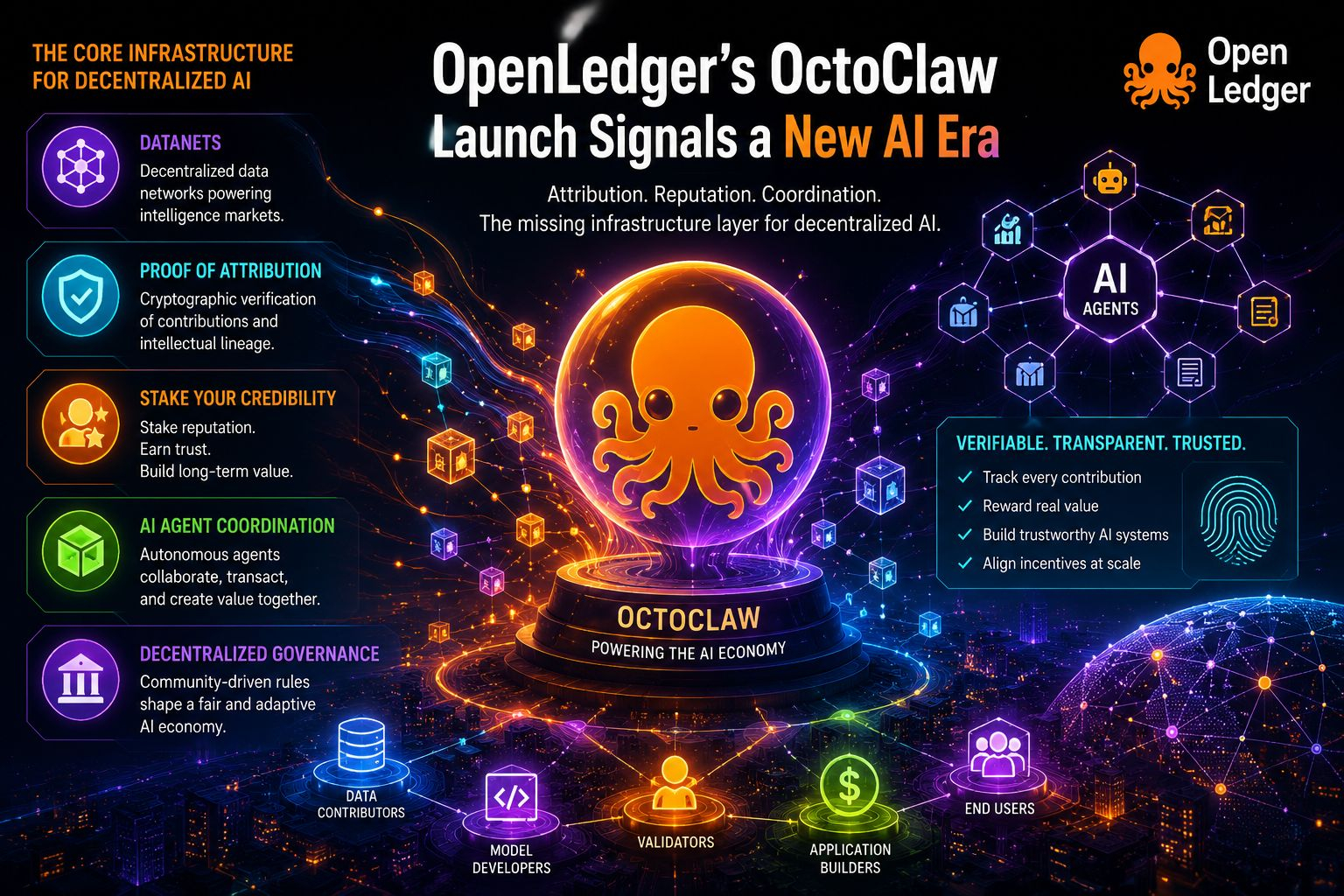
OpenLedger seems to be testing whether that same logic can apply to AI coordination.
OctoClaw matters less because it introduces another AI framework and more because it quietly shifts attention toward reputation infrastructure. Datanets, Proof of Attribution, contribution tracking, staking credibility — these mechanisms are attempts to answer a difficult question: how do you create economic memory for intelligence production?
That question becomes more important once agents stop behaving like isolated chatbots and start functioning as market participants.
Right now, most AI systems still operate in environments where trust is socially assumed. A user trusts the interface. Developers trust benchmark scores. Platforms trust opaque datasets. But once autonomous agents begin transacting, routing information, allocating capital, or influencing governance decisions, trust becomes infrastructural rather than emotional.
And infrastructure behaves differently under stress.
The optimistic interpretation is that attribution systems could create a healthier data economy. Contributors might finally retain economic visibility instead of donating informational labor into black-box systems. Smaller specialized datasets could become economically valuable. Reputation could become portable rather than platform-dependent. In theory, this produces a more distributed intelligence market.
But there’s another possibility that feels equally plausible.Once attribution becomes financially meaningful, people begin optimizing for attribution itself.
Crypto has seen this pattern repeatedly. Governance systems designed for coordination become theaters for influence farming. Reputation systems attract sybil behavior. Yield incentives distort organic participation. Metrics intended to measure contribution slowly become targets for manipulation. Goodhart’s Law eventually arrives in almost every tokenized environment.
AI infrastructure won’t escape that dynamic simply because the language around it sounds more technical.
If OpenLedger succeeds in making contribution traceability economically important, the network may eventually face a paradox where the act of proving intelligence becomes more profitable than producing useful intelligence. That risk feels underexplored.
I think this is why the infrastructure layer matters more than the models themselves.
Models can improve incrementally. Compute becomes cheaper over time. Interfaces evolve quickly. But coordination architecture tends to lock in behavioral norms for years. Once a network establishes how attribution, rewards, and trust are measured, participants adapt around those incentives with surprising speed.
That adaptation process is where systems reveal their real philosophy.
A datanet sounds neutral until scarcity emerges. Proof of Attribution sounds fair until contributors dispute provenance. Agent coordination sounds efficient until competing agents discover adversarial strategies are economically rational.
Under scaling pressure, every infrastructure decision quietly transforms into a governance decision.
This is also where I find OpenLedger interesting in a non-speculative way. It doesn’t feel like a finalized thesis yet. It feels more like an infrastructure experiment trying to determine whether decentralized intelligence can remain economically coherent once incentives become large enough to distort behavior.
That distinction matters.
Crypto markets often mistake early architecture for solved architecture. But AI coordination is probably still in its pre-foundational phase. We still don’t fully understand how autonomous systems should inherit trust, how machine-generated outputs should accumulate reputation, or whether attribution itself can remain reliable once synthetic data dominates network activity.
Even the idea of “ownership” becomes unstable in these environments.
If an AI agent learns from thousands of distributed contributors, interacts with multiple datanets, modifies its behavior through reinforcement loops, and generates economic value autonomously, who exactly owns the resulting intelligence? The contributor? The operator? The network? The agent itself? Existing legal frameworks barely know how to describe that question, let alone resolve it.
Maybe that’s the deeper signal behind OctoClaw.
Not that AI infrastructure in crypto is finally maturing, but that the industry is beginning to realize intelligence markets require memory systems, attribution systems, and coordination systems before they require better personalities or faster outputs.$ADA
The uncomfortable possibility is that decentralized AI may ultimately depend less on intelligence breakthroughs and more on whether humans can design incentive structures that survive contact with human behavior itself.#openledger @OpenLedger $WLD

