
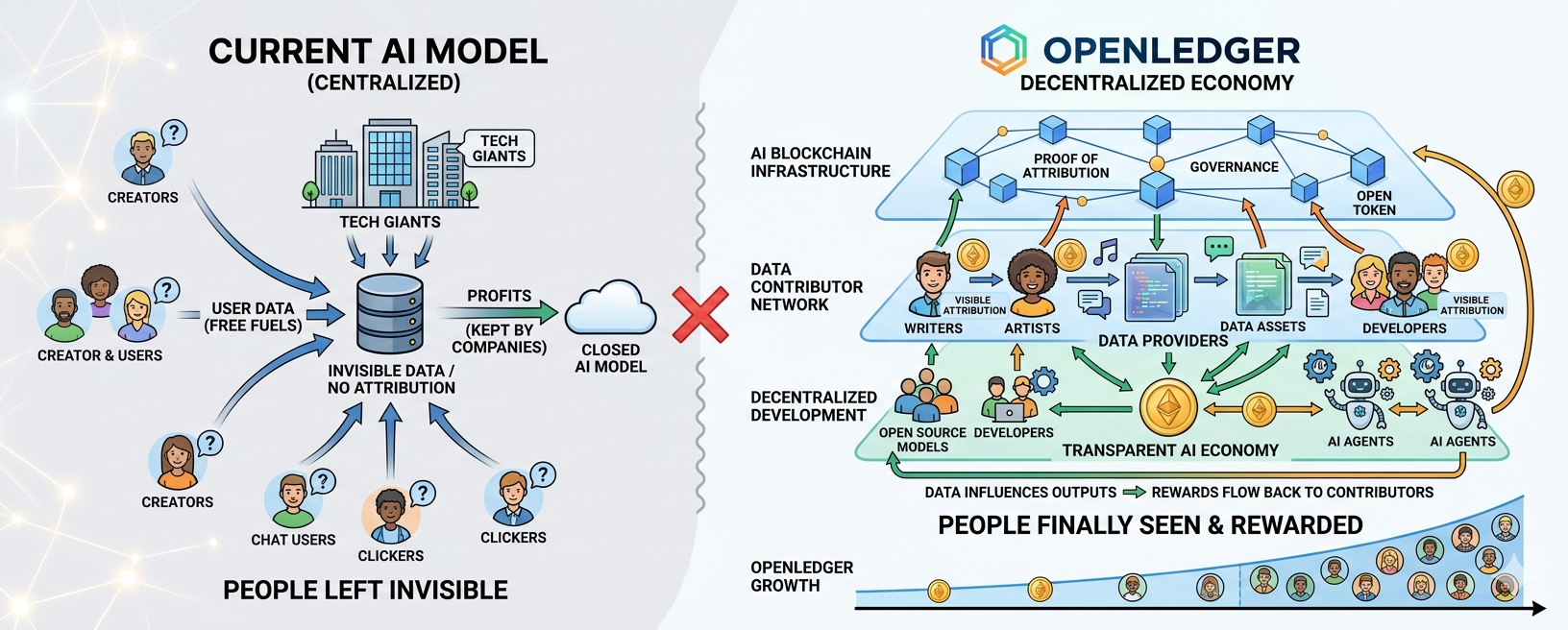
Most AI projects talk about changing the future, but deep down many of them are built the same way. A few powerful companies collect the data, train the models, keep the profits, and leave the people behind the intelligence invisible. The internet keeps moving forward, but the creators, users, and contributors are still standing outside the door watching others benefit from their effort.
OpenLedger is trying to change that feeling.
Instead of treating people like free fuel for artificial intelligence, OpenLedger wants to build a world where data has value, contribution has meaning, and the people helping shape AI are finally seen and rewarded. That idea alone makes the project feel different from the endless wave of empty AI hype flooding the market.
At its heart, OpenLedger is an AI blockchain built to connect data, models, and AI agents into one transparent economy. But the real story is much bigger than technology. It is about ownership in a future that is becoming more automated every single day.
Right now, most people do not even realize how much of themselves they have already given to AI systems. Every search, conversation, image, article, click, and interaction quietly becomes part of massive training pipelines controlled by centralized companies. The world keeps feeding intelligence into machines, but almost nobody gets rewarded for it.
That imbalance is starting to bother people.
OpenLedger was born from that exact tension. The project believes the future of AI should not belong only to giant corporations with endless servers and closed systems. It believes the people contributing the raw material behind intelligence deserve a place in the economy they are helping create.
That is where the idea of decentralized data networks becomes powerful.
Instead of data disappearing into invisible databases forever, OpenLedger introduces systems where datasets can become living assets connected to the people who contributed them. In simple words, your contribution no longer vanishes into a black hole. It can carry value, attribution, and rewards over time.
There is something deeply emotional about that shift.
For years, the internet trained people to create value without ownership. Social platforms grew into billion dollar empires using the attention, creativity, and behavior of ordinary users. AI is now accelerating that same cycle on an even larger scale. OpenLedger is trying to interrupt it before the gap becomes impossible to close.
The project also focuses heavily on transparency because trust around AI is slowly breaking apart. People are starting to ask difficult questions. Where did the training data come from. Who owns the outputs. Which creators were used. Who profits when a model succeeds. Most AI systems today cannot answer these questions clearly because everything happens behind closed walls.
OpenLedger wants attribution to become visible instead of hidden.
Its Proof of Attribution system is designed to track which data influences AI outputs so rewards can eventually flow back to contributors. That idea may sound technical on the surface, but emotionally it represents something simple. Recognition.
People want to know their effort matters.
People want proof that they were part of building something important.
That is the emotional layer behind the project that many overlook.
OpenLedger is not only building infrastructure for machines. It is trying to build a fairer relationship between humans and artificial intelligence.
Another reason the project has gained attention is because it lowers the barrier for smaller builders. AI development today is brutally expensive. Large corporations dominate because they can afford endless computing power while smaller developers struggle to survive. OpenLedger wants independent creators, communities, and smaller teams to participate without needing billion dollar backing.
That creates hope for builders who feel locked out of the AI race.
The ecosystem also pushes into the growing world of AI agents. These are intelligent systems capable of making decisions, automating tasks, interacting with applications, and eventually operating almost like digital workers. OpenLedger sees a future where these agents become part of everyday online life, creating entire economies around autonomous intelligence.
Imagine AI agents working, earning, paying fees, interacting with networks, and operating transparently onchain. It sounds futuristic now, but the speed of AI development makes it feel closer every month.
At the center of all this sits the OPEN token. It powers transactions, governance, staking, rewards, and model monetization across the ecosystem. But unlike many tokens that exist only for speculation, OPEN is designed to move through the actual activity of the network. Contributors can earn from their data, developers can monetize their models, validators secure the infrastructure, and the community can help shape the future direction of the protocol.
The tokenomics also show an attempt to focus on long term ecosystem growth instead of short term excitement. A significant portion of the supply is reserved for community incentives and ecosystem development, while unlock schedules stretch across years rather than flooding the market instantly.
Still, the road ahead is not easy.
The AI industry is moving faster than almost anything the tech world has seen before. Competition is intense, infrastructure costs are enormous, and regulations around data ownership and AI transparency are tightening globally. OpenLedger is stepping into one of the most difficult sectors in technology.
Success is far from guaranteed.
But sometimes projects become important not only because of what they build, but because of the questions they force people to confront.
OpenLedger asks something the internet has avoided for a very long time.
Who truly deserves to benefit from intelligence.
As AI grows stronger, that question becomes impossible to ignore.
Because behind every model, every output, and every intelligent system are millions of human moments that helped shape it. Human creativity. Human conversations. Human knowledge. Human emotion.
For too long, those contributions have been absorbed quietly while the rewards flowed somewhere else.
OpenLedger is trying to build a future where the people behind the intelligence are no longer invisible.
And maybe that is the real reason the project resonates with so many people right now.