
I have been tracking crypto long enough to know when an industry starts panicking.
And right now?
The panic around AI ownership is very real.
Not the glossy conference-panel version of panic either. I mean the quiet, ugly kind happening behind closed doors. The kind where creators realize their work trained billion-dollar models for free. The kind where developers understand a handful of companies are swallowing the entire intelligence economy before regulators even know what questions to ask.
That’s the backdrop behind OpenLedger.
Most people hear “AI blockchain” and immediately roll their eyes. Fair reaction. The market has been flooded with zombie projects stapling ChatGPT wrappers onto useless tokens while venture capital firms clap like trained seals.
But OpenLedger is chasing something bigger.
Much bigger.
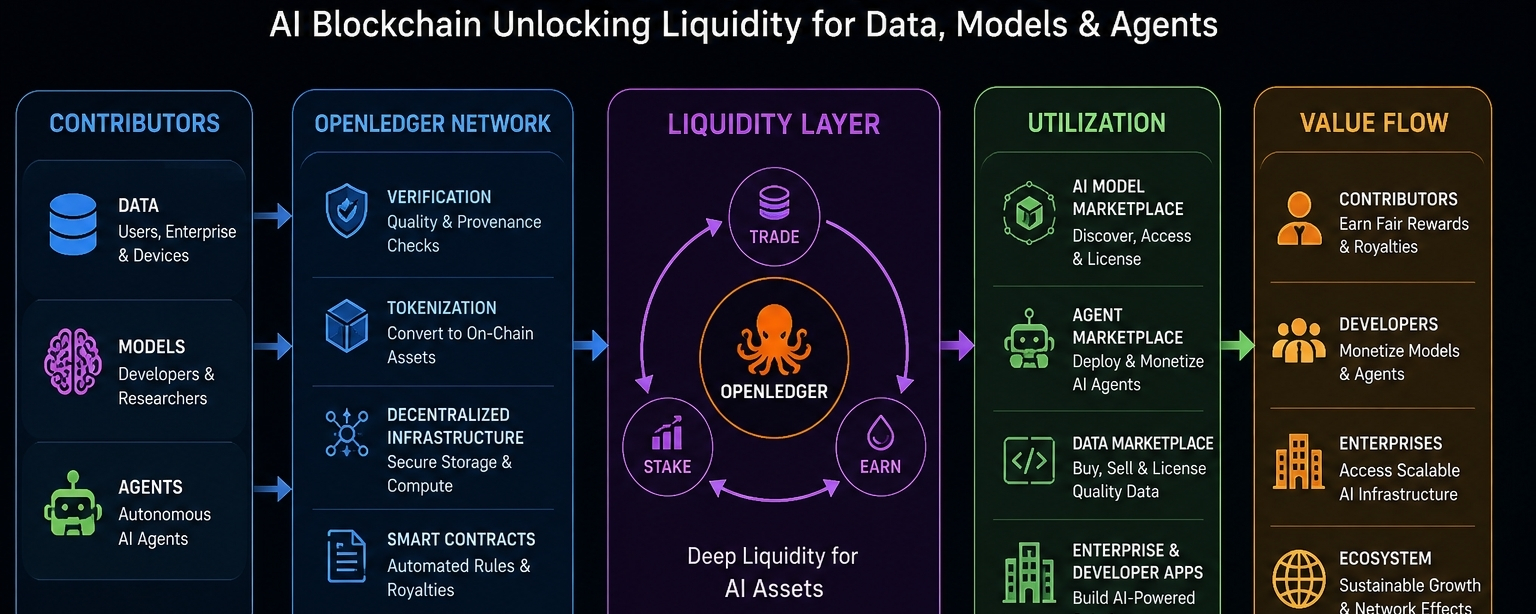
They want to turn AI itself into a liquid asset class.
Not apps. Not chatbots. Not another image generator.
The actual infrastructure underneath intelligence.
Data. Models. Agents.
That’s the bet.
And honestly, it’s one of the few crypto narratives lately that doesn’t feel completely manufactured in a marketing lab.
Because the problem they’re pointing at is real.
Painfully real.
Every modern AI system runs on stolen oxygen. Data scraped from the internet. Human conversations. Artwork. Code repositories. Medical records. Research papers. Voice samples. Behavioral patterns. Millions of people unknowingly feeding systems they don’t own and profits they’ll never touch.
That’s the current machine.
A giant vacuum cleaner pointed at humanity itself.
OpenLedger’s pitch is simple enough to explain over coffee: if AI feeds on human contribution, contributors should actually own part of the economic system.
Wild concept. Apparently.
The project wants to build a blockchain where datasets, AI models, and autonomous agents become tradable, monetizable digital assets. Think less “cryptocurrency casino” and more “Wall Street for machine intelligence.”
At least in theory.
Reality is messier.
Always is.
The crypto industry loves pretending hard infrastructure problems disappear if you slap enough token incentives onto them. OpenLedger doesn’t get to escape physics just because the branding sounds futuristic.
AI systems are brutally expensive to operate.
Not expensive in the cute startup sense. Expensive in the “entire data centers consuming city-level electricity” sense. Training serious models burns through GPUs, bandwidth, cooling systems, and cash at absurd velocity. Even tech giants are bleeding billions trying to stay competitive.
Now imagine decentralizing that chaos.
Good luck.
That’s where things get tricky for OpenLedger and every other decentralized AI project trying to punch above its weight. They aren’t just competing against smaller crypto startups. They’re stepping into a knife fight with companies like OpenAI, Google, and Meta — firms with near-limitless infrastructure budgets and enough computing power to make smaller networks look like science fair projects.
Not remotely fair.
But OpenLedger understands something many centralized AI players still underestimate: ownership matters.
A lot.
Especially once money gets serious.
The internet spent twenty years teaching users to trade privacy for convenience. AI is now escalating the deal. People aren’t just giving away clicks and browsing behavior anymore. They’re giving away cognition. Personality patterns. Creative instincts. Intellectual labor.
And the average person still has no clue how valuable that data has become.
That ignorance won’t last forever.
You can already feel the tension building. Writers suing AI companies. Artists revolting. Regulators sniffing around like bloodhounds. Governments realizing a tiny handful of corporations may soon control the most powerful information systems ever built.
Chaos. Pure chaos.
OpenLedger slides directly into that anxiety with a seductive promise: decentralize the ownership layer before the monopolies calcify permanently.
The mechanics behind it are surprisingly straightforward once you strip away the crypto jargon.
You contribute useful data.
Developers train models using that data.
The blockchain tracks contributions.
Revenue gets distributed through the network.
Simple diagram. Complicated execution.
Because open systems attract parasites fast.
Spam. Manipulation. Sybil attacks. Garbage datasets. Speculative farming.
Pick your poison.
If rewards exist, people will exploit them. That’s not cynicism. That’s internet history. OpenLedger’s biggest challenge may not be technical architecture at all. It may be behavioral economics. Building incentive systems strong enough to reward genuine contributors while filtering out armies of opportunists trying to game the machine.
That balancing act destroys projects constantly.
And then there’s the autonomous agent angle.
This is where OpenLedger starts sounding less like crypto and more like the early scaffolding of a strange new economy.
AI agents are evolving fast. Faster than most people realize. These aren’t just chatbots answering customer service questions anymore. We’re talking about systems capable of executing workflows, negotiating tasks, conducting research, managing operations, and coordinating with other software autonomously.
Tiny digital workers.
Some useful. Some dangerous. Some hilariously broken.
OpenLedger wants those agents operating inside decentralized financial rails.
Picture this for a second: an AI research agent purchases specialized market data from another AI system, rents compute resources from a decentralized network, completes an analysis, then automatically distributes payments across contributors without human involvement.
Sounds ridiculous.
Until you realize pieces of this already exist in algorithmic trading and automation infrastructure today.
The scary part?
We’re still early.
Very early.
Most governments can barely regulate social media properly, and now the industry is sprinting toward autonomous machine economies. Regulatory agencies are going to lose their minds once AI agents start handling real economic activity across decentralized systems.
Who’s liable if an autonomous agent breaks financial rules?
Who owns AI-generated intellectual property?
What happens when decentralized networks train models on disputed datasets?
Nobody has clean answers yet.
And corporate giants know this uncertainty works in their favor. Large companies can absorb compliance costs. Small decentralized projects often can’t. Regulation has a funny way of entrenching incumbents while crushing experimental ecosystems under paperwork and legal ambiguity.
That risk hangs over OpenLedger constantly.
Still, I keep coming back to one uncomfortable truth.
The centralized AI model already looks unstable.
A few corporations controlling intelligence infrastructure for billions of people? That’s not just a business story anymore. That’s geopolitical power. Cultural power. Economic power. Whoever controls advanced AI systems eventually shapes labor markets, information access, media ecosystems, education, finance — maybe even governance itself.
That level of concentration never stays uncontested forever.
Never.
So even if OpenLedger stumbles technically, the broader movement behind it probably survives. Because the demand driving decentralized AI isn’t just speculation anymore. It’s distrust. Distrust of opaque systems. Distrust of giant tech monopolies. Distrust of handing civilization-scale intelligence infrastructure to a tiny cluster of corporate executives and hoping they behave responsibly.
History suggests they won’t.
It never really works out that way.
That’s why projects like OpenLedger matter even if they remain rough around the edges. They’re early attempts at answering a question the entire tech industry is quietly circling around but rarely says out loud:
Who gets to own intelligence once machines become economically essential?
Right now, the answer is drifting toward centralized empires with massive compute budgets and terrifying influence over global information systems.
OpenLedger is betting people eventually push back against that future.
And if they’re right, the next great tech war won’t be fought over social media platforms or smartphone ecosystems.
It’ll be fought over who owns the mind of the machine.
