
@OpenLedger | $OPEN | #OpenLedger
I want to be honest about where I'm starting from.
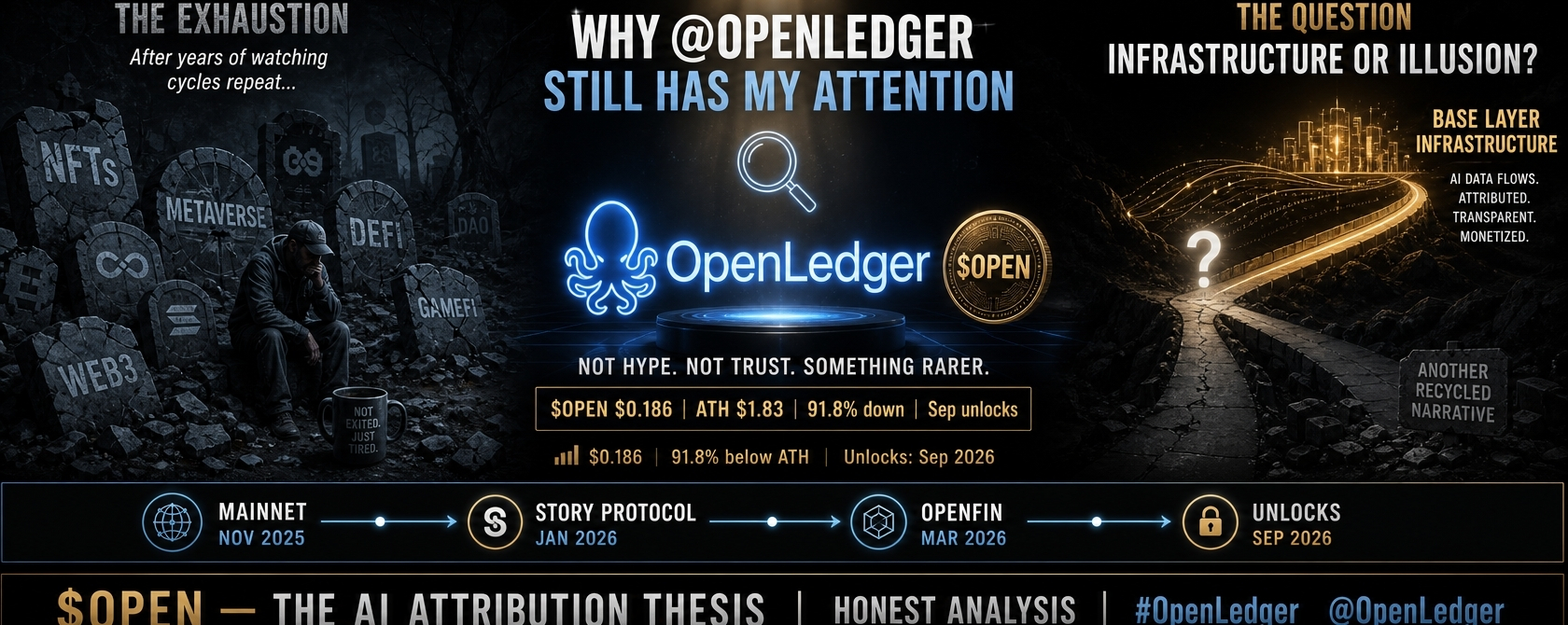
I've been in crypto long enough to have watched entire categories of projects rise, dominate every timeline, then quietly disappear. DeFi summer. NFT mania. GameFi. The metaverse moment that lasted about three months before everyone moved on. Each cycle arrives with new vocabulary and a genuine feeling that this time the pattern is different.
It never is.
What changes is the branding. The underlying dynamic stays the same — excitement builds, capital flows in, incentives warp behavior, the original purpose gets distorted, and then the community that was built around rewards dissolves the second rewards slow down. I've watched it happen enough times that I've stopped getting excited about announcements. Dramatic roadmaps don't move me anymore. Perfectly edited launch videos make me more skeptical, not less.
So when I say @OpenLedger caught my attention — I want that to land with the right weight.
Not excitement. Not hype. Attention. And after everything I've seen, attention is harder to earn than optimism. 👀
The AI + blockchain narrative was already exhausted when I found this.
Every week another project claims it's building the future of decentralized intelligence. Most of them sound interchangeable after the first paragraph. "Ownership." "Agents." "AI infrastructure." Crypto is extraordinarily good at turning genuinely complicated problems into catchy slogans — and the AI wave gave the industry about fifty new slogans to cycle through.
I was skeptical. I'm still partially skeptical.
But the more I spent time with what @OpenLedger was actually building rather than how they were describing it, something started feeling different. Not revolutionary. Not certain. Just — more honest about what it's trying to solve.
The mainnet launched in November 2025 with a focus on verifiable data provenance and automated creator payments. (Investing.com) That's a specific claim about a specific problem. Not "we're disrupting AI." A stated mechanism for a stated friction point.
The friction point itself is real. I know it's real because I can feel it without needing a whitepaper to explain it.
Here's the thing that actually stays in my head.
The internet spent years training people to give away value without knowing it. Every search query, every uploaded image, every conversation, every behavioral signal — all of it became input for systems that became enormously valuable. The people generating that value remained disconnected from the outcome. Not because anyone was explicitly stealing from them. Because the infrastructure for tracking and compensating that contribution simply didn't exist.
AI accelerated that imbalance into something that's getting harder to ignore.
Models become worth billions. The data underneath them disappears into the background. The contributors who made those models possible get nothing — not because of malice, but because there's no mechanism that connects their contribution to the value it produced later.
OpenLedger's Proof of Attribution system attempts to maintain that link — tracing which data influenced which output and routing compensation accordingly. (Investing.com) Whether it actually solves that at scale is a genuinely open question. I don't think anyone knows yet. Infrastructure projects are slow. The edge cases are brutal. The incentive design has to hold across conditions the team hasn't faced yet.
But at least it's pointing toward something real instead of manufacturing a problem to solve.
Where my skepticism lives — and I'm not going to pretend it doesn't.
$OPEN is currently trading at $0.186 — down 91.8% from its all-time high of $1.83. (Milk Road) Only 21.6% of the total supply is circulating right now. (Fear & Greed Meter) Team and investor token unlocks begin September 2026 on a 36-month linear release. (Investing.com)
That combination — deep drawdown, low float, large unlocks approaching — creates a specific kind of pressure that doesn't show up in the technology conversation. It shows up in the price. And ignoring it doesn't make it less real.
I've also seen what happens when leaderboard campaigns become the primary engagement mechanism around a project. Timelines fill with forced enthusiasm. Everyone starts sounding identical because they're farming visibility rather than sharing genuine thoughts. The original signal gets buried under noise that looks like signal.
I'm not criticizing @OpenLedger specifically for running campaigns. Attention is currency now and I understand why projects do it. But I notice it. And I try to adjust for it when I'm reading what people say. 🔍
What keeps me watching anyway.
The Story Protocol partnership in January 2026 created machine-readable ownership definitions and licensing terms specifically for AI training data — with automatic enforcement when data is used. (Investing.com) That's not a press release partnership. That's two projects solving the same problem from different angles and finding overlapping infrastructure.
The OpenFin teaser in March 2026 — described as bringing DeFAI closer — suggests a new product layer merging decentralized finance with the existing AI attribution infrastructure. (Investing.com) If that materializes into something real, it expands $OPEN's utility beyond data compensation into a much larger addressable market.
Good ideas fail in crypto all the time. Strong narratives disappear overnight. Infrastructure projects especially tend to move slower than communities expect and faster than the price reflects.
But every once in a while something appears that feels slightly more thoughtful than the usual noise. Slightly less desperate for attention. Slightly more aware of the tradeoffs it's navigating.
That's the best description I have for how @OpenLedger sits in my head right now.
Not trust. Not hype.
Just attention. Genuine, earned, cautious attention.
And after years of watching this market repeat itself — that's become a much rarer thing than optimism. 🎯
⚠️ Personal analysis only. Not financial advice. DYOR. Crypto carries significant risk.
💬 Do you think AI attribution can actually be solved at scale — or is this another good idea that breaks under real-world conditions?
Drop 🏗️ — the infrastructure thesis is real, watching long term
Drop ⚠️ — good idea, execution risk is too high right now
Drop 🤔 — genuinely undecided, need to see more
🪙 Every COMMENT = Binance Square coins earned RIGHT NOW!
🪙 LIKE if this matched how you actually think about early-stage projects!
🪙 SHARE — the AI + crypto conversation needs more honest takes!
🪙 FOLLOW for deep analysis without the hype — completely free!
#OpenLedger #OPEN #AIBlockchain #DecentralizedAI #Web3AI #BinanceSquare #CryptoAnalysis #DeFAI #AIAttribution #Crypto2026 🪙