
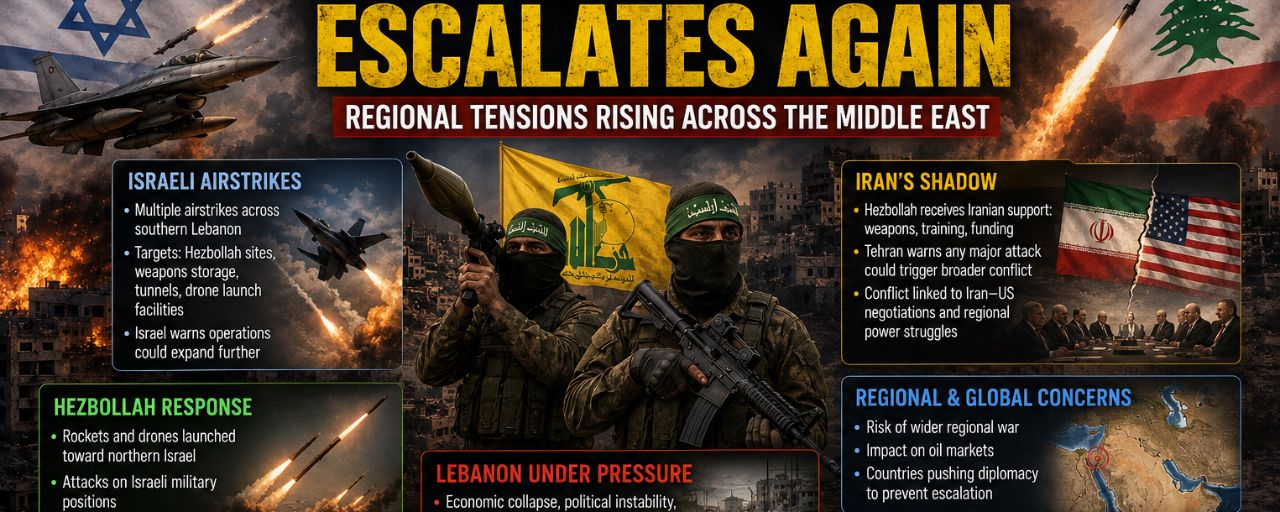
The situation between Israel and Lebanon is becoming increasingly dangerous again as fresh military operations and cross-border attacks continue escalating across southern Lebanon.
Over the past 24 hours, the conflict has entered another sensitive phase after Israel expanded airstrikes and military pressure against Hezbollah-linked positions near the border regions.
While global attention remains focused on Iran–US negotiations, the Israel–Lebanon front is quietly becoming one of the biggest risks for a wider regional war.
⚠️ Israel Intensifies Airstrikes Inside Lebanon
According to regional reports, Israeli forces launched multiple new airstrikes targeting: ▪️ Hezbollah infrastructure ▪️ weapons storage facilities ▪️ drone launch sites ▪️ military tunnels near southern Lebanon
Israeli officials claim the operations are aimed at preventing future cross-border attacks and stopping Hezbollah’s growing military buildup.
The Israeli military also warned that: ⚠️ operations could expand further if rocket attacks continue.
🚀 Hezbollah Responds With Rocket & Drone Activity
In response, Hezbollah-linked groups reportedly launched: ▪️ rockets toward northern Israel ▪️ surveillance drones ▪️ border-area attacks targeting Israeli military positions
Although most projectiles were intercepted, the situation remains highly unstable.
This ongoing exchange is increasing fears that: 🌍 a localized conflict could suddenly turn into a full regional escalation.
🇮🇷 Iran’s Shadow Still Looms Over The Conflict
One of the biggest concerns globally is Iran’s indirect involvement.
Western intelligence sources continue claiming that: ▪️ Hezbollah receives Iranian military support ▪️ regional proxy coordination is increasing ▪️ Tehran is monitoring the conflict closely during negotiations with Washington
Iran itself has warned that: ⚠️ any major attack on Hezbollah or Lebanon could trigger broader regional consequences.
This is one reason why the Israel–Lebanon situation is now directly connected to: ▪️ Iran–US diplomacy ▪️ Gulf security ▪️ oil markets ▪️ global geopolitical stability
🌍 Why The World Is Watching Closely
The conflict matters globally because: ✅ Lebanon sits near critical regional trade routes ✅ escalation could impact oil markets ✅ regional alliances are becoming more fragile ✅ multiple global powers are already involved diplomatically
Countries including: ▪️ Qatar ▪️ Turkey ▪️ Egypt ▪️ Saudi Arabia ▪️ France
have reportedly increased diplomatic communication to prevent wider escalation.
🇺🇸 United States Increasing Military Readiness
The United States has also reportedly increased military readiness in the region.
According to defense sources: ▪️ naval monitoring in the Eastern Mediterranean increased ▪️ regional bases remain on high alert ▪️ Washington is pressuring Israel to avoid uncontrolled escalation
At the same time, US officials continue supporting Israel’s “right to self-defense,” while also trying to prevent a direct Iran-linked regional conflict.
⚠️ Lebanon’s Internal Situation Becoming Worse
Lebanon itself is already facing: ▪️ severe economic collapse ▪️ political instability ▪️ energy shortages ▪️ humanitarian pressure
Any wider war could push the country into: ⚠️ full-scale national crisis.
Civilians near southern Lebanon have reportedly started relocating again due to fears of expanded military operations.
Final Analysis
Right now, the Israel–Lebanon conflict is no longer an isolated border issue.
It has become connected to: 🌍 Iran–US negotiations 🌍 Gulf security 🌍 oil market stability 🌍 regional power struggles 🌍 global diplomatic pressure
The most dangerous part is this:
Multiple conflicts across the Middle East are now overlapping at the same time.
That means: ⚠️ even a small military mistake could trigger a much larger regional escalation very quickly.
For now, diplomacy is still active. But military pressure across the region continues increasing day by day.