
I’ll be honest The most important problem in AI right now may not be intelligence.
It may be ownership.
Because the more AI evolves, the clearer one thing becomes:
Modern AI systems consume enormous amounts of value from people who rarely participate in the value being created.
Users generate data.
Creators produce content.
Developers build tools.
Communities train systems through interaction and feedback.
But once that value enters centralized AI platforms, it usually disappears into closed infrastructure.
The contributors remain outside the economy they helped build.
And that becomes a bigger issue as AI moves from experimental technology into a foundational layer of the internet.
Right now, most people focus on the visible side of AI.
The models.
Which one is smarter.
Which one is faster.
Which company released the latest breakthrough.
But underneath every powerful AI system is an invisible network of data, contributors, applications, and infrastructure constantly feeding the machine.
Without that ecosystem, the intelligence itself cannot scale.
That’s where the idea behind OpenLedger (OPEN) starts becoming interesting.
Because @OpenLedger is not just trying to build another AI product.
It’s trying to build an economic layer around AI itself.
The approach begins with a simple shift in perspective.
AI is not treated as a closed platform.
It’s treated as an open economy.
In traditional AI systems, data becomes locked inside centralized companies.
Models remain privately controlled.
Users contribute value but rarely own any part of the network they help strengthen.
OpenLedger approaches the structure differently.
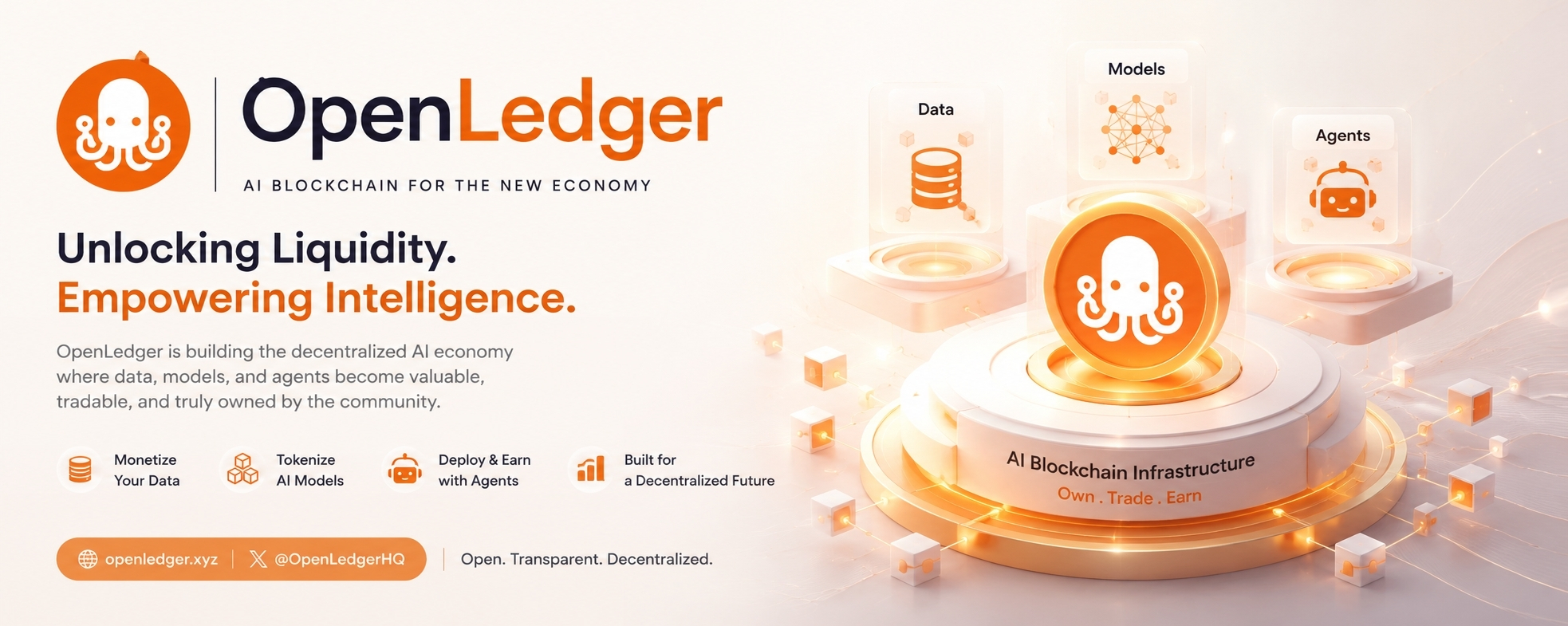
Instead of concentrating ownership, the protocol attempts to create liquidity around AI assets themselves.
Data can become monetizable.
Models can become monetizable.
Agents can become monetizable.
Rather than existing as isolated tools controlled by a single entity, these components become participants inside a shared network economy.
That changes how value moves through the system.
The blockchain layer coordinates ownership, attribution, and incentives.
Not by storing massive AI datasets directly on-chain, but by creating transparent infrastructure that tracks participation and economic activity across the ecosystem.
In effect, the system tries to turn AI contributions into digitally native assets.
And that matters because AI is becoming increasingly modular.
The future probably will not revolve around one giant model doing everything perfectly.
It will likely involve networks of specialized systems working together.
Some models will generate information.
Some agents will execute tasks.
Some systems will provide data.
Others will coordinate workflows between applications.
As those systems grow more autonomous, another problem appears:
How do they exchange value efficiently?
Traditional internet infrastructure was not designed for machine-native economies.
It was designed for human platforms.
But AI agents may eventually operate more like economic participants than passive software tools.
They may negotiate services.
Access data.
Coordinate workflows.
Interact with other agents.
And execute transactions autonomously.
OpenLedger appears to be positioning itself around that future.
The protocol introduces infrastructure where AI systems, datasets, and agents can interact through programmable economic mechanisms rather than relying entirely on centralized intermediaries.
That creates liquidity in places where none previously existed.
A dataset becomes economically active.
A model becomes economically active.
An AI agent becomes economically active.
Not simply through corporate ownership.
But through participation inside the network itself.
This is also where blockchain infrastructure begins to make more practical sense in AI.
A lot of AI-blockchain projects feel disconnected from real utility.
Sometimes the blockchain exists mostly as branding.
But AI introduces coordination problems that decentralized systems are actually well-suited to solve.
Ownership tracking.
Incentive alignment.
Transparent attribution.
Permissionless participation.
Cross-network value exchange.
These are infrastructure problems.
And infrastructure problems become more important as ecosystems grow larger.
OpenLedger seems to recognize that the long-term AI economy may depend less on who owns the biggest model and more on who builds the systems that allow contributors, agents, and applications to coordinate efficiently.
Because intelligence alone does not create sustainable ecosystems.
Incentives do.
And incentives shape behavior.
If contributors are rewarded fairly, networks grow stronger.
If developers can monetize specialized agents, innovation expands.
If data providers retain ownership exposure, participation increases.
The result is an AI ecosystem that behaves less like a closed corporate product and more like an open economic network.
Of course, building this kind of infrastructure introduces challenges.
Scalability matters.
Governance matters.
Data quality matters.
Economic incentives must resist manipulation.
But these are the kinds of coordination challenges every major digital infrastructure system eventually faces.
Financial systems required settlement layers.
The internet required communication protocols.
Cloud computing required shared infrastructure standards.
AI may now be entering the phase where it requires economic infrastructure.
Because as AI systems become more integrated into everyday digital life, ownership and value distribution become impossible to ignore.
The more powerful AI becomes, the more important its economic structure becomes too.
That’s why projects like OpenLedger (OPEN) are starting to attract attention.
Not because they are trying to replace AI.
Not because they are competing with the models themselves.
But because they are trying to build the rails underneath the emerging AI economy.
The long-term future of AI may not belong only to the systems generating intelligence.
It may also belong to the networks deciding how that intelligence is owned, monetized, and shared across the people and agents helping create it.
#OpenLedger #openledger $OPEN $OPENAI
