
I’ve been in crypto long enough to know how easily people fall in love with narratives.
Every cycle starts with the same energy. New projects appear overnight. Communities grow rapidly. Timelines fill with predictions about the future. Everyone talks like they’ve already seen what comes next.
Then the market changes.
The excitement fades. Liquidity disappears. People quietly move on to the next trend. And suddenly you realize most projects were built more for attention than survival.
I’ve seen this happen again and again.
That’s why I’ve become far more interested in the projects that continue building when nobody is watching. The quieter ones. The ones trying to solve problems that still matter after speculation cools down.
That mindset is what eventually led me toward OpenLedger.
At first, I honestly didn’t think much of it.
The combination of AI and blockchain has become one of the most overused narratives in this market. Every project suddenly wants to be part of the AI conversation because that’s where attention is flowing. After multiple cycles, you learn to approach these things carefully.
But every now and then, something feels different beneath the surface.
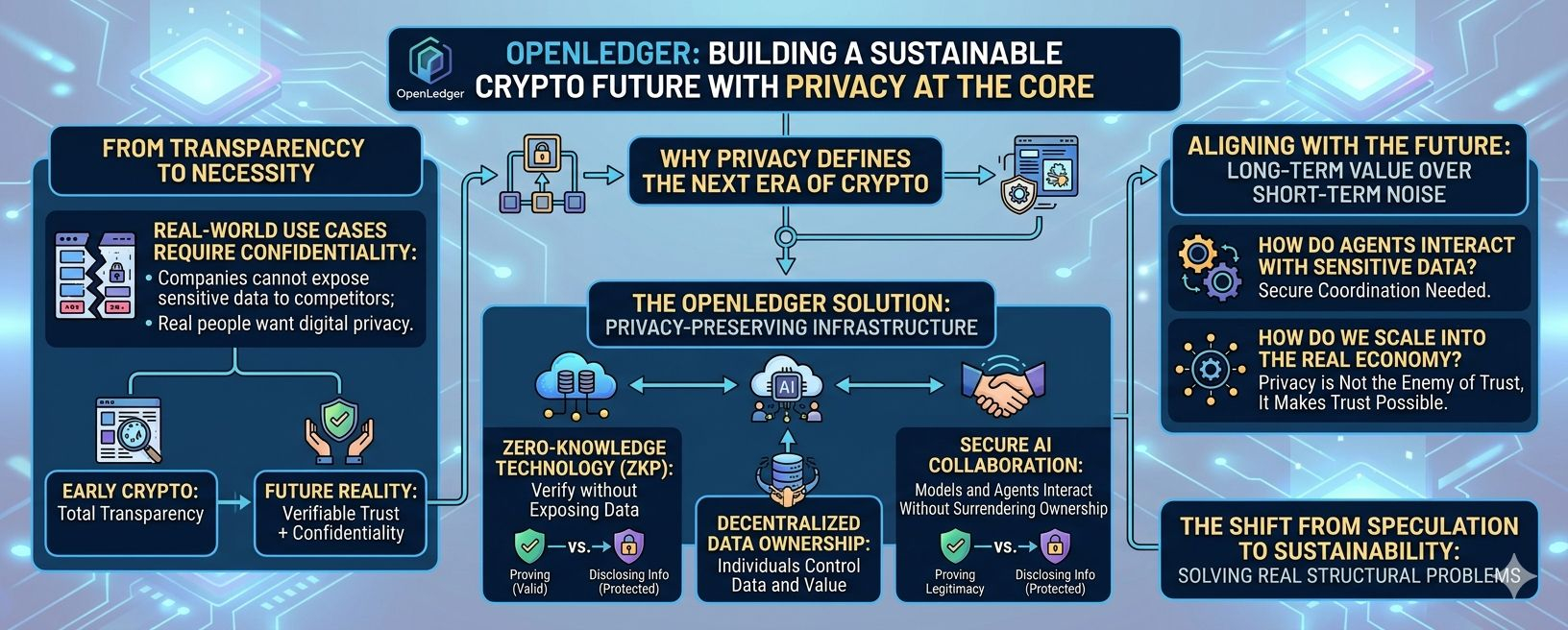
What pulled me in wasn’t hype or marketing. It was the deeper idea behind the network. The realization that data, intelligence, and privacy may eventually become the most important layer of the digital economy.
And right now, most systems are not prepared for that future.
For years, crypto treated transparency like the ultimate solution to trust.
Everything visible. Everything public. Everything on chain forever.
In the early days, that felt revolutionary.
But over time, I started noticing the cracks in that philosophy. Real people do not want every detail of their lives exposed forever. Companies cannot operate with sensitive data fully visible to competitors. AI systems cannot function efficiently if every valuable dataset or model becomes publicly accessible the moment it enters a network.
The deeper blockchain moves into the real world, the more obvious this becomes.
Privacy is not the enemy of trust.
In many cases, privacy is what makes trust possible.
That shift in thinking changed the way I look at infrastructure projects.
I remember when zero knowledge technology first started becoming a serious topic in crypto circles. Most people treated it like advanced mathematics that sounded impressive but felt disconnected from reality.
Even I was skeptical.
But the more I watched AI evolve, the more I realized how important this technology could become.
The ability to verify something without exposing the underlying data changes everything.
It means systems can prove legitimacy without sacrificing confidentiality. Data can remain protected while still being useful. AI models can interact economically without fully exposing what gives them value.
That is where OpenLedger started to make sense to me.
The network seems focused on building an environment where data, AI models, and autonomous agents can operate together while preserving ownership and privacy. Instead of forcing everything into public view, the system leans toward verification without unnecessary exposure.
That sounds subtle at first.
But I honestly think it could become one of the defining ideas of the next generation of blockchain infrastructure.
One thing I’ve learned after surviving both euphoric bull markets and brutal bear markets is that speculation eventually runs out of energy.
Reality always returns.
And when it does, the projects that survive are usually the ones solving real structural problems.
Privacy is one of those problems.
Not the flashy kind that creates instant excitement. The deeper kind that becomes more important as technology evolves.
The internet today runs on data. AI runs on data. Entire companies are built around collecting data. Yet most people contributing to these systems have almost no ownership over the value being created.
That imbalance feels unsustainable to me.
I think we are slowly moving toward a world where people begin caring far more about who controls information, who profits from it, and how it can be used safely.
That is why privacy focused infrastructure feels important now in a way it didn’t a few years ago.
Not because it sounds futuristic.
Because it feels necessary.
What I find most interesting about OpenLedger is that it does not feel obsessed with short term noise. The project appears more focused on creating infrastructure for a future where intelligent systems need verifiable trust without total transparency.
And honestly, that future no longer feels far away.
AI agents are already beginning to interact with financial systems, digital services, and automated workflows. As these systems grow more powerful, the need for secure coordination becomes impossible to ignore.
How do you verify intelligence without exposing proprietary models
How do you monetize data without surrendering ownership
How do decentralized systems scale into the real economy if privacy does not exist
These questions matter far more to me now than transaction speed or temporary market trends.
I think spending years in crypto changes the way you see technology.
In the beginning, everything feels exciting. Every chart feels meaningful. Every narrative feels permanent.
Then you live through crashes.
You watch billion dollar ecosystems disappear. You watch hype evaporate overnight. You realize how much of this market is built on emotion rather than durability.
Eventually, your perspective changes.
You stop looking for the loudest projects.
You start looking for the ones quietly building around problems that are not going away.
That is the feeling I had while researching OpenLedger.
Not excitement.
Something more grounded than that.
Curiosity.
The kind that grows slowly when you sense a project may be aligned with where the world is naturally heading rather than where social media attention happens to be today.
I still approach every crypto project carefully.
Experience teaches caution better than any market lesson ever could.
But I also know that the most important infrastructure shifts usually begin before the majority fully understands why they matter.
Privacy preserving systems feel like one of those shifts.
Not because they are trendy.
Because the modern digital world cannot function forever on absolute transparency and uncontrolled data extraction.
At some point, people will demand systems that allow trust without surrendering everything underneath.
And when I look at OpenLedger, that is the part that stays in my mind long after the hype fades away.
