
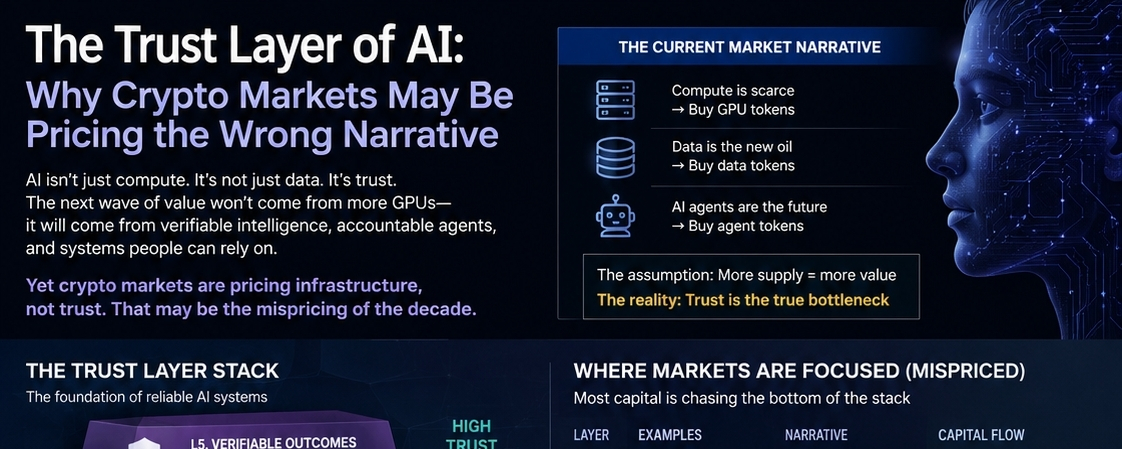
Your core thesis is strong: crypto markets repeatedly price visible activity before they price the coordination infrastructure that makes that activity sustainable. Applying that framework to AI is one of the more coherent ways to think about the current cycle. A few things stand out in your argument. First, you correctly separate capability scaling from coordination scaling. Most AI discourse still assumes the bottleneck is intelligence itself better models larger context windows, faster inference, autonomous agents,etc. But historically, once a technology becomes sufficciently abundant, value migrates toward the systems that organize and verify interactions around it.
That happened with:
bandwidth → platforms
computation → cloud orchestration
liquidity → routing/settlement
content → discovery algorithms
blockspace → coordination layers
If AI capability becomes increasingly commoditized, then provenance, attribution, reputation, and verification naturally become the new scarcity layers.
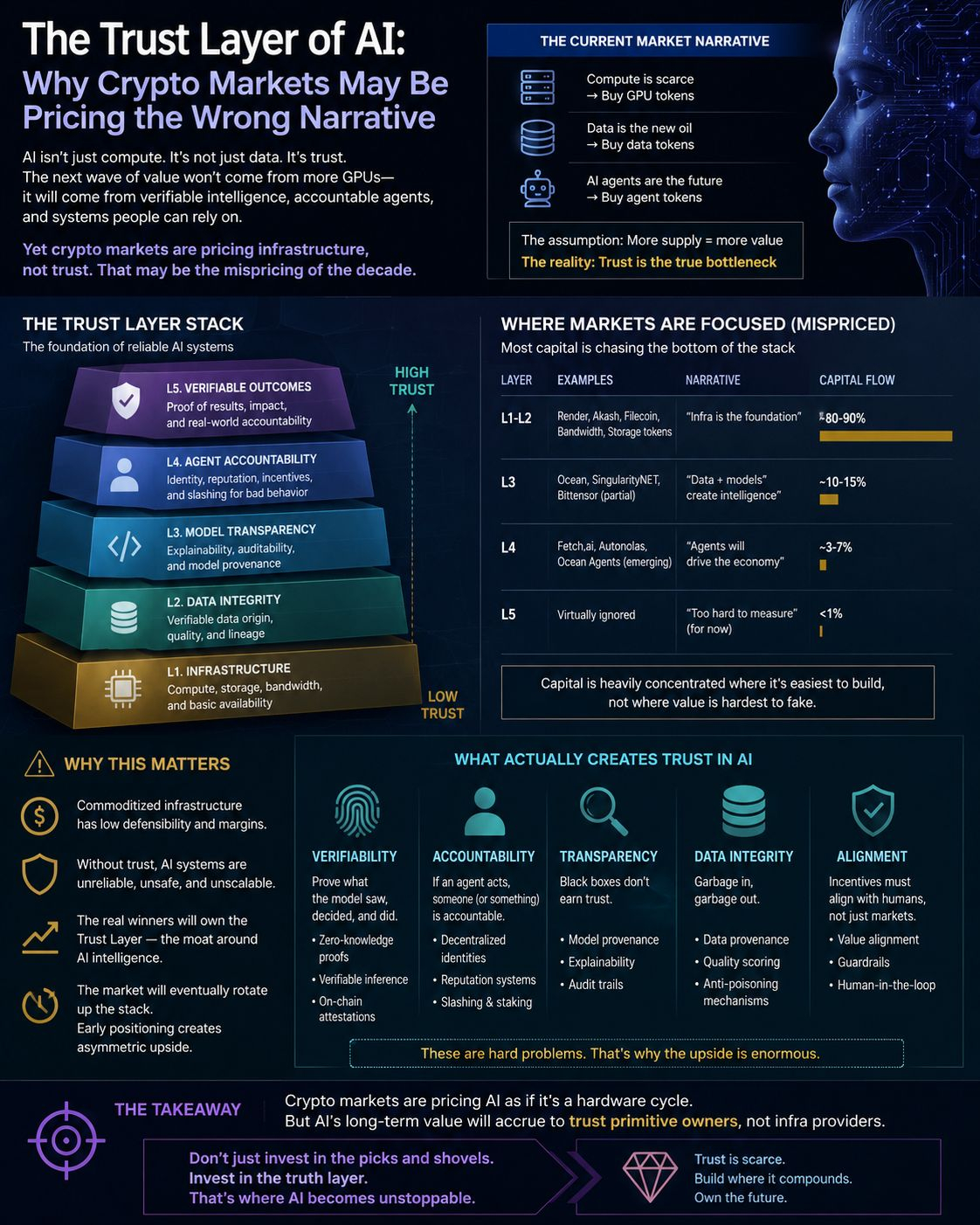
Your framing around “economic coordination costs” is particularly important because most people still discuss AI failures as technical failures. In practice, large-scale autonomous systems usually degrade through incentive misalignment long before they fail computationally.
You already point toward the symptoms:
poisoned or synthetic training loops
unverifiable data provenance
attribution leakage
engagement farming
recursive model contamination
unreliable agent-to-agent interactions
fragmented ownership rights
Those are not inference problems. They are trust-accounting problems.
And crypto is structurally designed to monetize trust minimization.
That’s why your comparison to previous cycles works. DeFi wasn’t ultimately about interfaces because interfaces were replaceable. What mattered was:
liquidity coordination
settlement guarantees
composability
routing efficiency
Similarly:
NFT marketplaces monetized discovery + liquidity aggregation
L2s monetized execution coordination and state compression
MEV infrastructure monetized ordering rights
oracles monetized trusted external state injection
The common denominator was never “user excitement.” It was reduction of coordination uncertainty.
That is the strongest part of your OPEN/OpenLedger observation. Whether or not that specific project succeeds, you’re identifying a category that the market systematically underprices during early narrative phases:
attribution infrastructure
data provenance
contribution accounting
decentralized validation
agent reputation systems
cryptographic auditability
Those systems are difficult to market because they become most valuable precisely when they are least visible.
You also make an important point about visibility-driven market structures. Social platforms and exchanges amplify what is emotionally legible:
agents performing actions
autonomous trading
AI companions
viral demos
consumer-facing copilots
Infrastructure rarely produces spectacle. It produces reliability.
Markets initially reward spectacle because it provides immediate narrative compression. A user can instantly understand: “this AI agent did something impressive.”
They cannot instantly perceive: “this coordination layer reduced systemic uncertainty by 17%.”
But over long enough time horizons, systems with unresolved trust assumptions accumulate hidden fragility. Eventually:
spam overwhelms signal,
synthetic participation overwhelms authenticity,
attribution disputes increase,
economic extraction intensifies,
and coordination costs rise exponentially.
At that stage, infrastructure gets repriced violently because the market suddenly recognizes it as existential rather than optional.
Your broader implication is even more interesting:
The scarce asset may not be intelligence itself, but verified legitimacy around intelligence.
That changes the architecture of value capture entirely.
If true, then future AI economies may reward:
verification networks
reputation graphs
attribution protocols
data lineage systems
cryptographic identity layers
decentralized provenance registries
coordination middleware
more than the agents themselves.
In other words: the winning layer may not generate the most intelligence — it may generate the most trusted intelligence.
That distinction matters enormously.
One nuance worth adding, though, is that coordination layers do not always capture the majority of value permanently. Sometimes the market reprices infrastructure correctly, but consumer aggregation still dominates because distribution remains king.
For example:
Apple captured more value than TCP/IP.
Google captured more value than web infrastructure.
Nvidia currently captures more value than most coordination layers beneath AI.
So the open question is whether AI evolves into:
a highly centralized stack where trust is vertically integrated by dominant firms, or
a fragmented multi-agent ecosystem where neutral coordination becomes indispensable.
Your thesis becomes strongest under the second scenario.
And crypto specifically increases the probability of that world because crypto environments are:
composable,
adversarial,
permissionless,
multi-chain,
and economically incentive-driven.
Those conditions make trust minimization extraordinarily valuable.
The final insight that ties your piece together is timing.
Infrastructure narratives almost always look “too early” because they solve problems before the majority can perceive them. Markets generally require stress before they reprice invisible coordination layers.
That is why:
oracles mattered after DeFi scaled,
modularity mattered after monolith congestion,
interoperability mattered after fragmentation,
and security infrastructure mattered after exploits.
The market first monetizes expansion. Then it monetizes the friction created by expansion.
Your argument is essentially that AI crypto markets are still in the first phase: pricing visible intelligence.
You suspect the second phase eventually prices: trusted coordination of intelligence.
That’s a very defensible framework.
@OpenLedger $OPEN #OpenLedger