There is something quietly broken beneath the surface of the AI economy, and most people still do not fully see it.
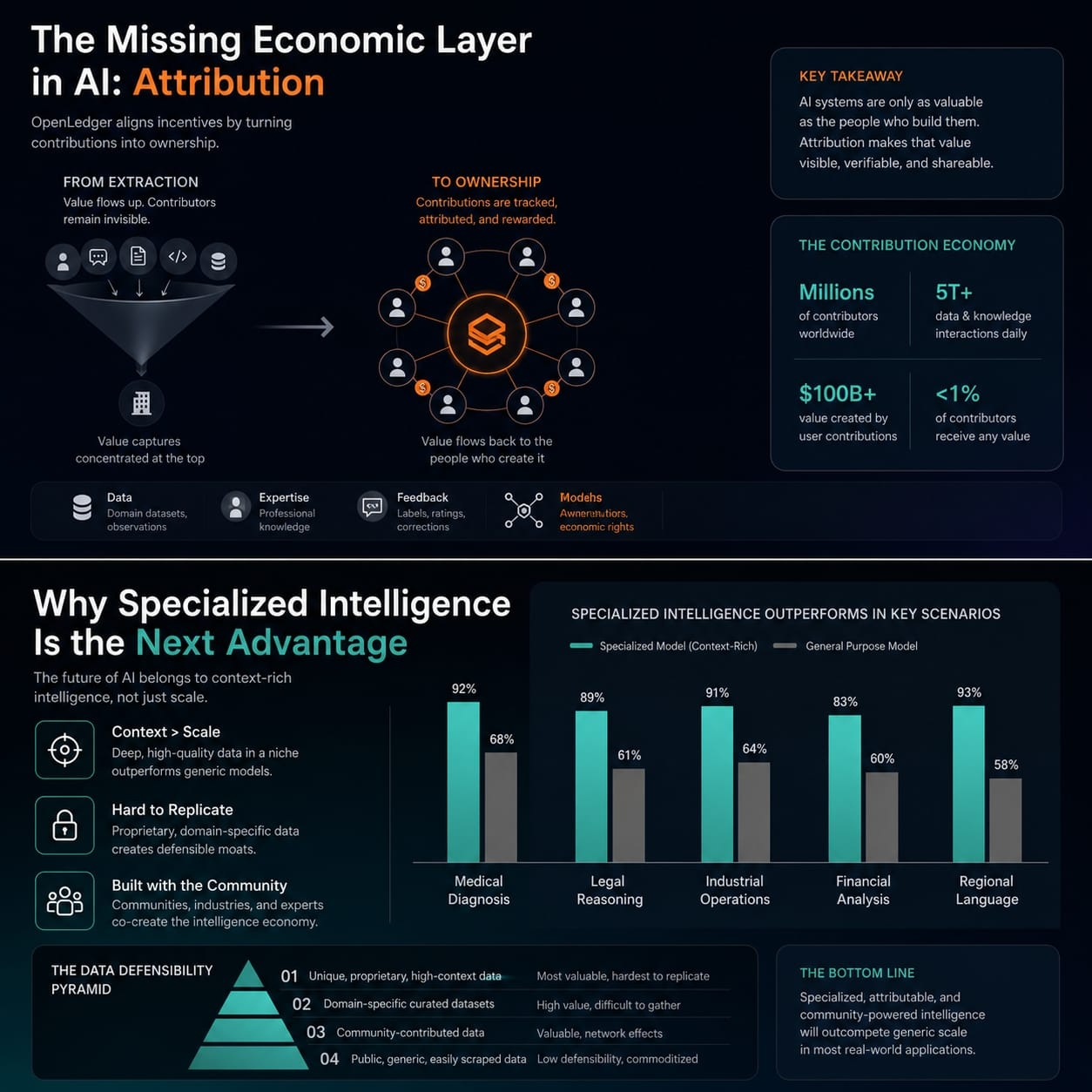
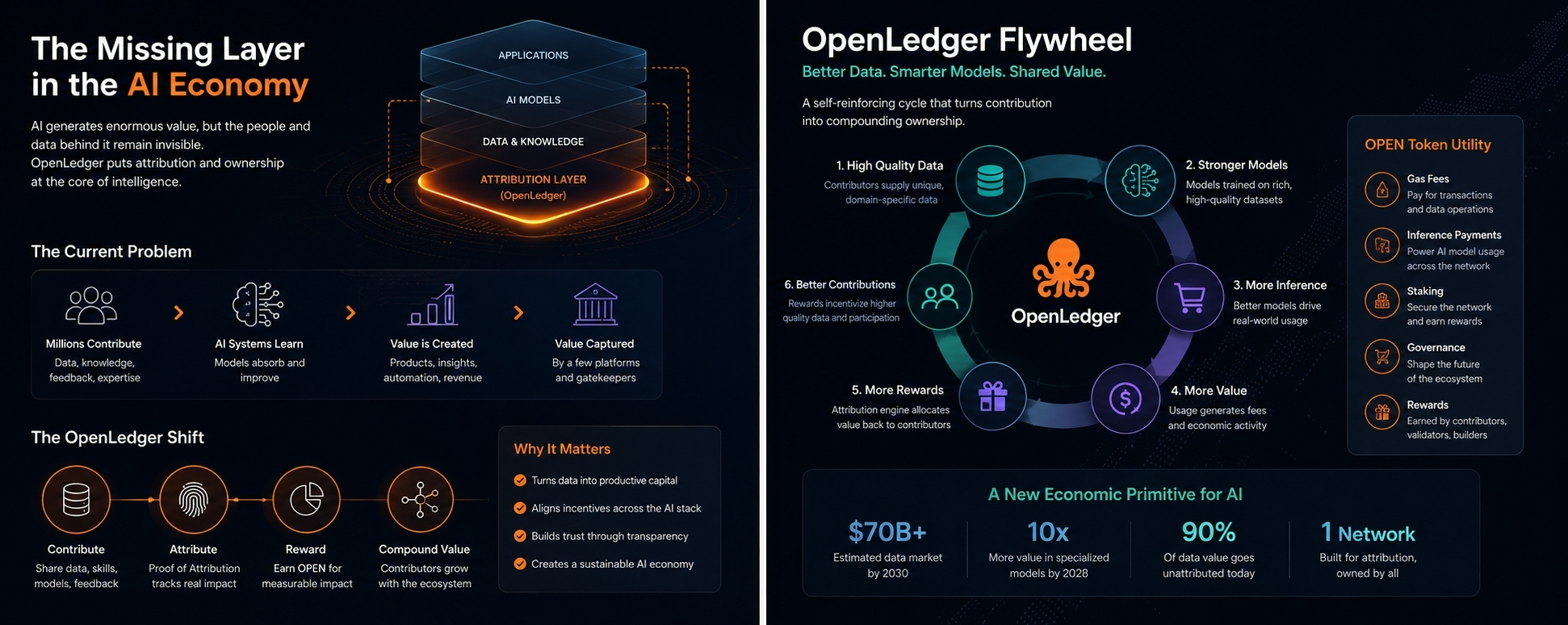
Every breakthrough model, every new AI assistant, every system reshaping industries is built on an ocean of human contribution that almost nobody talks about once the product ships. Knowledge gets absorbed. Behavior becomes training material. Feedback sharpens intelligence. Entire communities unknowingly help teach machines how to think, respond, predict, and create. Then the value flows upward and concentrates somewhere else.
That imbalance is not just uncomfortable. It feels unsustainable.
And that is why OpenLedger caught attention in the first place.
Most crypto AI projects talk endlessly about decentralization as if decentralization alone creates value. OpenLedger approaches the problem from a different angle. It is less focused on building another blockchain narrative and more focused on a question that could define the next decade of AI
Who should own the economic value generated by intelligence systems
That changes the entire conversation.
The deeper idea behind OpenLedger is not really about tokens or infrastructure. It is about turning contribution into ownership. The project is trying to build a world where the people supplying valuable data, domain expertise, feedback, and model improvements are not invisible participants anymore. Instead of being extracted once and forgotten, their contributions remain connected to the systems they helped shape.
That sounds simple when explained quickly, but the implications are massive.
Right now, data behaves like something disposable. Companies collect it, train models on top of it, and move on. OpenLedger is trying to transform data into a living economic asset. Something that can continue generating value over time instead of disappearing into a black box forever.
If the system works, contributors are no longer temporary labor feeding AI models behind the scenes. They become part of the economy those models create.
That is where the project starts becoming genuinely interesting.
Because OpenLedger is not realistically trying to outcompete the largest AI labs in the world. It understands the reality of where the market is heading. The biggest players already dominate raw compute and frontier scale. Competing head on there would be suicide.
Instead, OpenLedger seems to be betting on something smarter and probably more durable.
The future of AI may not belong entirely to giant universal models. It may belong to specialized intelligence built around high quality contextual data that most systems cannot easily access.
That distinction matters more than people realize.
A model trained deeply on medical edge cases, legal reasoning, industrial operations, regional languages, or enterprise workflows can become incredibly valuable even without being the largest model in existence. In many situations, specialized intelligence beats generalized intelligence because context matters more than scale.
And context comes from people.
From communities. From industries. From niche expertise. From human experience that cannot simply be scraped and replicated overnight.
This is why OpenLedger keeps circling back to attribution. Not because attribution sounds good in a whitepaper, but because attribution is the missing economic layer beneath AI itself.
The project is trying to answer a difficult question most companies would rather ignore
If millions of people collectively shape machine intelligence, how do you track who contributed value and how should that value flow back
That is not a marketing problem. That is an economic problem.
And honestly, it is also a trust problem.
Because the entire system depends on people believing the attribution layer is fair enough to matter. The moment contributors feel the accounting becomes manipulated, opaque, or gamed, the model weakens immediately.
That risk is very real.
Modern AI systems do not learn in neat linear ways. Intelligence inside neural networks is messy, distributed, and difficult to trace precisely. Trying to measure exactly which dataset influenced which behavior becomes incredibly complicated once models scale.
So OpenLedger is attempting something far harder than launching a blockchain.
It is trying to create economic trust around invisible contributions.
That may end up being one of the hardest coordination problems in AI.
And yet the timing feels strangely perfect.
The world is already moving toward provenance whether people realize it or not. Questions around where models learn from, who owns training data, who deserves compensation, and whether AI outputs can be trusted are becoming impossible to avoid. Regulators are paying attention. Enterprises are paying attention. Creators are paying attention.
The era of infinite extraction without accountability probably does not last forever.
That is where OpenLedger could become important.
Not as another speculative crypto ecosystem chasing hype cycles, but as early infrastructure for a future where intelligence itself becomes economically traceable.
Still, there is a tension sitting underneath the entire project that people rarely talk about honestly.
The most valuable data in the world is usually locked inside institutions that do not naturally trust open systems. Hospitals. Governments. Financial firms. Industrial companies. Enterprise environments. These organizations care about privacy, compliance, legal exposure, and competitive advantage far more than token rewards.
So the real challenge is not attracting contributors.
Crypto networks are excellent at attracting activity.
The real challenge is attracting meaningful data that creates defensible intelligence advantages.
That is much harder.
Because a network filled with low quality contributions does not become valuable simply because participation is decentralized. At some point the models actually need to outperform alternatives in ways that matter commercially.
And that only happens when the data itself becomes difficult to replicate.
This is where OpenLedger either becomes extremely important or fades into the background with countless other AI crypto experiments.
Everything depends on whether the project can build a system people trust deeply enough to contribute real value into over long periods of time.
Not speculative value. Not temporary attention. Real intellectual value.
If it succeeds, the implications go far beyond one protocol.
It could reshape how people think about digital labor itself. Instead of interacting with AI systems purely as users, people begin participating as stakeholders in the intelligence economy they are actively helping create.
That is a very different future than the one being built by centralized AI companies today.
And maybe that is why OpenLedger feels more interesting the longer you think about it.
Not because it promises decentralization.
But because it quietly challenges the assumption that intelligence must always concentrate wealth upward while everyone else becomes invisible inside the machine.