
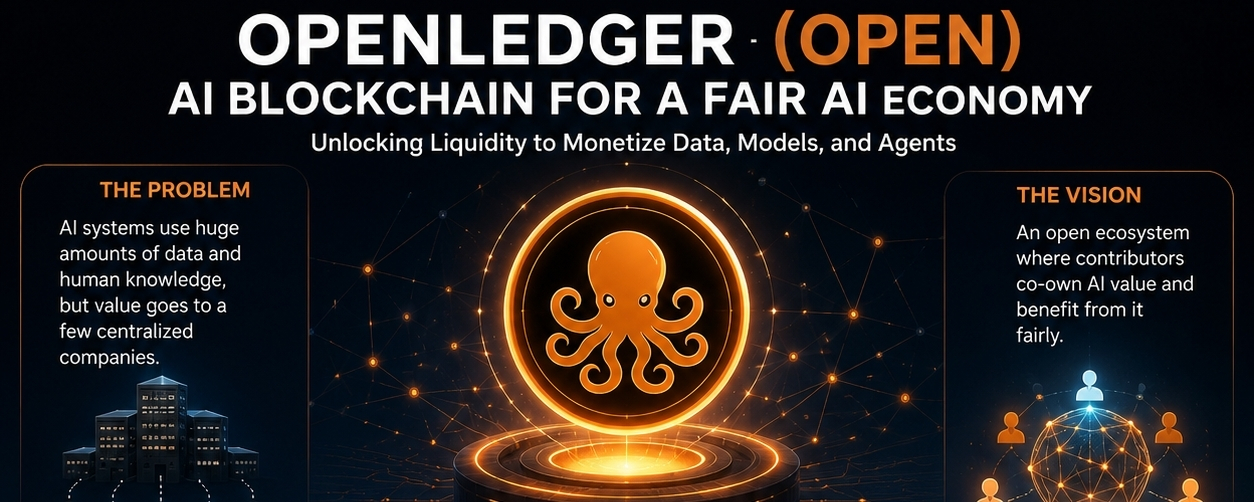
OpenLedger (OPEN), Building an Economic Layer for Artificial Intelligence
Artificial intelligence is becoming one of the most powerful forces shaping the digital world, but most people still look at it only from the surface. The conversation usually focuses on smarter chatbots, better image generation, faster automation, or which company is leading the AI race. What gets ignored is the deeper structure underneath these systems. AI is not created from code alone. It is built from data, human behavior, online knowledge, research, conversations, creativity, and millions of invisible contributions flowing across the internet every single day. Yet the value created from these systems usually ends up concentrated in the hands of a very small number of companies.
This is where OpenLedger (OPEN) becomes interesting in a different way from most AI related crypto projects. Instead of focusing mainly on building another AI tool or another hype driven application, OpenLedger focuses on the economic structure surrounding artificial intelligence itself. The project is built around a simple but important idea. If people contribute data, knowledge, or infrastructure that helps AI systems become valuable, then those contributors should not disappear from the economic picture completely.
In many ways, OpenLedger is trying to treat AI like an open economy rather than a closed product. That distinction matters because artificial intelligence is slowly becoming infrastructure for almost everything online. AI is entering finance, healthcare, software development, media, education, logistics, customer support, research, and even decision making systems. As AI becomes more deeply integrated into daily life, the question of ownership becomes much more serious. If intelligence infrastructure ends up controlled entirely by centralized companies, then the future digital economy itself becomes increasingly dependent on a small group of gatekeepers.
OpenLedger attempts to approach this problem through blockchain based coordination. The project combines AI systems with decentralized infrastructure to create an environment where datasets, models, and autonomous agents can interact economically in a more transparent way. Instead of information flowing into closed systems where contributors lose visibility forever, OpenLedger tries to create mechanisms where participation remains connected to value creation over time.
The easiest way to understand the project is to stop thinking about AI as only software. OpenLedger sees AI as a network of contributors. A model becomes valuable because of the information it learns from, the infrastructure supporting it, the developers improving it, and the users interacting with it. In traditional systems, most of this value flows upward into centralized ownership structures. OpenLedger tries to build a system where value can move across the network instead of accumulating only at the top.
This is why the project places strong attention on attribution. One of the biggest unsolved problems in modern AI is that once data enters a training pipeline, the original source often becomes economically invisible. Millions of people contribute to the internet every day, but very few have any connection to the long term economic value AI companies generate from that information. OpenLedger introduces the idea that datasets and contributors should remain part of the economic lifecycle instead of being treated as disposable inputs.
The concept becomes even more important when thinking about the future of specialized AI systems. Right now, most public attention goes toward giant general purpose models trained on broad internet data. But over time, some of the most valuable AI systems may actually become highly specialized. A healthcare model trained on verified medical information, a legal AI trained on jurisdiction specific cases, or an industrial model trained on manufacturing environments may produce more useful real world outcomes than massive general systems.
Specialized AI depends heavily on specialized datasets, and those datasets often come from smaller organizations, researchers, professionals, or communities with unique expertise. In the current AI environment, these contributors usually have very little leverage. OpenLedger attempts to create infrastructure where these groups can participate economically instead of simply handing over value to larger centralized systems.
The blockchain side of OpenLedger exists mainly to support this coordination process. Many people misunderstand blockchain technology because they focus only on token speculation. The deeper role of blockchain is actually about settlement, transparency, and accountability. It creates a system where transactions, ownership, participation, and incentives can be recorded openly without depending completely on one centralized operator.
In OpenLedger’s structure, the blockchain layer helps manage attribution, incentives, payments, governance, and participation across the ecosystem. The OPEN token acts as the economic layer connecting all these moving parts together. Contributors, validators, developers, infrastructure providers, and users interact through the token economy, creating a system where activity inside the network can theoretically produce shared economic participation.
At least in theory, this creates a more balanced relationship between AI systems and the people helping build them. Instead of value moving only toward platform owners, OpenLedger attempts to create circular economic flows where contributors remain connected to future network activity.
Of course, building this in reality is much harder than describing it.
One of the biggest challenges facing OpenLedger is attribution itself. AI models are extremely complicated systems. Once a model learns from billions of pieces of information, measuring exactly how much influence a particular dataset had on future outputs becomes technically difficult. The idea of rewarding contributors fairly sounds reasonable, but building reliable systems around that idea is one of the hardest technical and economic problems in decentralized AI.
Another major challenge is data quality. Open contribution systems naturally attract attempts to exploit incentives. If rewards exist for contributing information, some participants will inevitably try to submit low quality, duplicated, or manipulated data simply to earn tokens. This is a common problem across decentralized systems. Open networks are powerful, but maintaining quality without recreating centralized control structures is extremely difficult.
Economic sustainability is another important issue. Many blockchain ecosystems appear active during early stages because token rewards temporarily subsidize participation. But long term survival depends on real usage. If developers, organizations, and users do not genuinely rely on the network for useful AI coordination, then token incentives alone cannot sustain the system forever.
There is also the reality that AI infrastructure itself remains highly centralized globally. Even decentralized AI projects still depend heavily on GPUs, cloud computing providers, and semiconductor manufacturing controlled by a relatively small number of companies. This means OpenLedger is not fully decentralizing artificial intelligence itself. Instead, it is mainly trying to decentralize the economic and coordination layers surrounding AI systems.
Regulatory pressure may also become a serious challenge in the future. Governments are increasingly examining AI training practices, copyright issues, data privacy, and accountability standards. Open AI ecosystems may face legal complications if sensitive or copyrighted information enters decentralized training environments without clear permission structures.
Despite all these risks, the broader direction behind OpenLedger still matters. The project represents a larger shift happening inside Web3. The crypto industry is slowly moving away from purely speculative narratives and toward infrastructure focused systems dealing with ownership, coordination, incentives, and digital economies.
The internet already experienced something similar during the rise of social media. Billions of users generated content, engagement, attention, and culture, while a relatively small number of companies captured most of the financial value. AI may repeat this pattern at an even larger scale because intelligence systems continuously absorb and monetize human generated information.
That is why OpenLedger feels important beyond short term market cycles. It raises a deeper question about the future structure of artificial intelligence itself. If AI eventually becomes one of the central infrastructures of the global economy, then who owns that infrastructure matters enormously.
During hype cycles, these conversations are easy to ignore because most attention goes toward speculation, partnerships, and short term excitement. But under real world stress, economic systems reveal their true design. Systems with weak incentives, concentrated ownership, or opaque coordination structures eventually create trust problems. If future AI economies become too centralized, too extractive, or too disconnected from the people contributing to them, the imbalance will become impossible to ignore.
OpenLedger is essentially an attempt to explore a different direction before those structures become permanent. Whether the project fully succeeds is still uncertain because the technical and economic challenges are massive. But the core idea behind it is becoming increasingly relevant. The future of artificial intelligence will not only be shaped by who builds the smartest models. It will also be shaped by who controls the economic systems surrounding those models, who receives value from them, and whether ordinary contributors remain part of the digital economy they help create every day.
