
Most people think the future AI economy will be dominated by a handful of winning models.
I think the bigger market may eventually come from the models that fail.
That sounds irrational at first.
But real economies almost never waste assets completely.
Weak companies still get acquired. Failed startups still sell patents. Distressed real estate gets repurposed. Dead crypto ecosystems sometimes keep trading because liquidity, infrastructure, or communities still retain value underneath the collapse.
Markets are surprisingly efficient at recycling things that no longer look impressive on the surface.
And I think AI may evolve the same way.
That is one reason OpenLedger and $OPEN keep pulling my attention back.
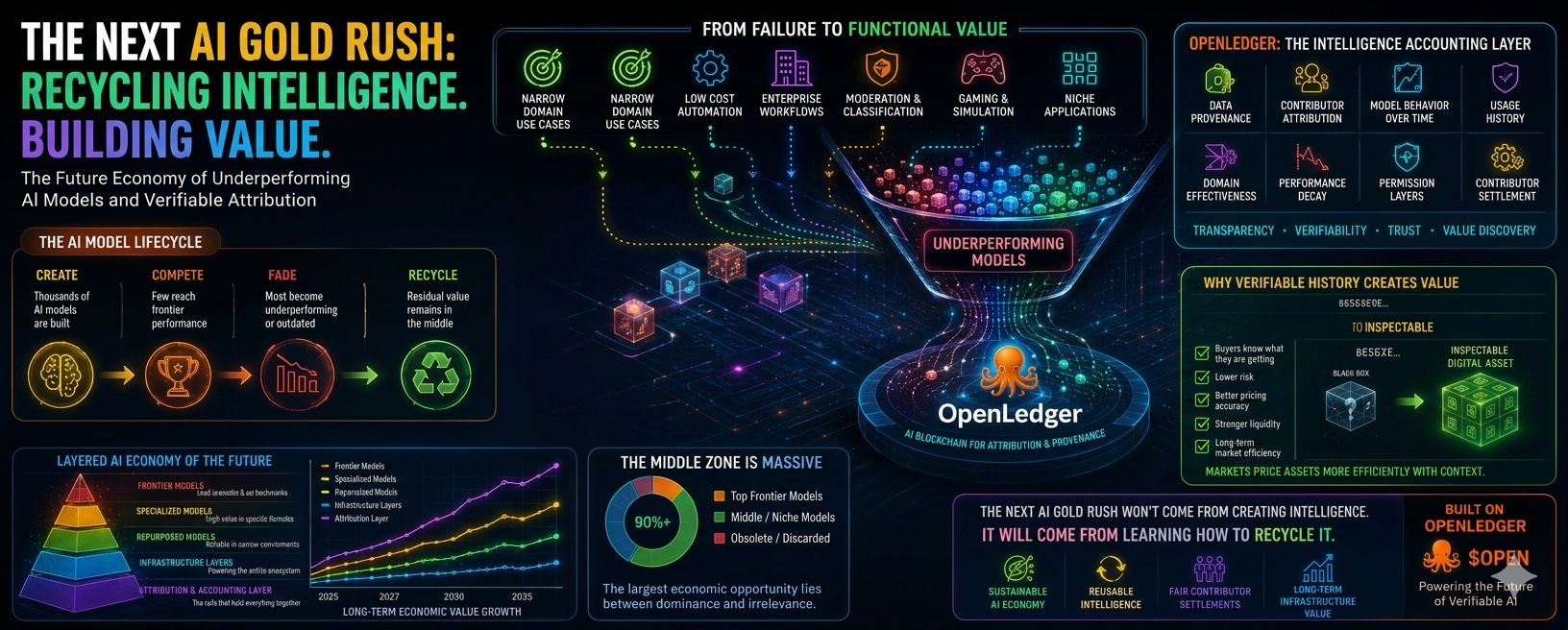
Because if the AI industry eventually develops a secondary market for underperforming models, then attribution, provenance, and traceable usage history may become far more valuable than people currently realize.
Right now, most underperforming AI models are treated like disposable software.
If a model cannot compete with frontier intelligence, the market usually labels it obsolete.
But I am not convinced the future AI economy will think that simplistically.
A weak general-purpose model may still perform extremely well inside narrow environments.
It could still power:
• repetitive enterprise workflows
• moderation systems
• localized datasets
• gaming behavior
• low-cost automation
• internal business tools
• predictable classification systems
• niche operational tasks where consistency matters more than intelligence
That changes the entire framing.
The question stops being:
“Is this the smartest model?”
And becomes:
“What is this model still economically useful for?”
That middle zone feels important to me.
Because historically, the largest secondary markets are usually born between dominance and irrelevance.
And honestly, AI may be heading directly into that territory.
A failed AI model may still remain commercially useful long after it stops being technologically impressive.
That idea feels strange now.
But so did secondary debt markets.
So did distressed acquisitions.
So did abandoned protocol revivals.
Markets eventually monetize almost everything that retains residual utility.
The real challenge is not recycling the model.
The real challenge is proving what the model actually is.
That is where OpenLedger becomes far more interesting than most people are discussing.
Because secondary AI markets cannot function properly without records.
Not marketing.
Not vague benchmark screenshots.
Actual traceable history.
If OpenLedger can track:
• data provenance
• contributor attribution
• model behavior over time
• usage history
• domain effectiveness
• performance decay
• permission layers
• contributor settlement
…then AI models stop behaving like black boxes.
They start behaving more like inspectable digital assets.
Not necessarily premium assets.
But auditable assets.
And markets price assets far more efficiently once context becomes visible.
If buyers can verify where a model came from, how it evolved, which datasets shaped it, where it remained reliable, and which environments still produced stable outputs…
Then even weaker models may retain economic value.
That creates a completely different future from the one most people currently imagine.
The AI economy may not become winner-takes-all.
It may become layered.
A massive ecosystem filled with recycled intelligence, specialized systems, low-cost inference layers, narrow-domain models, and repurposed AI infrastructure quietly operating underneath the headlines.
Honestly, that feels more realistic to me than a clean monopoly outcome.
Because technology markets rarely stay clean for long.
And there is another uncomfortable implication here.
If failed models become tradable or reusable, some builders may eventually optimize for salvage value instead of long-term quality.
At first, that sounds unhealthy.
Then I realized markets already behave like this everywhere.
Companies sell intellectual property.
Communities migrate.
Protocols recycle narratives.
Even failed assets can retain value if their history still matters.
AI may simply evolve into the same economic structure.
Which means the long-term infrastructure opportunity may not sit only inside intelligence creation.
It may sit inside intelligence accounting.
Who contributed?
Who owns what?
Which datasets shaped outputs?
Which systems remained reliable?
Which attribution records can still be trusted years later?
That is the layer I keep watching with OpenLedger.
Because if attribution, provenance, reusable AI records, and contributor settlement all begin flowing through OpenLedger rails, then $OPEN may become connected to something much deeper than temporary AI hype.
Not just the production of intelligence.
But the accounting system surrounding intelligence itself.
And historically, accounting layers often survive longer than the assets moving through them.
Everyone is currently focused on building the smartest AI models.
I think one of the largest future markets may emerge from managing the intelligence nobody fully wants to throw away.
The next AI gold rush may not come from creating intelligence.
It may come from learning how to recycle it.