
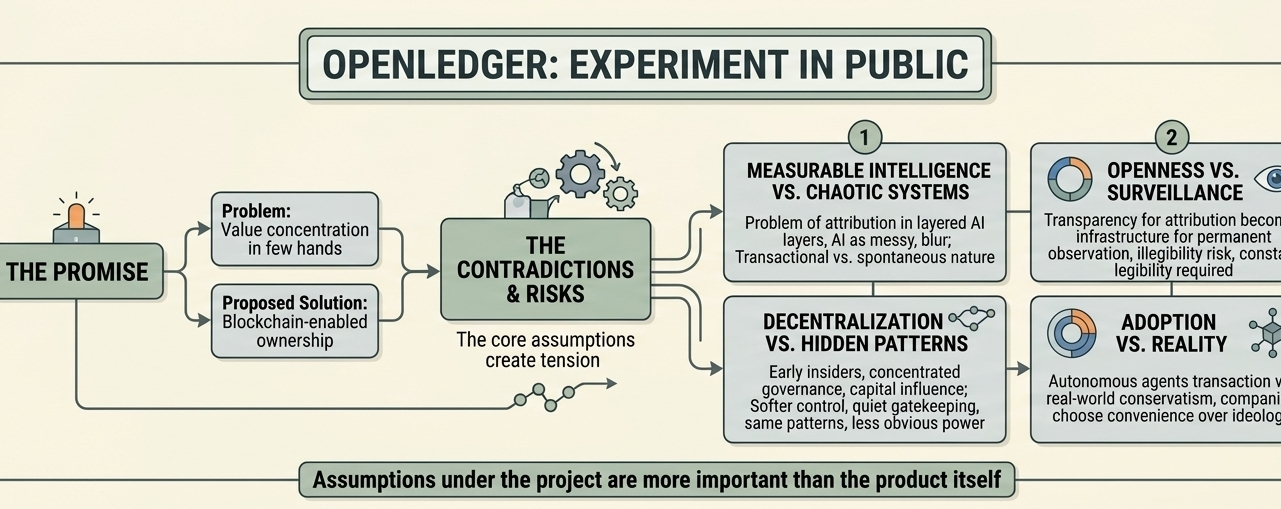

OpenLedger is interesting to me because it taps into a feeling that’s becoming harder to ignore in AI a lot of people are contributing value, but very few actually own any part of what gets built. Everyone feeds the machine in some way: data, prompts, fine-tuning, feedback, automation, content. The promise here is that maybe blockchain can finally create a system where those contributions are visible and rewarded instead of quietly absorbed by large platforms.
But I keep wondering if making everything measurable also changes the nature of participation itself.
A protocol like this depends on the idea that intelligence can be broken down into trackable economic units. Data becomes an asset. Models become assets. Even agents become assets. And maybe that works to a certain extent. But AI systems are messy by nature. They’re built from layers of influence that blur together over time. Trying to assign clean ownership inside that chaos feels a little like trying to measure exactly which drop of rain caused a flood.
What sounds empowering can also become strangely transactional.
There’s also this tension between openness and surveillance that doesn’t get talked about enough. Blockchain projects often describe transparency as freedom open records, verifiable activity, immutable history. But if every contribution is tracked because rewards depend on attribution, then constant visibility becomes part of the system. At some point transparency stops feeling collaborative and starts feeling like infrastructure for permanent observation. The protocol needs people to stay legible in order to function economically.
And honestly, I’m not fully convinced decentralization automatically solves the problems it claims to solve. A lot of these networks still end up revolving around the same patterns: early insiders, concentrated governance, capital influence, quiet gatekeeping behind the language of community ownership. The control just becomes softer and harder to point at directly. Less obvious than a corporation maybe, but not necessarily less real.
What I find most uncertain is whether people actually want this future outside crypto-native circles. The vision assumes AI agents will eventually transact with each other constantly buying data, exchanging services, coordinating autonomously through token systems. It’s futuristic and technically fascinating, but real-world adoption tends to move slower and more conservatively than protocol culture expects. Most companies still choose convenience over ideology every time.
I don’t think projects like OpenLedger are meaningless though. If anything, they’re exposing questions the tech industry hasn’t answered yet. Who deserves compensation when intelligence is built collectively? Can openness exist without creating new forms of monitoring? Is decentralization genuinely empowering, or does it just redistribute power into more abstract systems?
That’s why I see this less as a guaranteed breakthrough and more as an experiment happening in public. Maybe it becomes useful infrastructure. Maybe it turns into another speculative layer wrapped around AI hype. Right now it feels too early to know. But the assumptions underneath it are probably more important than the product itself.