
Market's been choppy all week. I kept refreshing the same charts, nothing interesting happening, so I ended up falling down a rabbit hole I wasn't planning on.
I started looking at @OpenLedger . Not for any particular reason — someone mentioned it in passing and I figured I'd spend twenty minutes on it. Two hours later I'm still there, which usually means something clicked.
Here's the thing that got me.
We've been talking about "decentralized AI" for a while now. The pitch is always roughly the same: open data, community-owned models, no single company controlling everything. Sounds right. Sounds good, even. But there's a problem nobody really addresses cleanly — why would anyone actually contribute?
I mean really contribute. Not stake tokens hoping for a pump. Actually bring useful data, train models, do the unglamorous work that makes AI functional.
Most protocols kind of wave at this question. They say "incentives" and move on. But incentives for what, exactly? Contributing bad data is still contributing. Gaming a reward system is still participating. You can design a token economy that looks perfectly aligned on a whiteboard and still end up with a network full of junk inputs and rational actors extracting value while producing nothing real.
That's the part that clicked for me when I looked at how OpenLedger is approaching this.
The model they're building ties rewards not to participation volume but to verifiable contribution quality. Contributors — whether they're bringing data, compute, or model training — get evaluated against actual model performance outcomes. The incentive isn't just "you showed up." It's closer to "the thing you added made the output measurably better."
I thought that was just a framing difference at first. But actually, it's a structural one.
Most crypto incentive systems reward inputs. You stake, you get yield. You provide liquidity, you earn fees. The output quality is someone else's problem. OpenLedger is trying to reward outputs — or at least, inputs that demonstrably move outputs in the right direction. That's a fundamentally harder thing to measure, but if you can measure it, the misalignment problem mostly goes away. You stop paying people for showing up and start paying them for actually being useful.
Which sounds obvious when you say it like that. But almost nobody does it. Because it's hard.
Here's the part that bothers me though.
"Verifiable contribution quality" is doing a lot of work in that sentence. How do you actually verify it, in real time, at scale, without centralizing the verification process in a way that just recreates the problem you were trying to solve?
If a small committee decides what counts as quality contribution, you've just moved the trust assumption, not eliminated it. If you automate it with on-chain scoring, you've created a new game — figure out what the scoring function rewards and optimize for that, not for actual model quality.
I'm not fully convinced this holds under pressure. When there's real money in the system and sophisticated actors stress-testing the incentive structure, "we reward quality" becomes "we reward whatever proxies for quality in our measurement system." Those aren't always the same thing.
OpenLedger's answer, from what I can tell, involves a layered verification approach — cross-validation across contributors, reputation staking, and outcome-linked rewards that settle over time rather than immediately. It's more thoughtful than most. But "more thoughtful than most" and "actually solved" are different categories.
What makes this matter beyond the protocol itself is the broader question it surfaces.
We're heading into a world where AI infrastructure is genuinely valuable. The question of who builds it, who owns it, and who gets paid for it is not academic. If the incentive layer is broken, you don't get decentralized AI — you get a decentralized facade with centralized quality control quietly running underneath. Which might be fine as a business, but it's not what's being advertised.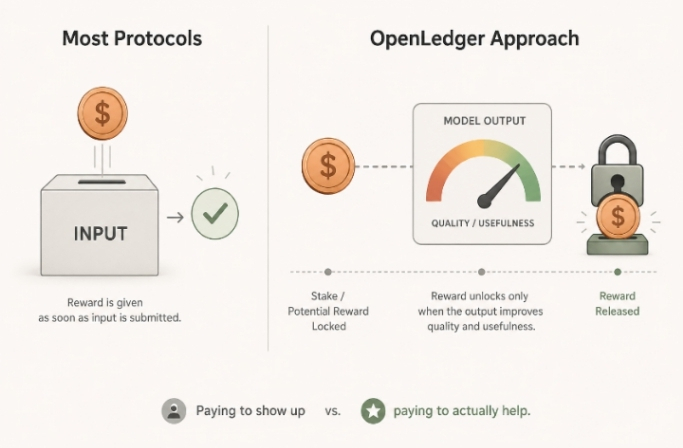
OpenLedger is at least asking the right question. Whether the answer is robust enough — that I genuinely don't know yet.
I'll probably just watch how this plays out over the next few months. The choppy market isn't going anywhere, and neither is this problem.