
Title: The Quiet Shift Happening Behind Artificial Intelligence
Most people see artificial intelligence through products.
A chatbot answering questions.
An image generator creating art.
A trading assistant making predictions.
An automation tool saving time.
That’s the visible side of AI.
But lately I’ve been thinking more about the invisible side — the people, systems, and contributions quietly powering everything underneath it.
Because the truth is, AI does not build itself.
Behind every intelligent model are researchers training systems for years. Developers optimizing performance. Communities testing outputs. Contributors organizing data. Countless people helping improve the quality of intelligence before the public ever interacts with the final product.
Yet somehow, once the technology becomes successful, those contributors almost disappear from the story.
The platforms receive recognition.
The products generate value.
The intelligence becomes profitable.
But many of the people helping create that intelligence remain invisible.
And honestly, I think that becomes a much bigger issue as AI evolves into something larger than a simple technology trend.
Right now, artificial intelligence is moving toward becoming infrastructure for the modern internet. Finance, healthcare, cybersecurity, media, education, and research are already being reshaped by intelligent systems.
As that transformation accelerates, ownership and contribution will matter far more than people currently realize.
Who controls the data?
Who benefits from the value?
Who gets recognized for helping build these systems?
Those questions are becoming harder to ignore.
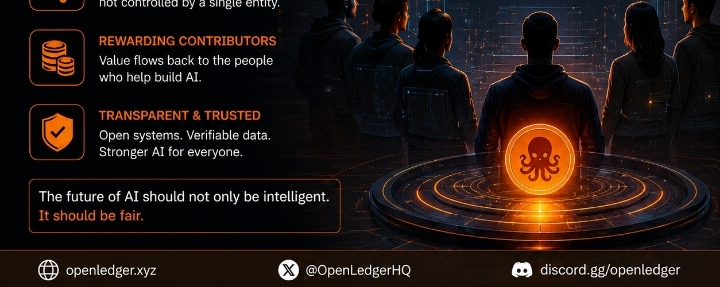
This is one reason decentralized AI projects like @OpenLedger have started standing out recently.
Instead of only focusing on launching another AI narrative, the project appears focused on attribution, transparency, and contributor-driven infrastructure. The idea of Proof of Attribution feels especially important because it creates a framework where contributions can potentially be tracked and acknowledged instead of disappearing into centralized systems.
And maybe that becomes one of the biggest differences between old internet models and future AI economies.
For years, digital platforms were built around extracting value from users while concentrating ownership at the top. AI could repeat that structure — or completely redesign it.
The platforms that build transparent ecosystems around intelligence may eventually become more valuable than those relying only on scale and hype.
Of course, decentralized AI still faces major challenges.
Governance is difficult.
Security risks exist.
Scalability remains complex.
Incentives must be carefully balanced.
But every important technological shift starts with uncertainty before the world fully understands its impact.
For now, I’m simply paying attention to the projects exploring AI from a different angle.
Not just as smarter technology.
But as a future economic system built around contribution, coordination, and trust.
Because the future of AI may not only depend on how intelligent machines become.
It may depend on whether the people helping build that intelligence are finally seen, valued, and remembered.