
I have been tracking crypto long enough to know when a sector starts smelling desperate.
And right now?
AI crypto smells like a crowded casino floor at 3 a.m. Loud promises. Half-working demos. Venture capital everywhere. Founders talking about “decentralized intelligence” like they just discovered fire.
Most of it is noise.
That’s why OpenLedger caught my attention.
Not because it’s flawless. It isn’t.
Not because the token chart looks exciting. I’ve seen enough charts implode to stop romanticizing them years ago.
What grabbed me was the uncomfortable question sitting underneath the entire project:
What happens when human knowledge becomes the most valuable commodity on Earth?
That’s the real game here.
Not chatbots.
Not memes.
Not another glossy AI assistant pretending to understand your emotions while vacuuming your data into a corporate warehouse somewhere in California.
Data is the oil. Everyone says that. Fine. But OpenLedger is chasing something nastier and more ambitious than raw data alone.
It wants to build a market for intelligence itself.
And honestly, that should make people a little nervous.
Because once intelligence becomes tradable infrastructure, everything changes. Your writing patterns. Your browsing behavior. Your medical history. Your code. Your voice. Your weird midnight search history. All of it becomes economically useful to somebody.
The tech industry has been quietly training us for this moment for years.
Free apps.
Free platforms.
Free convenience.
Nothing was free.
You paid in behavioral exhaust.
Every click fed the machine.
OpenLedger just strips away the polite corporate language and says the quiet part out loud: if AI companies are getting rich from user-generated intelligence, then contributors should probably get a cut.
Fair point.
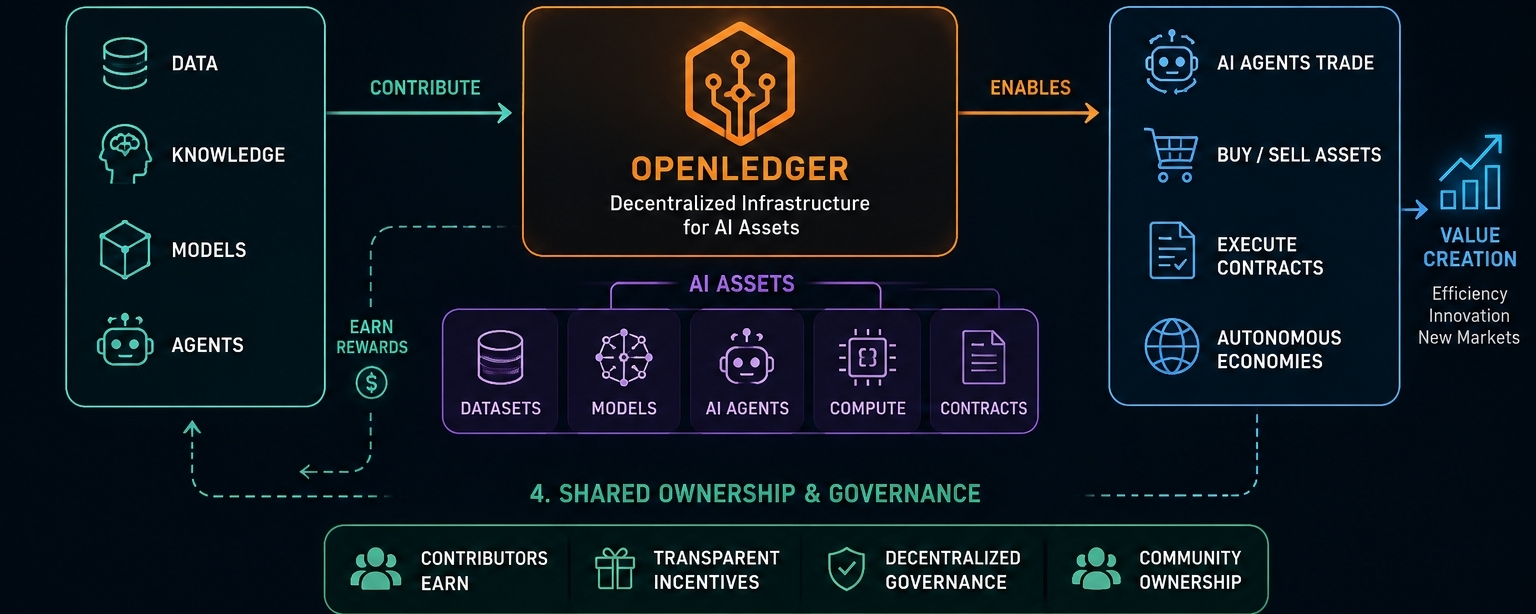
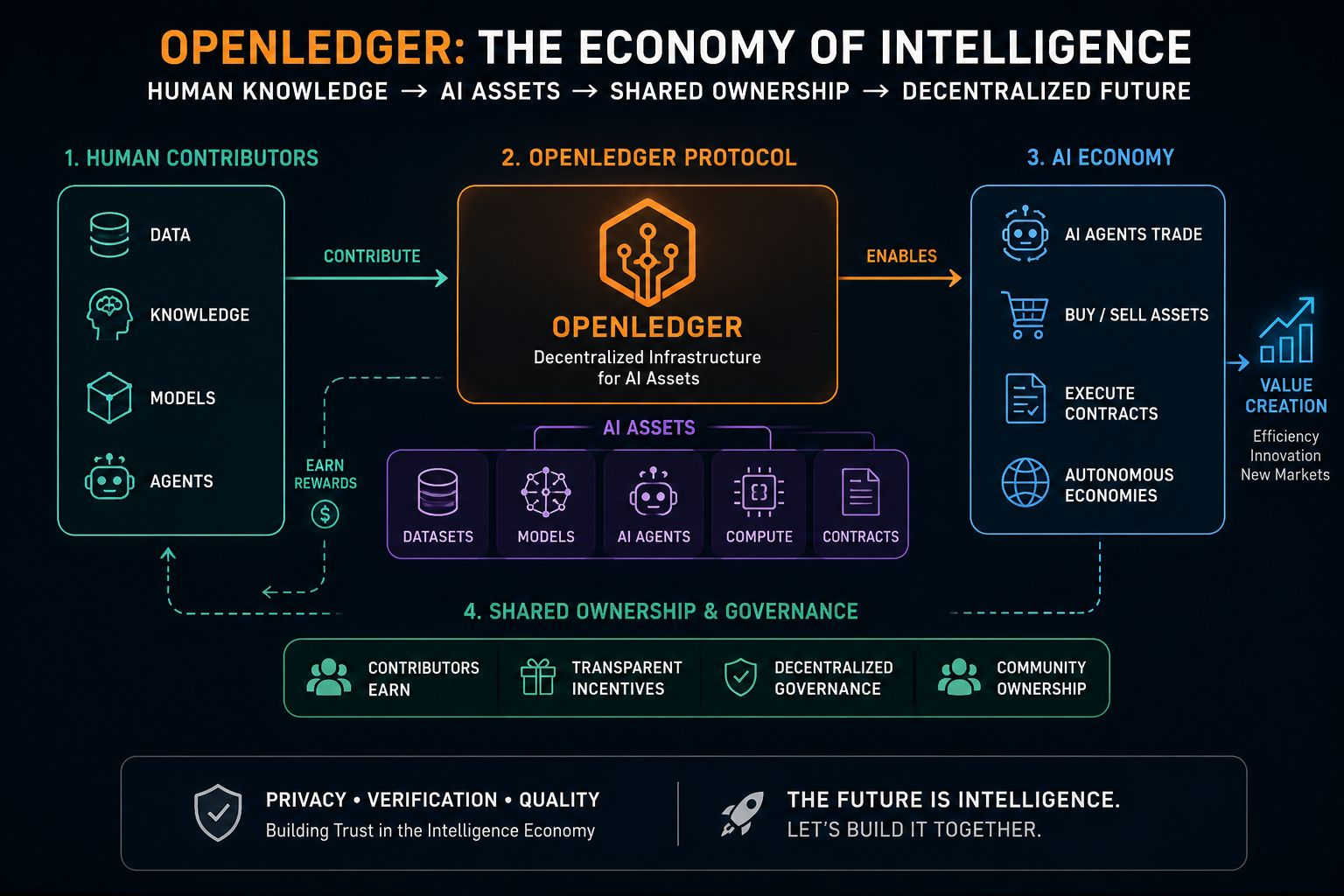
The mechanics behind it are actually less complicated than the whitepapers make them sound. OpenLedger is basically trying to create blockchain rails for AI assets. Datasets, machine-learning models, and autonomous AI agents become tradable objects inside an economic network.
Think of it less like Bitcoin.
Think of it more like Wall Street for machine intelligence.
That’s the pitch.
And it’s arriving at exactly the moment Silicon Valley is becoming violently competitive over AI infrastructure.
You can feel the panic now.
Big tech firms are scrambling for compute power like countries hoarding weapons before a war. NVIDIA chips vanish instantly. Data licensing deals are exploding in price. Entire companies are being bought just to secure engineering talent.
Chaos. Pure chaos.
The public sees polished AI demos online.
Behind the curtain, it’s an arms race fueled by cash burn and corporate ego.
OpenLedger is trying to slide into that disorder by offering something centralized firms struggle with: shared ownership.
That matters more than people think.
For years, the internet has operated on a brutally uneven trade. Users create value. Platforms absorb it. Then those same platforms sell the value back to users through subscriptions, ads, APIs, and algorithmic manipulation.
OpenLedger wants contributors to participate economically instead of acting as unpaid fuel sources.
Sounds noble.
It also sounds incredibly difficult.
Because decentralized systems break in very human ways.
People spam incentives.
Validators collude.
Developers chase short-term token pumps.
Communities turn tribal overnight.
I’ve watched enough crypto cycles to know idealism usually survives right up until real money enters the room.
Then the knives come out.
And OpenLedger isn’t operating in some safe experimental bubble either. It’s stepping directly into one of the ugliest battlegrounds in modern technology: AI ownership.
That battlefield is getting darker by the month.
Artists are suing AI firms over training data.
Governments are circling with regulatory threats.
Publishers want licensing money.
Startups are racing to lock down proprietary datasets before competitors grab them first.
Nobody agrees on the rules because nobody fully understands the consequences yet.
Here’s where OpenLedger becomes genuinely fascinating.
The protocol isn’t only about storing data or moving tokens around. The bigger vision involves autonomous AI agents participating inside machine economies.
That sounds abstract until you picture it clearly.
Imagine AI agents negotiating contracts.
Buying datasets.
Hiring compute resources.
Executing trades.
Managing digital businesses.
Without humans approving every step.
That future is not science fiction anymore. Parts of it already exist in fragmented form across finance, logistics, customer service, and algorithmic trading.
OpenLedger is betting those fragments eventually merge into full-scale AI economies.
Maybe they’re right.
Maybe they’re early.
Maybe the entire thing collapses under technical debt and regulatory pressure before it ever reaches escape velocity.
All three possibilities feel realistic.
And there are serious technical headaches ahead.
Scalability alone is brutal.
AI workloads are monstrously expensive compared to traditional blockchain activity. Moving tokens between wallets is easy. Coordinating intelligent systems with massive datasets? Different universe entirely.
Not remotely cheap.
Then there’s verification.
Everybody talks about decentralized AI until somebody asks the obvious question: how do you verify whether datasets are actually useful instead of synthetic garbage scraped from the internet?
That problem gets uglier every year.
The web is already drowning in AI-generated sludge. Fake articles. Fake images. Fake engagement. Entire ecosystems of synthetic content polluting training pipelines. Any protocol trying to monetize data has to solve quality control or risk becoming a landfill of algorithmic junk.
Blockchain doesn’t magically fix that.
Nothing does. Not fully.
And looming over all of this is the uncomfortable reality nobody in crypto likes discussing openly: centralized companies still hold absurd advantages.
Infrastructure.
Distribution.
Capital.
Political influence.
A decentralized protocol may sound philosophically superior, but philosophy doesn’t pay GPU bills.
That’s where OpenLedger faces its hardest test.
Can open systems compete against trillion-dollar firms building private AI empires behind closed doors?
I honestly don’t know.
But I do know this.
The current trajectory of AI is concentrating power at terrifying speed. A handful of corporations are positioning themselves as gatekeepers for intelligence infrastructure itself. Not social media. Not cloud computing. Intelligence.
That’s a different level of control entirely.
And once society becomes dependent on AI systems for healthcare, education, finance, logistics, and governance, whoever controls those systems controls far more than software.
They control access to decision-making.
That’s the real tension underneath projects like OpenLedger.
Not token prices.
Not hype cycles.
Not conference buzzwords.
Power.
Who owns intelligence.
Who profits from it.
Who gets replaced by it.
And who gets locked out completely.
The industry still pretends these are technical questions.
They’re not.
They’re political questions wearing a hoodie and pretending to be code.
