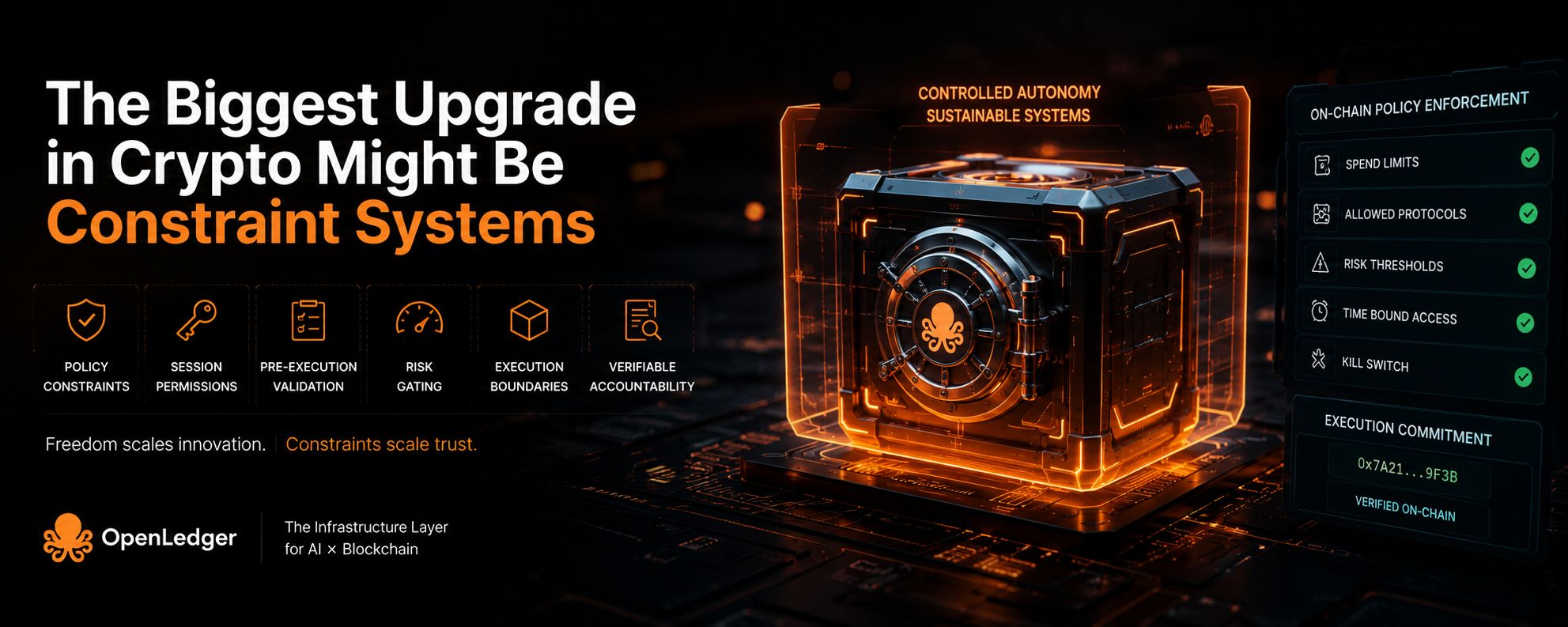
Projects like @OpenLedger are already starting to build around this shift at the infrastructure layer.
For years, crypto treated restrictions almost like enemies of innovation.
The entire culture grew around openness. Permissionless deployment. Infinite composability. Unlimited execution. Anyone could launch a protocol, connect liquidity, automate strategies, or move capital across systems without asking for approval from anyone.
At the beginning, that freedom created momentum the industry genuinely needed.
But the environment looks very different now.
Markets are no longer dominated by humans manually clicking through interfaces and adjusting positions a few times a day. Autonomous agents already execute trades, rebalance vault exposure, rotate liquidity between chains, manage treasury allocations, and interact with multiple protocols simultaneously.
Capital itself is starting to behave less like stored value and more like continuously moving infrastructure.
That changes the nature of risk completely.
A few years ago, most failures stayed relatively isolated. A protocol exploit affected one application. A bad trade impacted one user. An inefficient strategy usually stopped at human reaction speed.
Autonomous systems don’t fail that way.Once execution becomes continuous, instability spreads through dependencies extremely fast. A routing engine affects liquidity conditions. Liquidity conditions affect vault allocation. Vault exposure affects leverage risk. Cross-chain latency affects settlement assumptions. One unstable variable starts reshaping every connected layer around it.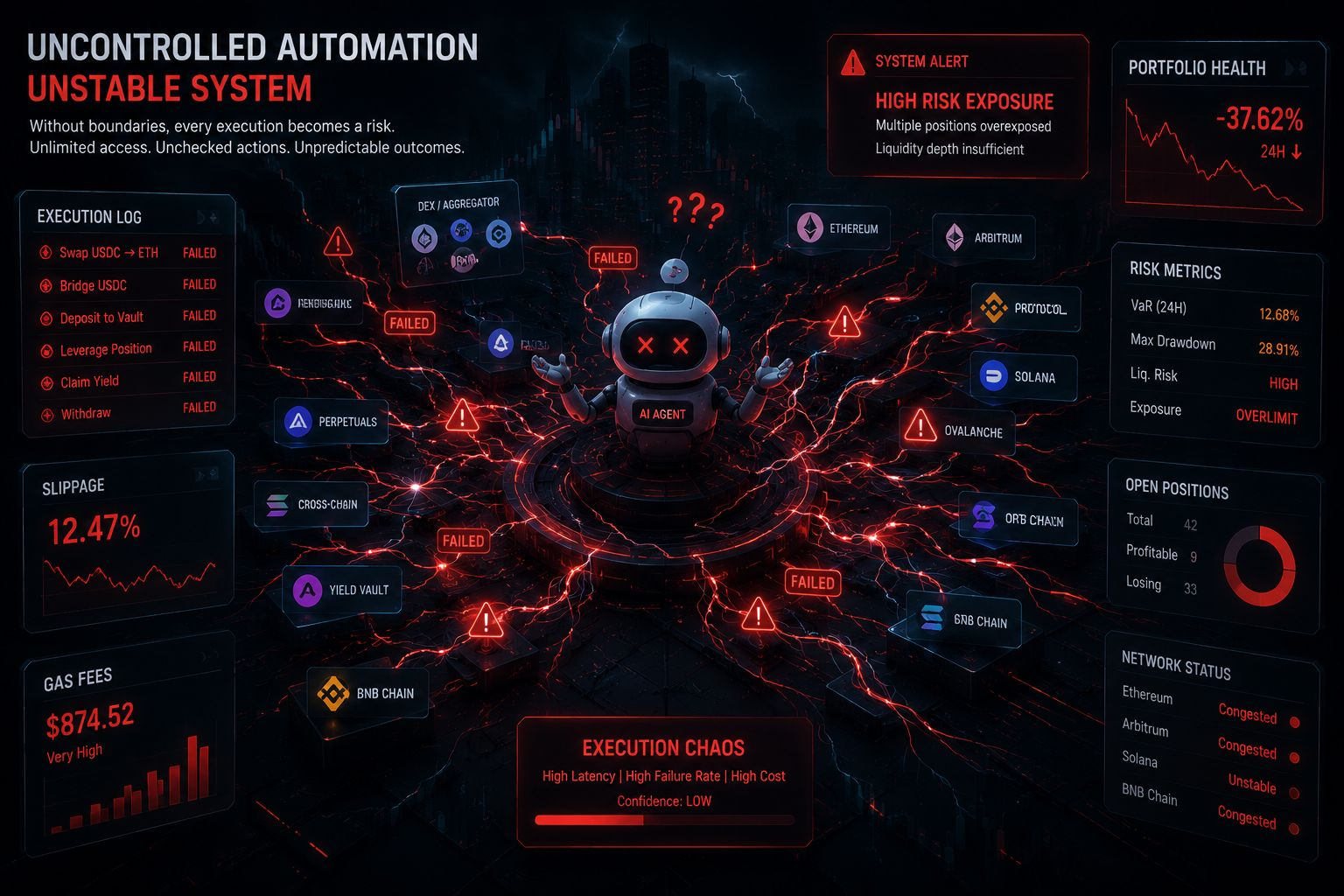
The deeper I look into modern crypto infrastructure, the more I feel the industry quietly realized something uncomfortable:
Unlimited optimization eventually becomes dangerous.
Especially when machines operate faster than humans can supervise.
That realization is probably why so many systems are now evolving toward constraints instead of pure freedom.
But now I’m starting to think those invisible control layers may become more important than the intelligence itself.
Take smart accounts for example.
The old wallet model assumed access and authority were basically the same thing. If a system received permission, it often inherited enormous control over capital.
Newer architectures are moving away from that completely.
Session keys can restrict how much an agent spends, what assets it interacts with, how long permissions remain active, and which actions stay permanently blocked. Suddenly automation no longer requires exposing the entire wallet environment.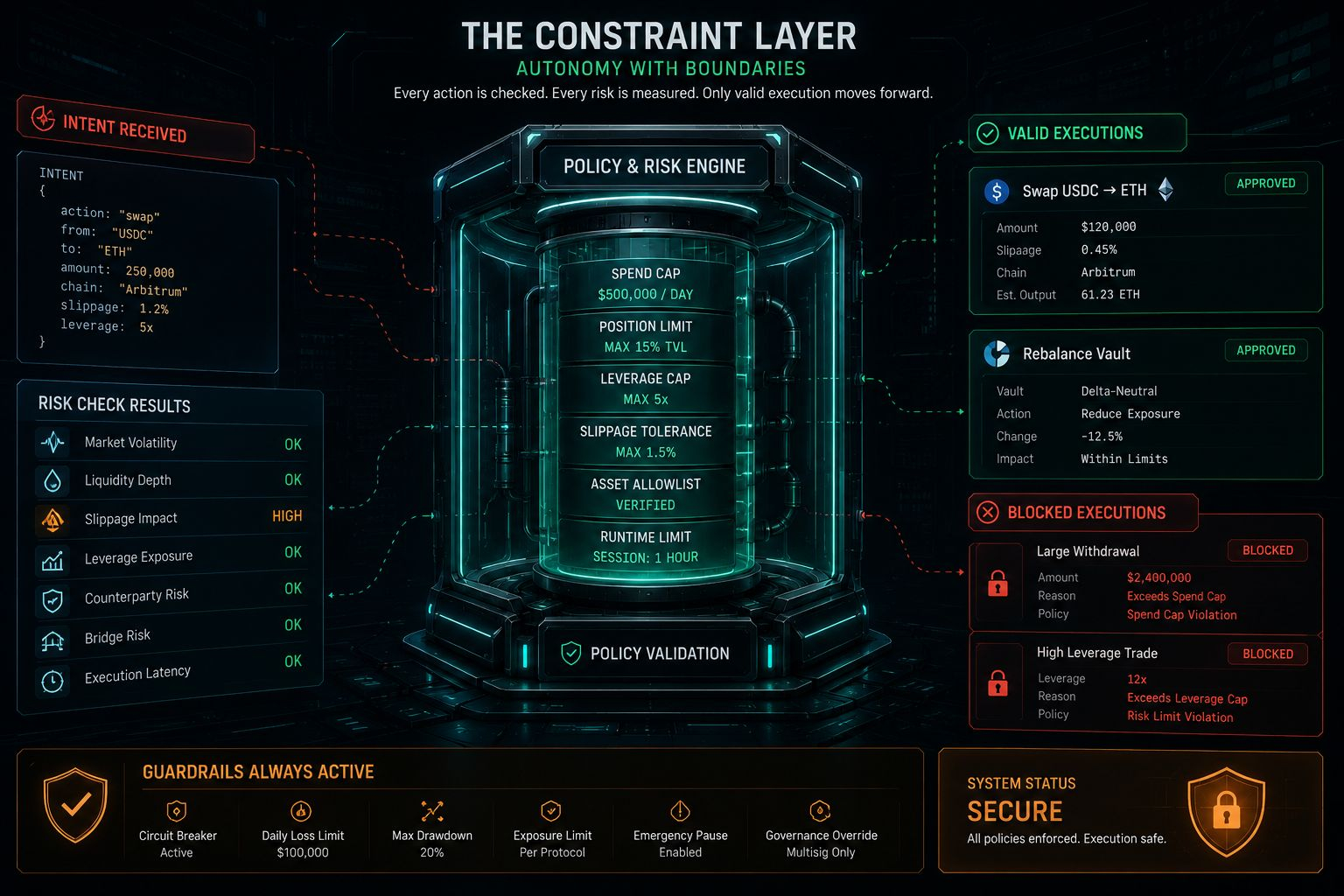
That shift toward programmable execution permissions feels much closer to infrastructure design than traditional wallet design.
The same shift is happening inside execution systems too.
Intent-based infrastructure separates desired outcomes from transaction construction. Solver networks compete to fulfill execution conditions while policy systems validate whether actions stay inside predefined boundaries before settlement occurs.
Even vault architecture is evolving in this direction.
ERC-4626 standardized how capital behaves mechanically, but newer allocation systems increasingly focus on controlling how autonomous strategies operate under changing conditions. Exposure limits, slippage tolerances, liquidity requirements, leverage ceilings, and execution gating are becoming core infrastructure components rather than optional safety features added afterward.
What interests me is that these systems are not reducing autonomy.
They are shaping it.That distinction matters a lot.
A trading agent with unlimited authority is not necessarily advanced infrastructure. In many cases it is simply unstable infrastructure waiting for market stress to expose weaknesses.
The stronger systems seem to be the ones designed around bounded behavior from the beginning.
That idea keeps showing up everywhere now.
Pre-execution validation layers simulate transactions before execution. Risk engines evaluate liquidity conditions dynamically. Smart accounts enforce programmable limits directly onchain. Attribution systems bind model identity and policy state to execution records. Adaptive capital systems rotate liquidity continuously while staying inside predefined risk parameters.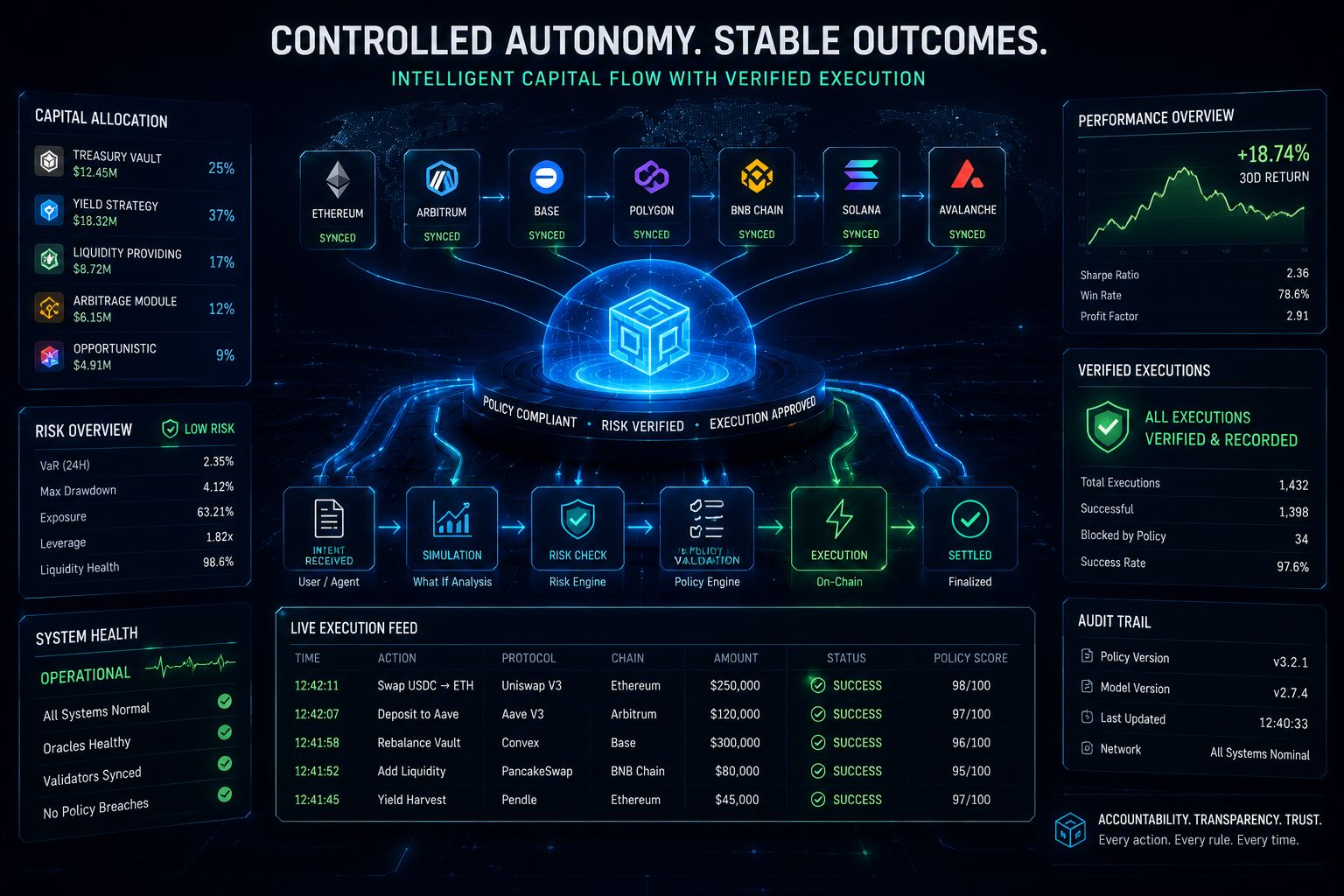
Individually, these all look like separate technical improvements.
Together, they start looking like an entirely different philosophy for autonomous finance.
The goal no longer seems to be creating systems capable of doing everything possible.
The goal is creating systems capable of operating safely without requiring constant human intervention.
That’s a much harder problem.
Especially once AI agents begin interacting economically with each other at larger scale.
Because eventually intelligence alone stops being enough. Coordination becomes more important. And coordination without boundaries becomes fragile very quickly.
That’s part of why infrastructure projects like @OpenLedger stand out to me right now.
The direction feels less focused on unrestricted autonomy and more focused on making autonomous execution verifiable, constrained, and survivable under real market conditions.
Attribution tracking. Execution commitments. Runtime constraints. Policy enforcement. Verifiable execution records. Permission architecture.
Those things sound less exciting than giant AI demos, but I suspect they become much more important once autonomous systems leave controlled environments and enter real financial networks.
And honestly, I don’t think the market fully understands that transition yet.
Crypto spent years trying to remove every restriction possible.
Now it feels like the next generation of infrastructure is being built around deciding which restrictions should never disappear in the first place.