
A few nights ago, I was thinking about something strange.
AI is becoming more powerful every month.
Models can now write articles, generate code, analyze markets, create videos, summarize research, and even interact like digital workers. Entire industries are reorganizing around AI infrastructure.
But despite all that progress, one question kept bothering me:
Who actually owns the value AI creates?
At first, the answer seems obvious.
The companies building the models.
But the deeper I looked, the less complete that answer felt.
Because no AI system exists on its own.
Behind every powerful model is an invisible network constantly feeding it.
People generating data.
Developers building tools.
Communities creating content.
Users training systems through interaction.
Infrastructure providers running computation.
AI looks centralized on the surface.
But underneath, it’s already deeply collective.
The strange part is that most contributors inside that ecosystem never truly participate in the upside they help create.
Their data improves the models.
Their activity strengthens the systems.
Their interactions increase the value of the platforms.
Yet ownership usually stays concentrated in a small number of companies.
And I think that imbalance may become one of the biggest structural problems in AI over the next decade.
That’s where OpenLedger started feeling interesting to me.
Not because it promises some magical AI breakthrough.
But because it approaches AI from a completely different angle.
Instead of asking:
“How do we build smarter models?”
It asks:
“How do we build a fairer AI economy?”
That distinction changes everything.
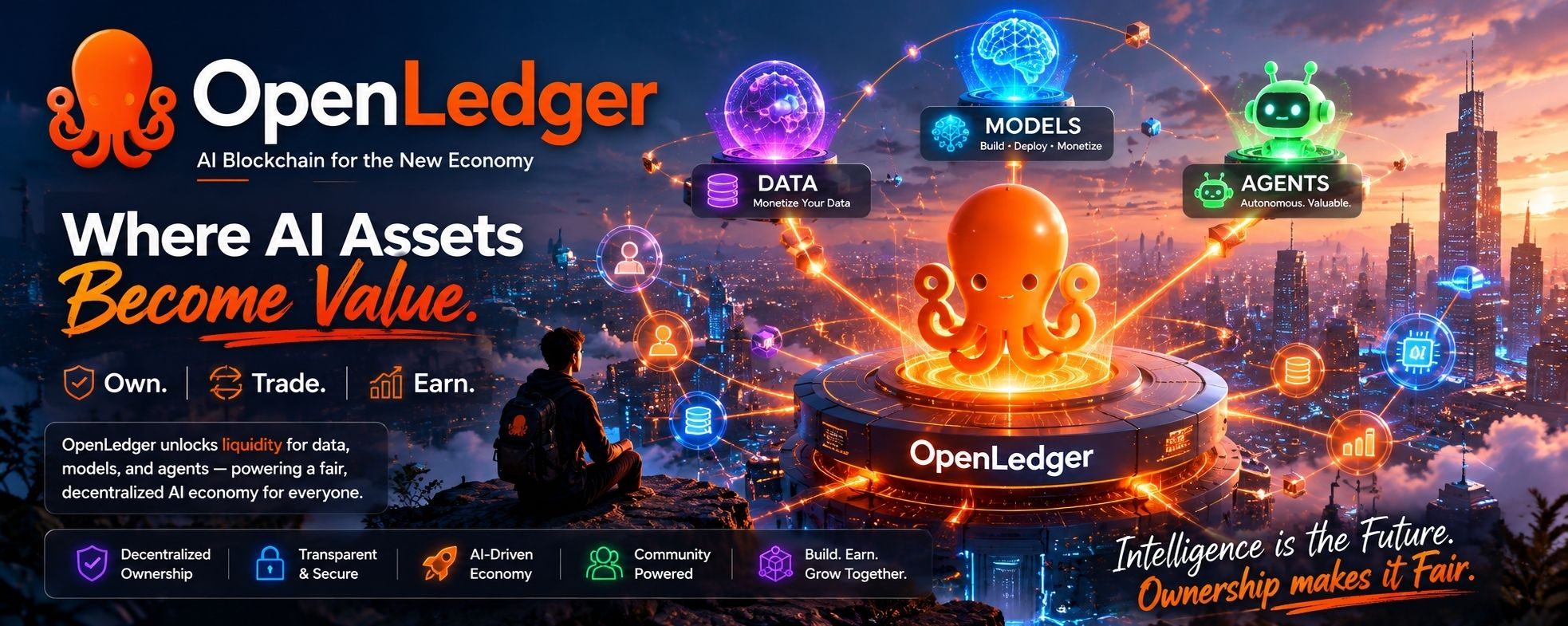
@OpenLedger is built around the idea that AI assets should become economically visible.
Data.
Models.
Agents.
Contributions.
Rather than disappearing into closed systems, they can become part of an open network where ownership and rewards are programmable.
The first time I understood this properly, it reminded me less of a traditional AI startup and more of financial infrastructure.
Because what OpenLedger is really trying to unlock is liquidity.
Not liquidity around tokens alone.
Liquidity around intelligence itself.
That idea sounds abstract at first.
But the implications are huge.
Today, most AI systems behave like isolated black boxes.
You use the product.
The company captures the value.
The ecosystem around it remains mostly invisible.
OpenLedger flips that structure.
A dataset can become monetizable.
A specialized model can become monetizable.
An AI agent can become monetizable.
Instead of existing only as internal company resources, these components become active participants inside a decentralized economy.
That’s important because the future of AI probably won’t revolve around one giant model controlling everything.
It will likely involve networks of specialized systems interacting constantly.
Some agents will gather information.
Some will execute workflows.
Some will coordinate transactions.
Others will provide reasoning, automation, or analytics.
AI starts looking less like software and more like an ecosystem of digital participants.
And ecosystems need infrastructure.
Especially economic infrastructure.
That’s the part many people still underestimate.
As AI agents become more autonomous, they also become more economically relevant.
An agent may eventually pay another agent for data access.
A model may license its capabilities automatically.
Applications may coordinate services across decentralized networks without direct human involvement.
Traditional internet infrastructure was never designed for machine-native economies.
It was designed for websites and human interaction.
But AI changes the scale of coordination entirely.
OpenLedger seems to be positioning itself around that transition.
The blockchain layer is not there simply for branding.
It acts as the coordination system underneath the AI economy.
Ownership can be tracked transparently.
Contributions can be attributed.
Rewards can be distributed programmatically.
Transactions between agents can occur without relying entirely on centralized intermediaries.
That creates a different structure of trust.
Instead of value flowing upward into closed platforms, value can circulate across the network itself.
And that changes incentives.
Developers are incentivized to build.
Data providers are incentivized to contribute.
Agent creators are incentivized to innovate.
The network becomes stronger because participation itself becomes economically meaningful.
Of course, building this kind of infrastructure is difficult.
Scalability matters.
Governance matters.
Security matters.
Incentive systems must resist manipulation.
But these are the kinds of problems every foundational infrastructure layer eventually faces.
Financial systems needed settlement layers.
The internet needed communication protocols.
Cloud computing needed shared standards.
AI may now be reaching the stage where it needs economic coordination layers too.
Because the bigger AI becomes, the harder it becomes to ignore the question underneath it all:
Who actually benefits from the intelligence being created?
That’s why OpenLedger feels interesting beyond the usual AI narratives.
It’s not trying to replace intelligence.
It’s trying to organize the economy around intelligence.
And in the long run, that may become just as important as the models themselves.
Because the future AI economy probably won’t belong only to whoever builds the smartest system.
It may belong to the networks capable of distributing ownership, incentives, and value across everyone helping that intelligence evolve.
