
I Have Noticed that Most blockchain infrastructure was built around a simple assumption: capital is the primary resource that matters.
The architecture of decentralized finance reflects this belief. Liquidity pools, lending markets, staking systems, and governance frameworks are all designed around the movement and allocation of capital. Over time, this has produced increasingly sophisticated financial primitives, but it has also revealed a deeper limitation. Capital alone is not a sufficient foundation for sustainable network growth.
Many of the structural problems that continue to appear across DeFi stem from this reality.
Protocols compete aggressively for liquidity, often subsidizing participation through token emissions. Users provide capital not because they believe in the long-term utility of a network, but because short-term rewards temporarily outweigh perceived risks. Governance systems struggle with participation because most token holders have little incentive to engage deeply with complex decisions. Treasury growth frequently depends on market appreciation rather than productive economic activity. In many cases, ecosystems become dependent on reflexive loops where token value supports activity and activity supports token value.
These systems can function during favorable market conditions. They become considerably more fragile when attention shifts elsewhere.
What remains largely underexplored is the possibility that blockchains should be designed around productive digital assets beyond capital itself.
This is where OpenLedger introduces an interesting departure from conventional infrastructure design.
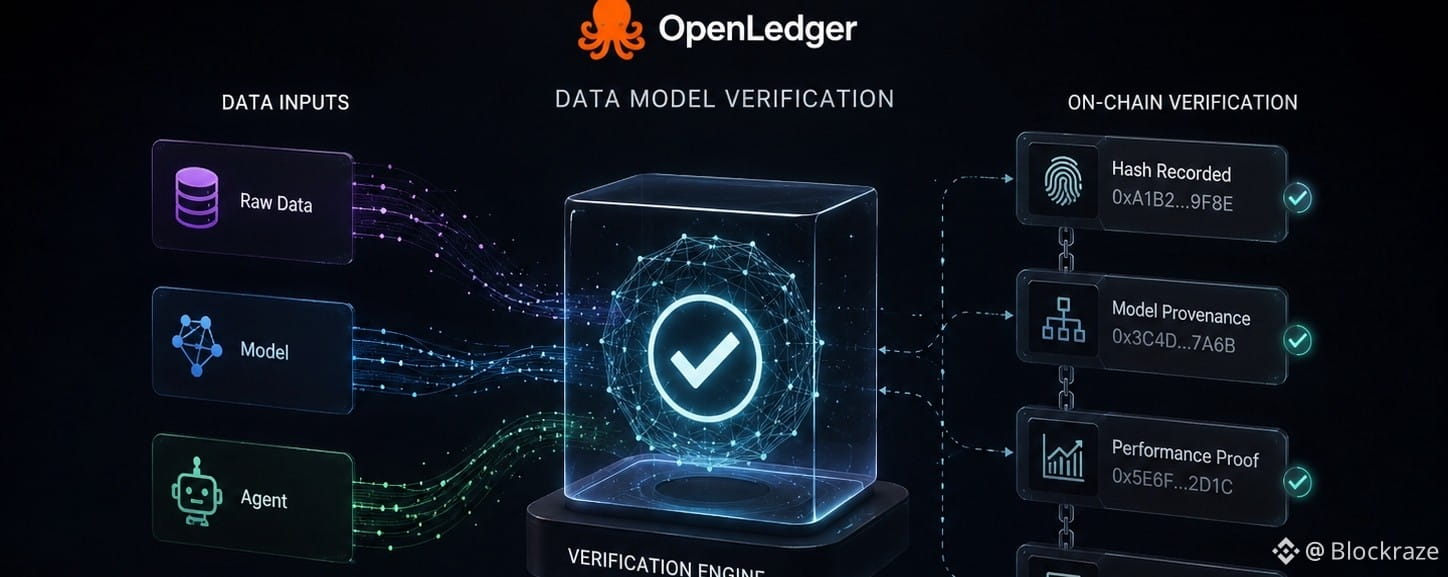
Rather than treating intelligence as something external to the blockchain, OpenLedger approaches AI as a native economic participant. The protocol is structured around the idea that data, models, and autonomous agents are not merely applications running on top of a network. They are economic resources that can be owned, exchanged, coordinated, and monetized directly on-chain.
The distinction appears subtle at first, but its implications are significant.
The Missing Economic Layer in AI
The rapid growth of artificial intelligence has created enormous demand for three resources:
Data
Models
Computational intelligence
Yet ownership and value capture remain heavily concentrated.
Data contributors rarely participate in the long-term value generated from their contributions. Model creators often depend on centralized platforms for distribution and monetization. Agent developers frequently operate within ecosystems where ownership rights, revenue streams, and operational transparency are difficult to verify.
As a result, AI development increasingly relies on infrastructure that separates contribution from reward.
The blockchain industry has attempted to address fragments of this problem before. Data marketplaces emerged. Decentralized compute networks appeared. Tokenized AI projects launched. Most focused on individual components of the value chain rather than the economic coordination layer connecting them.
OpenLedger's design reflects a broader observation: intelligence itself is becoming a productive asset class.
If AI systems increasingly participate in economic activity, then the infrastructure supporting them requires mechanisms for attribution, ownership, revenue distribution, and interoperability.
Traditional blockchains were not specifically designed for this purpose.
Why On-Chain Participation Matters
A recurring challenge within digital economies is the inability to accurately measure contribution.
In many systems, value creation occurs through invisible processes. Data contributors are difficult to identify. Model improvements are hard to attribute. Agent performance is often opaque. Revenue distribution becomes dependent on intermediaries rather than verifiable economic records.
When contribution cannot be measured effectively, incentives become distorted.
Participants focus on extractive behaviors because productive behaviors are difficult to reward.
OpenLedger's decision to place model training, agent deployment, and economic coordination directly on-chain can be interpreted as an attempt to solve this attribution problem.
The significance is not merely transparency.
Transparency alone rarely creates durable incentives.
The more important outcome is the ability to establish clear economic relationships between inputs and outputs. If contributors can be identified with precision, then compensation mechanisms become easier to design. If model usage can be tracked, revenue sharing becomes more credible. If agents operate within verifiable environments, their economic activity becomes measurable rather than speculative.
These are foundational requirements for productive digital economies.
Without them, most AI ecosystems remain dependent on trust assumptions that ultimately reintroduce centralization.
Beyond Liquidity Mining
One of the less discussed weaknesses of DeFi is that many protocols struggle to generate value independently of financial activity.
Liquidity generates trading volume.
Trading volume generates fees.
Fees support token valuations.
Token valuations attract liquidity.
The cycle is effective but inherently reflexive.
The challenge emerges when growth depends primarily on financial participation rather than productive output.
OpenLedger introduces a different economic direction.
Instead of asking participants to contribute only capital, the network creates pathways for contributing intelligence-related resources. Data, models, and agents become productive inputs capable of generating economic activity beyond simple asset exchange.
This matters because productive systems tend to be more resilient than purely financial systems.
A lending market without borrowers eventually loses relevance.
A liquidity pool without traders becomes inactive.
An intelligence network that supports useful models and functioning agents can continue generating utility independent of speculative cycles.
The distinction is important because it shifts the conversation from capital allocation toward value creation.
Ethereum Compatibility as a Strategic Decision
OpenLedger's alignment with Ethereum standards may appear like a technical implementation detail, but it reflects a broader strategic philosophy.
Many blockchain projects attempt to solve adoption challenges by creating isolated ecosystems.
The result is often fragmentation.
Users manage additional wallets. Developers learn new architectures. Liquidity becomes scattered. Infrastructure providers face increased integration costs.
History suggests that isolated ecosystems frequently underestimate the value of compatibility.
By maintaining alignment with Ethereum standards and existing wallet, smart contract, and Layer 2 infrastructure, OpenLedger reduces the friction associated with participation.

More importantly, it avoids a common mistake seen throughout crypto infrastructure development: assuming superior technology automatically compensates for weaker integration.
Networks rarely succeed because they exist.
They succeed because they fit naturally into broader economic systems.
Compatibility is therefore not merely a developer convenience. It is a recognition that infrastructure adoption depends heavily on reducing coordination costs.
The Emergence of Machine Economies
Perhaps the most interesting aspect of OpenLedger is not what it enables today, but what it anticipates.
Much of blockchain design still assumes humans remain the primary economic actors.
