
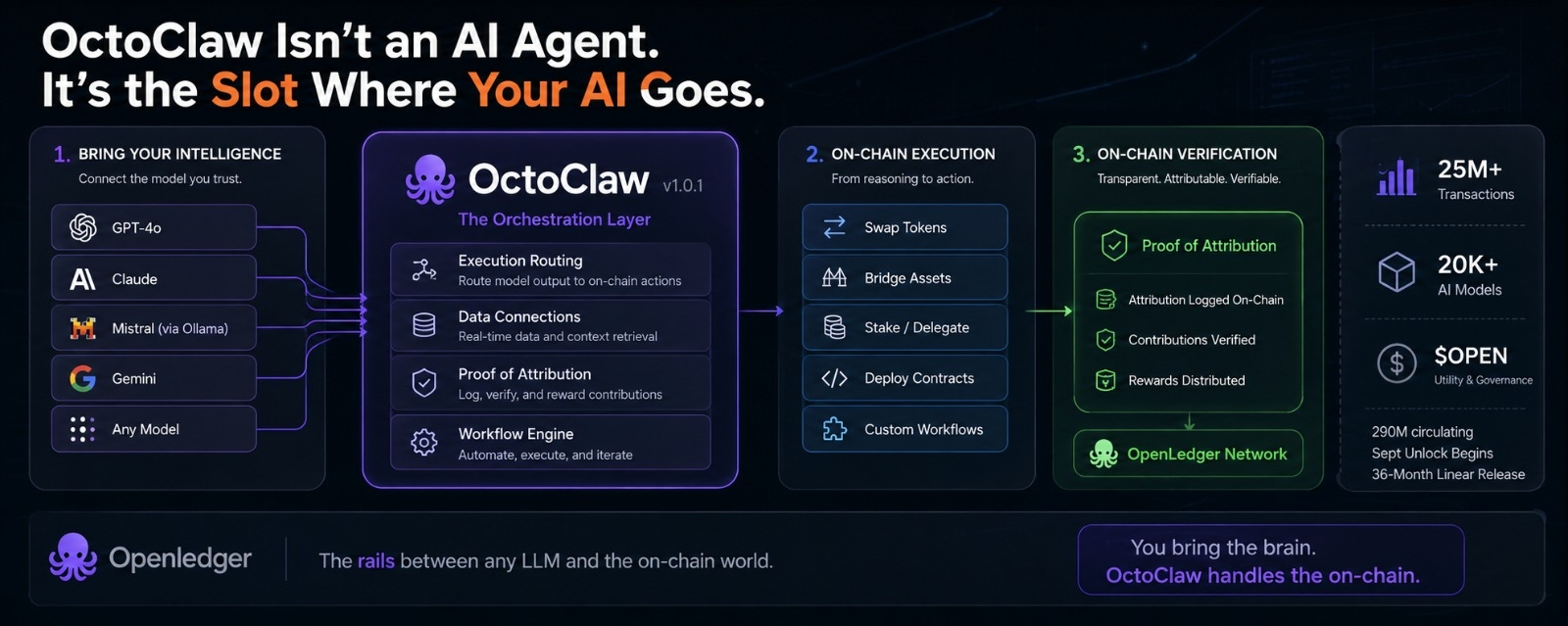
Market had that stale energy this week. $OPEN up about 13.7% over seven days while the wider crypto market bled somewhere around 3.7%, and I couldn't figure out what the actual catalyst was. I wasn't watching charts obsessively. I'd downloaded the OctoClaw v1.0.1 build that @OpenledgerHQ pushed on May 6 and just started running through it — not expecting much, honestly. The announcement tweet pulled 42 likes. Doesn't exactly scream momentum event.
So I opened it. MacOS desktop app, clean enough interface. And the very first thing it puts in front of you is not an agent doing anything. It's a configuration prompt. Choose your provider. Choose your model. Set the intelligence layer that powers your agent's decisions and execution.
I actually stopped there. I thought the friction-reduction pitch was about collapsing tools. It partially is. But I hadn't quite processed what it means that the intelligence itself is the thing you're supposed to bring.
Here's the thing I think most people are getting wrong about OctoClaw. Every write-up frames it as OpenLedger's AI agent for Web3 automation. Unified. Seamless. The multi-tool problem solved. And at surface level that reads correctly — you do get research, execution, and on-chain workflows inside one interface instead of duct-taping together a data terminal, a wallet, and a reasoning tool. The friction reduction is real in that narrow sense.
But OctoClaw doesn't contain an AI. It contains the place where your AI goes. Wire in GPT-4o, Claude, a local Mistral model via Ollama, whatever — and then OctoClaw acts as the orchestration layer that routes your chosen model's output into on-chain execution. The agent behavior you see is a function of the model you configured, not something OpenLedger built into the product.
Which means OpenLedger isn't actually competing in the AI race. Not directly. What they built is the abstraction layer between any capable LLM and the on-chain environment — the execution routing, the data retrieval connections, the attribution logging through Proof of Attribution. The intelligence is treated as interchangeable. The rails are the product.
That framing changes the whole evaluation. OpenLedger reported 25 million transactions and 20,000 AI models on its network heading into the TGE. Whether or not those numbers reflect current live activity, the bet the architecture is making is that the value in AI automation will concentrate at the layer that makes models actionable on-chain — not at the layer that builds the models. You swap out the reasoning engine, the execution layer stays. That's a durable bet if it holds.
But here's the part I keep circling back to. The BYOLLM design is elegant. It's also a dependency structure OpenLedger can't fully control. The major LLM providers — OpenAI, Anthropic, Google — have been quietly building more of their own execution tooling. If those providers start offering native on-chain connectors, or if a vertically integrated agent framework comes along where the model, the wallet interaction, and the attribution mechanism are all inside one product, OctoClaw becomes a layer people route around rather than through.
The modular case is that no single model wins and OpenLedger's model-agnostic positioning stays valuable indefinitely. The fragile case is that the infrastructure bet assumes the intelligence and execution layers stay separate — and there's no guarantee of that.
I also keep thinking about the timeline. With 290 million $OPEN tokens already circulating and the September unlock starting a 36-month linear release for team and investors, there's a specific pressure on every product drop between now and then. OctoClaw needs to show that the on-chain execution layer has real pull before that supply dynamic starts compressing the price. A 42-like launch tweet doesn't tell you much about developer adoption, but it tells you something about where retail attention currently is.
Maybe the real uptake is quieter. Developer tools often are. A team integrating OctoClaw into their stack doesn't announce it on X.
I'm not fully convinced this holds under the pressure coming in Q3. But I'm also not sure the "AI agent" framing anyone else is using for this product actually describes what OpenLedger built. What they built is a slot. A well-designed, on-chain-connected, attribution-aware slot. Whether that's the most important layer in Web3 automation or the most skippable one probably depends on decisions being made at OpenAI and Anthropic right now, not at OpenLedger.
Anyway. $OPEN still sitting at $0.18 and the market still looks unsettled. I'll watch how developer activity on OctoClaw shapes up over the next few weeks before I settle on any of this.