Most people still misunderstand where the real value in AI comes from.
They look at the industry and see giant models, massive GPU clusters, endless funding rounds, and they assume the future belongs to whoever controls the most compute. That is why so many crypto projects keep building the same thing over and over again — decentralized cloud layers, tokenized compute markets, endless infrastructure narratives dressed up as innovation.
But the deeper problem in AI was never just computation.
It is ownership.
Not ownership in the corporate sense. Ownership in the human sense. Who actually gets recognized when intelligence is created. Who benefits when a system becomes valuable after thousands of invisible contributions shaped it behind the scenes.
Because that is the uncomfortable truth nobody talks about enough.
Modern AI is built on layers of unpaid memory.
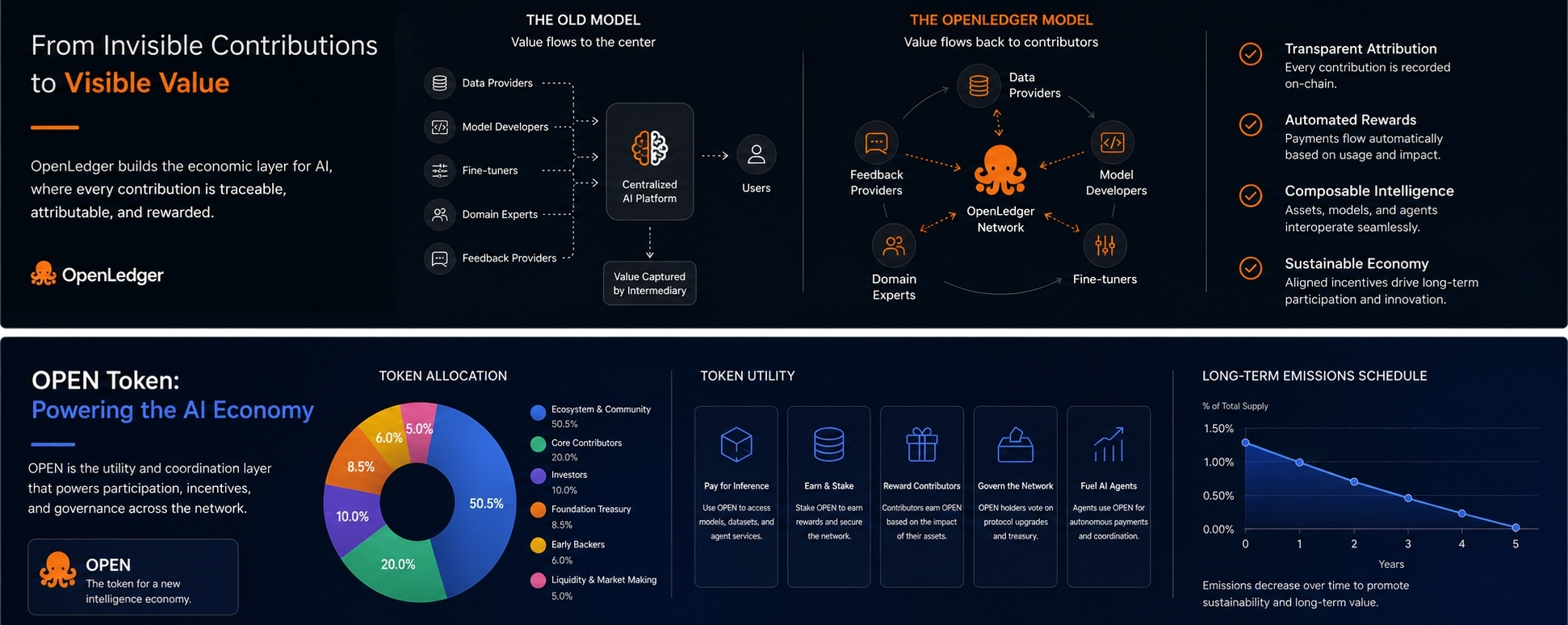
The data came from people. The corrections came from people. The niche expertise came from people. Entire industries unknowingly trained systems that may eventually replace parts of them, yet almost none of that value flows back to the source. Everything gets absorbed upward into a few centralized platforms while the contributors disappear into the background like they never mattered.
OpenLedger feels important because it starts exactly where this imbalance begins.
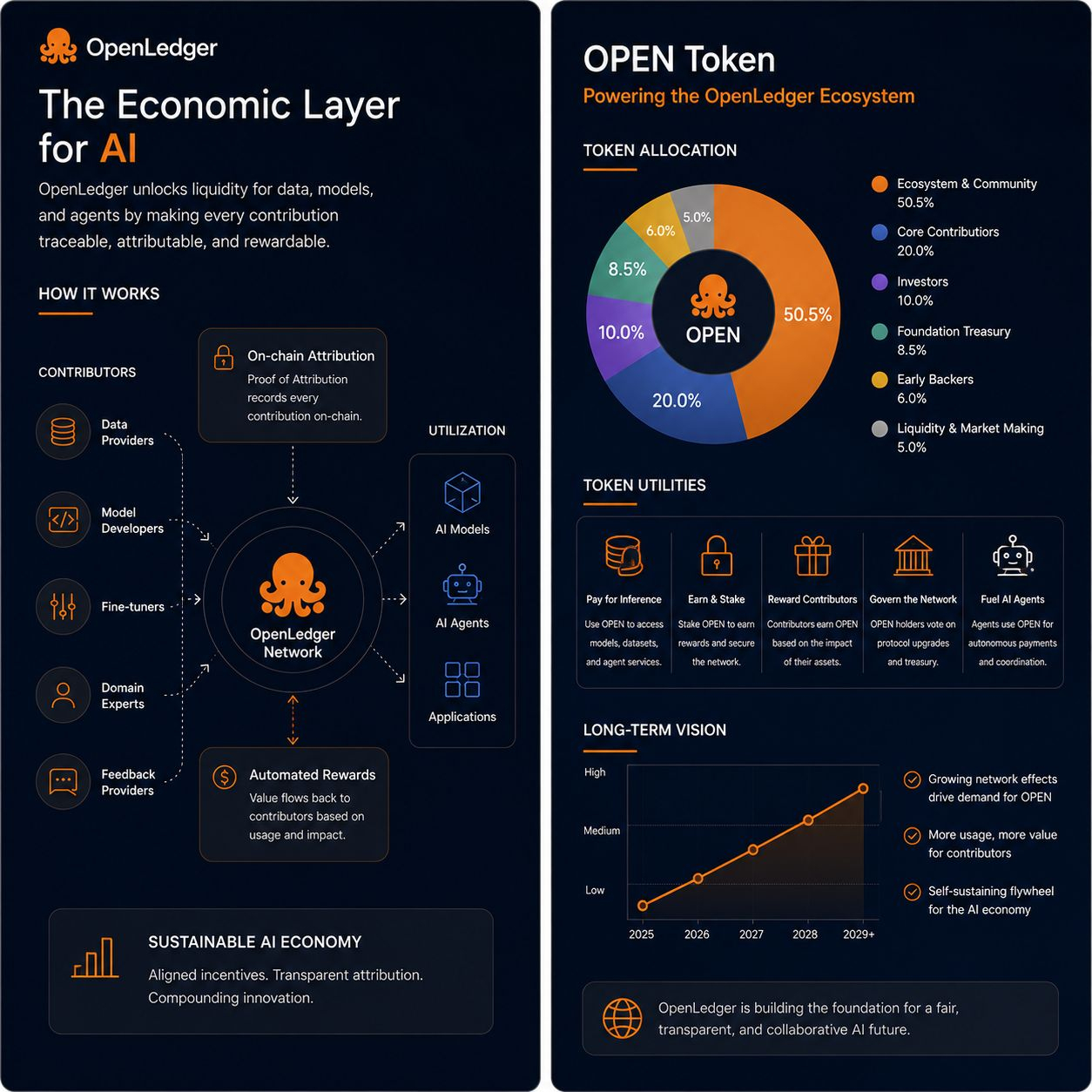
The project is not really trying to build another AI company. It is trying to build a system where intelligence carries economic history with it. A model output is no longer treated like magic appearing out of nowhere. It becomes the result of countless upstream contributions that can finally be tracked, measured, and rewarded instead of erased.
That changes the meaning of the blockchain completely.
In most AI crypto projects, the chain feels unnecessary. A token searching for relevance. Here, the ledger actually matters because the entire idea depends on attribution existing at scale. Without transparent settlement and persistent contribution tracking, the whole system collapses back into the same extraction model the AI industry already runs on today.
And honestly, that is what makes OpenLedger more interesting than most people realize.
The project is quietly betting on something much bigger than hype cycles. It is betting that the future of AI will become too fragmented for centralized ownership models to hold everything together forever.
That sounds abstract until you really look at where the industry is moving.
A few years ago, everyone believed intelligence would consolidate into a handful of giant foundation models. Bigger models. Bigger funding. Bigger monopolies. But that future already feels less certain now. Specialized models are exploding everywhere. Lightweight fine tuning is reducing barriers faster than expected. AI agents are combining tools and models dynamically instead of relying on one closed system to do everything.
Intelligence is starting to break apart into smaller moving pieces.
And once that happens, coordination becomes the real challenge.
Who owns the value when ten systems contribute to one outcome. Who gets paid when an agent combines datasets, models, APIs, and behavioral feedback from different sources simultaneously. How do you build an economy around intelligence when intelligence itself becomes modular.
That is the problem OpenLedger is really trying to solve.
Not replacing OpenAI.
Not winning headlines.
Not becoming the loudest AI chain in crypto.
It is trying to build the accounting layer for a world where intelligence no longer belongs to one company at a time.
That is a much more serious idea than most people are pricing in.
What makes this even more fascinating is that the market still treats attribution like a secondary feature when it may eventually become the entire foundation of the industry. The legal pressure alone is already building toward that direction. Copyright disputes are accelerating. Enterprises increasingly care about traceability. Regulators are slowly moving toward systems where provenance matters.
The AI industry spent years acting like data ownership was a philosophical debate. It is becoming an economic one now.
And OpenLedger seems early to that realization.
But this is also where the uncomfortable questions begin.
Because the vision only works if attribution itself can actually function in the real world. And that is far harder than it sounds. Neural systems are messy. Influence inside models is not clean or linear. You cannot perfectly isolate which dataset shaped which output in the same way you can trace royalties in music.
At some point, attribution becomes approximation.
And approximation creates tension.
If contributors stop believing the reward system is fair, behavior changes immediately. People stop optimizing for usefulness and start optimizing for extraction. Every incentive system eventually teaches participants how to game it. Crypto has proven that over and over again.
That is one of the biggest risks sitting underneath OpenLedger.
The other risk is more subtle.
Some of the most valuable intelligence in the world is private by nature. Enterprise data. Financial workflows. Healthcare systems. Proprietary behavior patterns. These are not assets companies casually expose inside open ecosystems.
So OpenLedger eventually has to walk a very difficult line.
Too much transparency and institutions never fully trust it.
Too much permissioning and it slowly becomes another closed system wearing decentralized branding.
That balance may determine everything.
The token model also deserves more attention than people give it. In many AI crypto projects, the token feels disconnected from reality. A speculative layer attached to infrastructure that would function almost the same without it. OPEN is more deeply woven into the actual mechanics of the network. Participation, deployment, coordination, inference, incentives — everything feeds back into the token economy.
That creates stronger alignment.
But it also creates pressure.
Because the system only becomes sustainable if real demand eventually exists underneath the speculation. If actual usage does not grow meaningfully, then the economy risks becoming circular — contributors earning tokens mainly because newer participants expect future growth rather than because real value is being generated.
That distinction is everything.
Crypto has a long history of looking alive long before it becomes useful.
OpenLedger still has to prove the difference.
And yet, despite all the uncertainty, there is something unusually grounded about the project compared to most narratives in this sector. It is not trying to convince the world that decentralized AI will suddenly overthrow the largest labs on Earth. It is addressing something much more practical and, in some ways, much more inevitable.
If intelligence becomes collaborative, then value distribution eventually has to become collaborative too.
There is no way around that forever.
In fact, the most contrarian possibility is that OpenLedger becomes more important precisely when nobody notices it anymore. The market keeps imagining success as dominance — massive ecosystems, loud branding, endless visibility. But some of the most powerful infrastructure in technology becomes invisible once it works properly.
Nobody thinks emotionally about the protocols moving information across the internet.
They just rely on them every day.
OpenLedger may end up following the same path. Quiet infrastructure sitting underneath future AI systems, handling attribution, value flow, and contribution accounting automatically while users barely think about the blockchain itself.
Ironically, that may be the strongest sign of success.
Because at its core, this project is not really about AI hype at all.
It is about what happens to ownership when intelligence stops being created by a single entity and starts emerging from networks of contributors, systems, agents, and data flows interacting constantly in the background.
That future feels closer than most people realize.
And if it arrives the way OpenLedger expects, the projects focused only on compute may end up solving the wrong problem entirely.