
I honestly think most people are looking at AI the wrong way right now.
A few nights ago I reopened an old AI chat because I needed a research note I saved during a latenight market session. The model completely lost the context 😭
Same chat. Same workflow. But the continuity was gone.
And weirdly… that frustration made me think harder about infrastructure than model intelligence itself.
Because the model wasn’t “dumb.” The system around it just failed.
That reminded me of something completely unrelated:
The moment I stopped buying CDs.
Not because I suddenly became “bullish” on streaming 😂 I just realized one day my CD shelf had basically become decoration.
Spotify already gave me everything instantly. Songs. Recommendations. Playlists. Discovery. Zero friction.
And looking back now, that tiny behavioral shift completely changed the music industry.
People thought music companies were selling songs.
But the real value quietly moved somewhere else: the system around the songs.
Convenience. Coordination. Personalization. Keeping users inside an experience that just worked.
And honestly… I think AI is moving toward the exact same outcome.
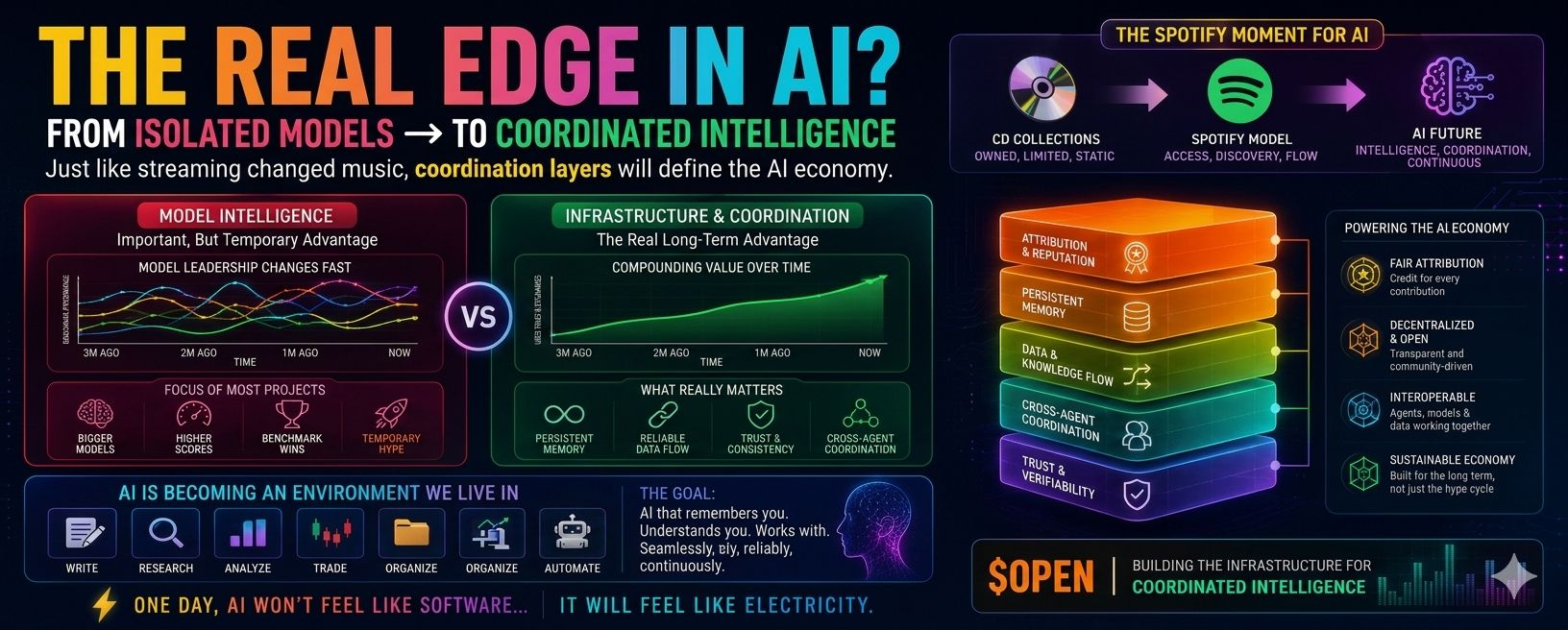
Right now everybody is obsessed with: GPT vs Claude vs Gemini. Benchmarks. Reasoning scores. Who’s “winning.”
But let’s be real for a second:
Can anybody even remember who was dominating AI benchmarks like 3 months ago? 😅
Everything changes weekly now.
New models. New launches. New hype cycles.
The real long-term advantage probably won’t come from temporary benchmark wins alone.
It’ll come from building systems people quietly depend on every single day.
That’s a completely different game.
Because AI is no longer just a tool people occasionally use.
It’s becoming an environment people stay inside.
I use AI while writing. While researching trades. While organizing ideas. Sometimes while multitasking through 15 tabs with coffee going cold beside me at 2am 😂
The interaction never really stops anymore.
And once AI becomes continuous like that, something more important than raw intelligence starts to matter:
Coordination.
Because even the smartest model feels terrible when the surrounding system keeps breaking.
We’ve all experienced it already: memory randomly disappears, context resets, responses become inconsistent, agents stop syncing properly, outputs start feeling unreliable.
Most people blame the model itself.
But honestly, I’m starting to think the bigger challenge is the invisible coordination layer underneath everything.
Persistent memory. Reliable data flow. Attribution. Cross-agent coordination. Trust. Consistency over time.
The boring stuff nobody talks about during flashy AI demos.
That’s actually why @OpenLedger caught my attention recently.
Most AI projects focus heavily on: “our model is faster” “our agents are smarter” “our automation is more powerful”
Cool. That matters.
But model leadership is becoming insanely temporary.
Infrastructure durability feels much harder to replicate.
Spotify didn’t win because music suddenly became better.
Music was already everywhere.
Spotify won because access became frictionless.
Everything worked together smoothly enough that people stopped thinking about the system itself.
I think AI eventually becomes the same kind of market.
Most users won’t care which model ranks #1 on a benchmark next year.
They’ll care about: Which AI remembers them properly. Which workflow feels smoothest. Which platform integrates naturally into daily life. Which system feels reliable enough to trust repeatedly.
In other words:
The moat may shift from isolated intelligence → coordinated intelligence.
And honestly, I think a lot of AI projects are underestimating how fragile trust really is.
If Netflix buffers constantly, users leave. If Spotify recommendations become terrible, users notice immediately. And if AI systems lose reliability too often, trust disappears FAST.
That’s why infrastructure suddenly matters so much.
Ironically, users never notice good coordination systems. They only notice broken ones.
And to be fair, I also changed my mind on something recently.
I used to think coordination layers would eventually matter more than the models themselves.
Now I think that take was too extreme.
Because if the intelligence itself feels weak, nobody stays anyway.
You can build perfect infrastructure, perfect memory, perfect attribution systems…
…but if the model outputs bad results, users eventually leave.
It’s like having the world’s smoothest music app filled with terrible songs 😂
The model is still the engine.
Infrastructure just determines whether people enjoy staying inside the experience long enough to build habits around it.
And honestly, I think that’s where the AI economy is quietly heading.
Not toward standalone models people occasionally test for fun.
But toward intelligent systems people slowly build parts of their lives around without even realizing it.
The scary part?
Most people probably won’t notice this shift happening until it’s already normal.
Just like streaming.
One day AI may stop feeling like software entirely…
…and start feeling more like electricity.
Always there. Always running quietly in the background.