
Most people still talk about AI as if the model is the product.
A better model...A smarter model....A faster model.
But after spending time studying @OpenLedger , I think the more important question sits somewhere else entirely.
What happens when AI starts participating in the movement of capital?
Not recommending.
Not suggesting.
Actually participating.
That future sounds distant until you look at how much of the financial stack is already becoming automated.
Liquidity is routed automatically.Vaults rebalance positions automatically.
Crosschain systems search for efficient paths automatically.
Market-making systems continuously adjust exposure without human intervention.
The next evolution is not difficult to imagine.
Agents making decisions about where capital should go.
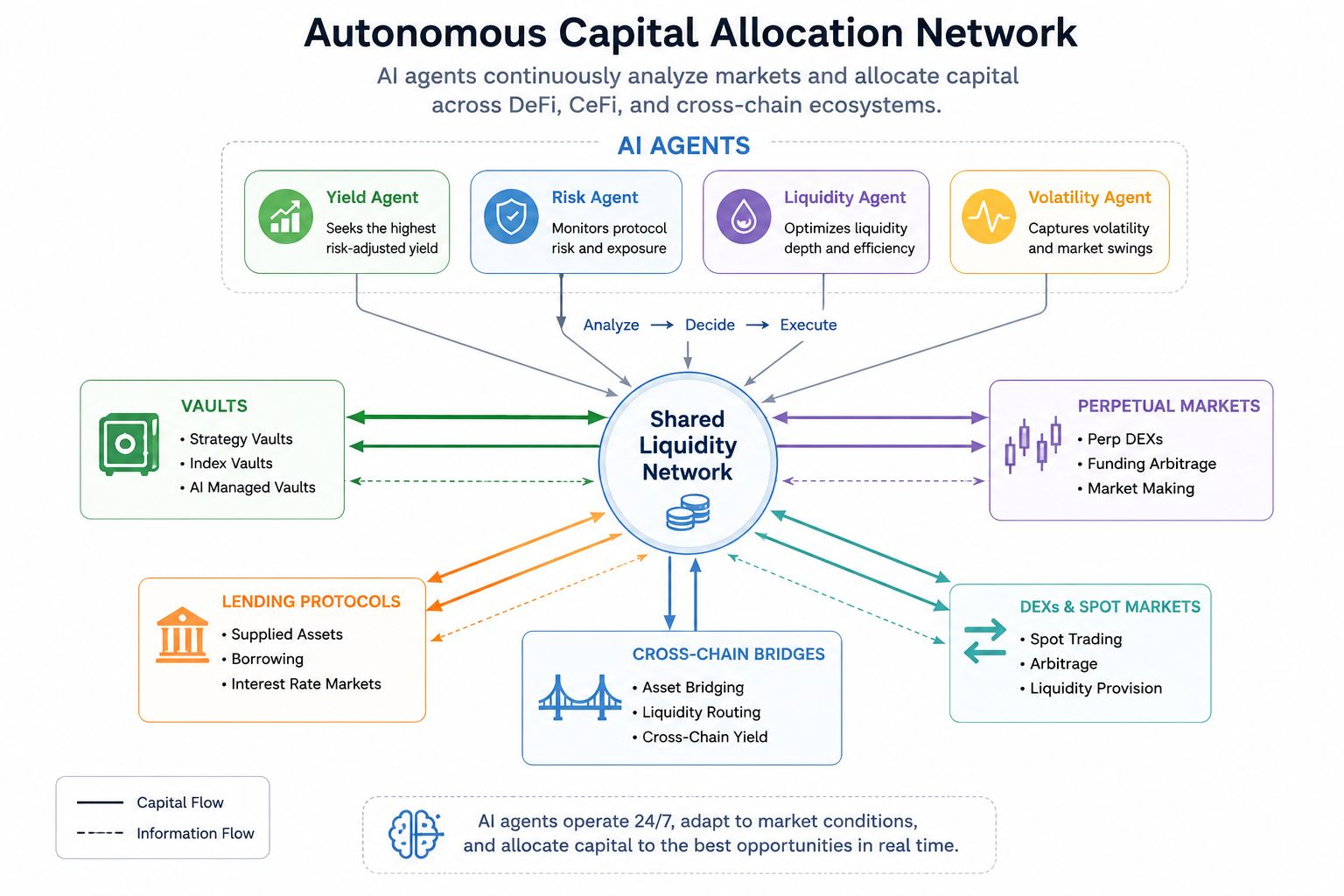
How much risk should be taken.
Which opportunities deserve liquidity.
And when execution should happen.
At that point, the biggest challenge may no longer be intelligence.
It may be attribution.
Because once an autonomous system moves capital, the transaction itself only tells a small part of the story.
The harder questions exist before execution.
What information influenced the decision?
Which model generated the output?
Which data sources shaped the model?
What historical context was retrieved?
Which contributors helped create the intelligence behind the action?
Can any of that be verified after the decision has already happened?
This is where OpenLedger feels fundamentally different from most AI narratives.
While much of the industry focuses on building smarter agents, OpenLedger is building infrastructure that makes intelligence traceable
That distinction becomes easier to understand when looking at how OpenLedger's architecture is designed.
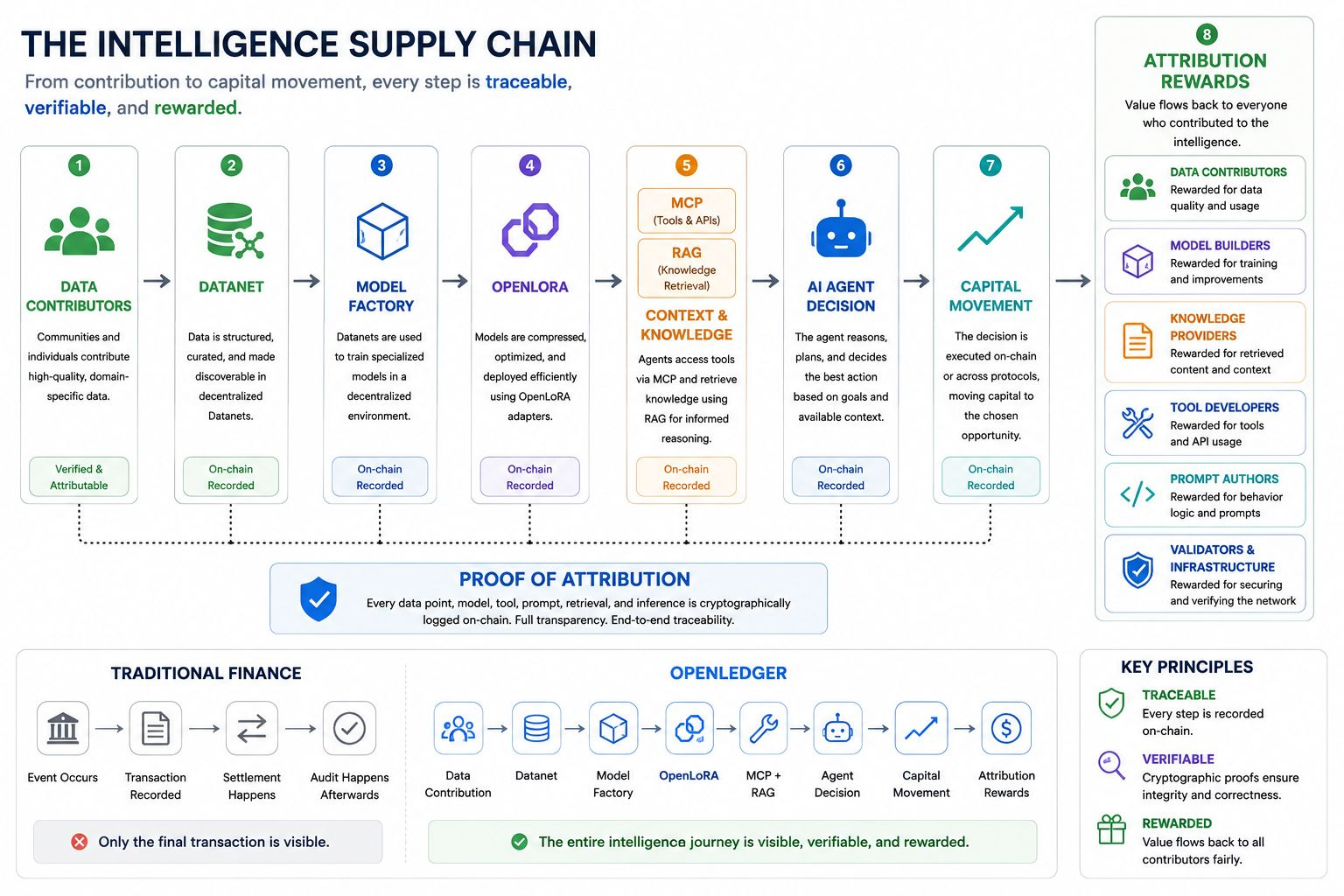
Everything begins with data.
Communities contribute domain-specific knowledge through Datanets. Instead of treating data as an invisible resource consumed by models, OpenLedger records where that information comes from and who contributed it.
Those datasets can then be transformed into specialized models through Model Factory and deployed using OpenLoRA.
At this stage, most AI systems would stop.
A model exists.
The job is done.
OpenLedger goes further.
An intelligent system still needs context.
It needs memory.
It needs tools.
It needs behavior.
Through MCP, agents can access external information sources and real-time tools.
Through RAG, agents can retrieve historical knowledge when reasoning about a decision.
Through prompts, developers can define how agents evaluate information and interact with their environment.
Suddenly the model becomes only one component inside a much larger intelligence stack.
And OpenLedger attempts to make every layer inside that stack attributable.
That becomes particularly important once financial agents enter the picture.
Imagine a trading agent operating inside decentralized markets.
The agent retrieves market data through external tools.
It pulls historical context from governance discussions, documentation, and token research.
It evaluates volatility, liquidity conditions, and sentiment.
It executes a decision.
Most systems can show the final transaction.
OpenLedger is attempting to show the path that produced it.
The dataset that contributed knowledge.
The documents retrieved during reasoning.
The model that generated the output.
The prompts guiding behavior.
The contributors whose information influenced the final result.
That is a completely different way of thinking about AI infrastructure.
Traditional finance audits transactions.
OpenLedger is attempting to audit intelligence itself.
And that distinction may become increasingly important as autonomous systems grow more capable.
Recent blockchain activity already demonstrates how difficult it can be to understand machine-driven behavior.
Research from Flashbots showed that MEV-driven activity consumed large portions of available blockspace across major rollups. On Solana, Ghostlogs researchers documented hundreds of millions of dollars extracted through sandwich attacks as automated systems competed for similar opportunities.
Those systems were not advanced autonomous agents.
They were specialized optimization engines responding to incentives.
Yet their collective behavior still shaped network conditions, execution costs, and market outcomes.
Now imagine a future where thousands of agents continuously allocate liquidity across lending protocols, perpetual exchanges, tokenized vaults, bridge networks, and crosschain markets.
The complexity increases dramatically.
The challenge stops being execution.
The challenge becomes understanding why execution happened.
This is why OpenLedger's Proof of Attribution feels increasingly important.
Proof of Attribution creates a framework where data influence can be measured, verified, and rewarded.
Contributors are not simply acknowledged.
They become participants in the economic value created by AI systems.
When inference occurs, value can flow across the intelligence supply chain.
Data contributors.Model builders.Knowledge providers Infrastructure participants.Each layer becomes visible.Each layer becomes attributable.Each layer becomes economically connected to the outcome.
That idea feels particularly relevant as AI evolves from answering questions to making decisions.
Because eventually the most valuable question may not be whether an agent produced the correct outcome.
The more important question may be understanding how that outcome was produced in the first place.
Blockchains solved ownership of assets.
OpenLedger is attempting to solve ownership of intelligence.
And if autonomous systems become meaningful participants in financial markets, that may prove to be one of the most important infrastructure layers of all.