

I’ve been thinking about @OpenLedger in a slightly different way recently — not just as an AI + Web3 project, but as a reflection of where intelligence itself is heading when it moves into decentralized environments.
From my perspective, the biggest shift happening right now is not simply technological, but environmental. AI is no longer operating in isolation; it is being shaped by everything around it — data sources, user interactions, economic incentives, and increasingly, decentralized infrastructure. This is where OpenLedger starts to become more relevant in my analysis.
Instead of treating AI as a closed system that simply consumes data, OpenLedger seems to be exploring a more dynamic model where intelligence is continuously influenced, verified, and improved by its surrounding environment. In this sense, AI is no longer just “artificial” — it becomes contextual intelligence embedded in a broader ecosystem.
What I find particularly interesting is how this direction changes the nature of competition in the space. It is no longer about who builds the strongest model or the fastest infrastructure. It becomes a question of who can design the most adaptive intelligence environment — one where data, incentives, and verification mechanisms work together in real time.
This is also where I see the emergence of OpenLedger as a meaningful concept rather than just a project. It represents an attempt to structure how intelligence evolves when it is exposed to open, verifiable, and economically aligned environments. In other words, it is trying to define the conditions under which AI becomes more reliable as it interacts with the world around it.
At the same time, I still maintain a critical perspective. If AI is embedded into everything around us — devices, systems, financial flows, and digital interactions — then the complexity of managing trust, latency, and scalability becomes significantly higher. Can decentralized systems handle this level of continuous intelligence flow without compromising performance? And will developers be willing to adopt such a paradigm when simpler centralized alternatives already exist?
These are not small questions, and I think they define the real competitive landscape.
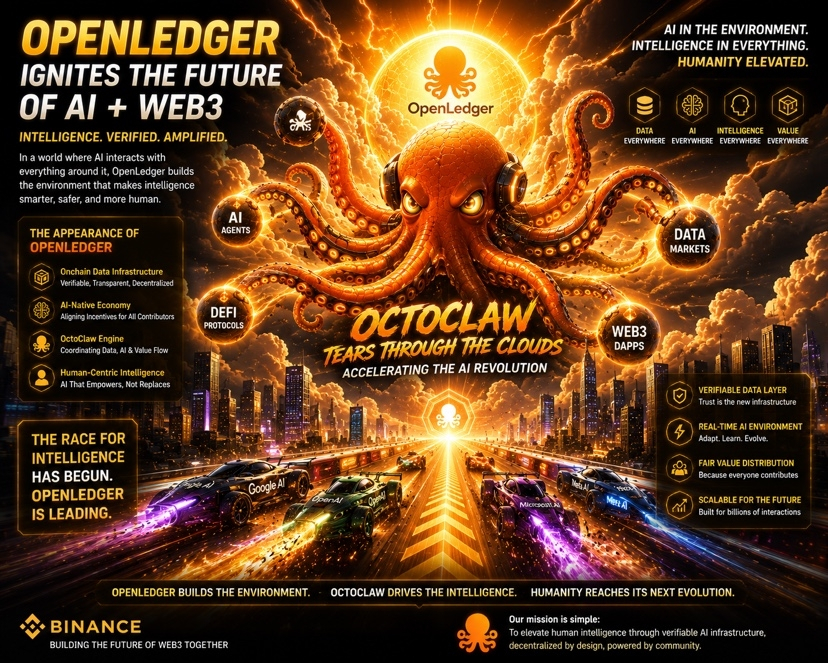
However, despite these uncertainties, I find the direction compelling. The idea that human intelligence is not being replaced, but amplified through better-structured AI environments, is something I personally resonate with. #OpenLedger , in this sense, is not just about building tools — it is about reshaping the relationship between humans, data, and machine intelligence.
So when I step back and look at the bigger picture, my conclusion is not absolute, but reflective: we may be entering a phase where intelligence is no longer defined by isolated systems, but by the environments that shape it. And OpenLedger is positioning itself directly inside that transition.
