
@OpenLedger The world is changing faster than most people emotionally understand. Artificial intelligence is no longer some distant futuristic concept hidden inside research labs. It is now shaping conversations, businesses, education, software, finance, creativity, healthcare, and even the way humans think every single day. People across the world are feeding AI systems with endless amounts of knowledge without realizing how valuable their contribution has become. Every search, every conversation, every correction, every line of code, every uploaded image, every emotional interaction is helping train the next generation of intelligence systems.
But there is a painful truth hidden inside this new AI revolution.
The people creating the value are usually not the people receiving the rewards.
Massive companies collect the data. Massive companies own the models. Massive companies control the infrastructure. Meanwhile ordinary contributors disappear into silence even though the systems would not exist without them.
This is the emotional foundation behind OpenLedger OPEN.
OpenLedger is not simply trying to become another blockchain project inside the crowded crypto industry. The team behind the network is attempting to solve one of the deepest problems emerging in the age of artificial intelligence. They believe intelligence itself should become a transparent and shared economy where contributors can finally receive ownership, attribution, and rewards for the value they help create.
That idea may sound idealistic at first.
But the deeper people study the AI economy the more important this conversation becomes.
Right now AI development is heavily centralized. Most advanced models are controlled by a small number of powerful organizations operating behind closed systems. Nobody fully sees where all the training data originates. Nobody completely understands how value flows internally. Contributors rarely receive recognition. In many cases even the people using AI tools every day are unknowingly helping improve systems they do not own and may never benefit from financially.
OpenLedger is trying to change that structure completely.
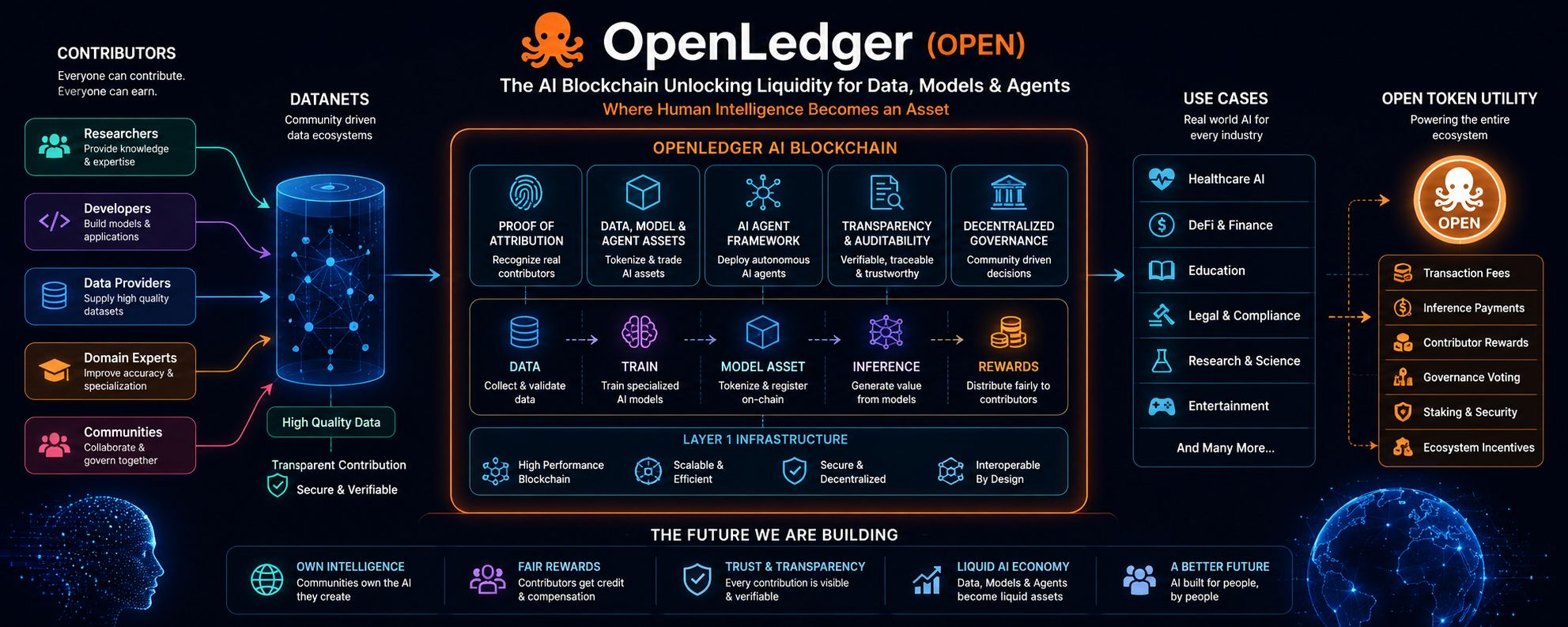
The project describes itself as the AI Blockchain because the entire network is designed around intelligence creation, ownership, and monetization. Instead of focusing only on payments or decentralized finance the ecosystem attempts to build infrastructure specifically for datasets, AI models, and autonomous AI agents. The goal is to transform intelligence itself into an economic layer that can become transparent, traceable, programmable, and liquid.
That word liquid matters deeply.
Normally people think about liquidity in financial terms. Stocks are liquid. Tokens are liquid. Cash is liquid. OpenLedger extends this idea into the world of artificial intelligence. The network believes datasets, AI models, and even autonomous AI agents should behave like economic assets that communities can build, own, improve, and monetize together.
This is one of the reasons the project has attracted attention from people who believe the future AI economy cannot remain entirely centralized forever.
Because eventually society will ask difficult questions.
Who owns the intelligence?
Who deserves the rewards?
Who contributed to the model?
Who benefits from the economic upside?
OpenLedger is trying to create infrastructure capable of answering those questions.
The project introduces an important concept called Proof of Attribution. Traditional blockchains reward miners or validators for securing consensus. OpenLedger attempts to reward the actual contributors behind intelligence creation itself. Instead of only rewarding infrastructure operators the system wants to recognize researchers, developers, communities, and data providers who help improve AI systems over time.
Emotionally this changes everything.
For years people have watched internet platforms absorb human creativity while contributors received almost nothing in return. Social media platforms became trillion dollar ecosystems powered by user generated content. AI systems are now accelerating that same dynamic at an even larger scale. Human intelligence is becoming raw material for machine learning economies.
OpenLedger is trying to ensure ordinary contributors are not erased inside that process.
Technically this is extremely difficult.
Artificial intelligence models absorb massive amounts of information from many sources simultaneously. Measuring exactly which contributions improve a model the most is one of the hardest problems in modern technology. But the OpenLedger team believes attribution systems are necessary if AI economies are going to remain fair and sustainable long term.
Without attribution there is no visible ownership.
Without ownership there is no fair reward structure.
Without fair rewards contributors eventually stop trusting the ecosystem.
That is why Proof of Attribution sits at the center of OpenLedger’s philosophy.
Another major reason the project stands out is its focus on specialized AI models instead of giant universal systems. Many companies are competing to build massive general purpose AI models that know a little about everything. OpenLedger is approaching the market differently. The network strongly emphasizes domain specific intelligence systems designed for specialized industries and use cases.
This strategy may become incredibly important over time.
A healthcare company often does not need a giant universal chatbot. It needs highly specialized medical intelligence trained on accurate healthcare information. A blockchain security company needs AI systems specialized in smart contract analysis. A law firm needs deep legal intelligence rather than broad general conversation.
OpenLedger believes specialized AI models may become one of the strongest economic sectors in the future because focused intelligence can outperform giant generalized systems inside specific environments.
This creates opportunities for communities to build targeted intelligence ecosystems together.
Medical experts can contribute healthcare datasets.
Developers can improve blockchain auditing models.
Researchers can strengthen scientific intelligence systems.
Communities can collaborate on educational AI infrastructure.
And if the ecosystem functions correctly contributors may eventually share in the value generated by those systems.
That possibility creates a very different emotional atmosphere compared to centralized AI development.
Instead of intelligence flowing upward into closed corporations the value may circulate through decentralized communities.
The network also introduces the idea of Datanets which are community driven data ecosystems designed to support AI training and specialization. This concept matters because high quality data is becoming one of the most valuable resources in artificial intelligence. Many people focus entirely on model architecture but data quality often determines whether an AI system becomes powerful or unreliable.
OpenLedger is trying to create environments where communities can collectively build valuable datasets while maintaining transparent contribution records and economic participation.
That may sound abstract right now.
But over the next decade data ownership could become one of the most important political and economic issues in the world.
Artificial intelligence systems require enormous amounts of information. As those systems become more advanced the value of high quality specialized data may continue increasing dramatically.
OpenLedger is positioning itself around this future.
The OPEN token acts as the economic engine powering the broader ecosystem. The token is designed for network transactions, inference payments, ecosystem coordination, contributor rewards, governance participation, and broader AI related activity inside the network.
But token utility alone does not guarantee success.
One of the biggest dangers facing AI crypto projects is speculative hype. Markets often move emotionally before real infrastructure matures. Narratives can create explosive excitement long before sustainable adoption appears. Many projects fail because the story grows faster than the actual ecosystem.
OpenLedger’s long term future depends heavily on whether real AI demand develops inside the network.
Real developers matter.
Real communities matter.
Real datasets matter.
Real usage matters.
Speculation alone cannot sustain infrastructure designed for the future of intelligence.
This is why the deeper metrics surrounding OpenLedger are more important than simple token price movements. The real indicators are things like active developers, dataset growth, model performance, contributor retention, inference demand, ecosystem participation, and specialized AI adoption across industries.
If developers continue building even during difficult market conditions that signals strength.
If communities continue contributing valuable datasets that signals belief.
If specialized models begin outperforming alternatives in real industries that signals utility.
Those are the measurements that truly reveal whether OpenLedger is building sustainable infrastructure or temporary excitement.
Of course the risks surrounding the project are enormous.
Combining blockchain and artificial intelligence is incredibly complex. Both industries are technically demanding individually. Merging them together creates massive engineering pressure. Scalability remains a serious challenge because AI computation requires significant resources while decentralized systems often struggle with efficiency compared to centralized infrastructure.
Competition is another major threat.
The decentralized AI sector is growing rapidly. Many projects are now competing across decentralized compute, AI marketplaces, autonomous agents, inference systems, and blockchain based intelligence economies. OpenLedger must prove that attribution focused infrastructure provides enough long term value to survive inside this competitive environment.
There is also the challenge of trust.
If attribution systems fail or contributors feel rewards are distributed unfairly the emotional foundation of the ecosystem could weaken quickly. OpenLedger’s entire philosophy depends on contributors believing their participation matters visibly and economically.
That creates enormous responsibility for the network.
Still despite these risks the project is pursuing a vision that emotionally resonates with a growing number of people.
Humanity is entering an era where intelligence itself is becoming infrastructure.
AI systems will increasingly shape education, healthcare, communication, finance, research, creativity, governance, and daily life. The systems being built today may influence billions of people tomorrow.
And many people are beginning to fear a future where all intelligence infrastructure becomes concentrated into a small number of powerful centralized entities.
OpenLedger is offering a different vision.
A future where communities can own intelligence systems together.
A future where contributors receive recognition instead of invisibility.
A future where datasets become collaborative economies instead of hidden corporate assets.
A future where AI development becomes more transparent, modular, auditable, and economically shared.
If It becomes successful the project could help redefine how society thinks about intelligence ownership itself.
Imagine specialized healthcare AI systems owned collectively by researchers and medical communities.
Imagine decentralized educational models continuously improving through global collaboration.
Imagine autonomous AI agents operating transparently across open economic networks.
Imagine scientific intelligence systems where contributors receive ongoing rewards for helping accelerate discovery.
That is the larger dream hidden inside OpenLedger.
Whether the project fully succeeds is still uncertain.
The road ahead is difficult.
The technology is complicated
The market is volatile.
The competition is intense.
But the deeper emotional force behind the project feels increasingly important with every passing year.
People no longer want to endlessly feed value into systems they do not own.
They want transparency.
They want participation.
They want attribution.
They want fairness.
And We’re seeing the early stages of a much larger movement where humanity begins questioning who should truly own the intelligence shaping the future of civilization.
OpenLedger is trying to answer that question before the rest of the world fully realizes how important it may become.
Maybe the project eventually transforms the AI economy.
Maybe it evolves into something entirely different.
Maybe it inspires future decentralized intelligence systems beyond itself.
But one thing already feels clear.
The age of invisible contribution is slowly being challenged.
And somewhere inside that transformation OpenLedger is trying to build a future where human intelligence finally becomes an asset instead of an invisible sacrifice.
