
I have been tracking crypto long enough to recognize the smell of recycled hype.
Usually, it arrives wearing expensive buzzwords and fake urgency. A little AI seasoning. A little “decentralized future” theater. Add tokenomics nobody understands and a Discord full of rocket emojis. Done.
OpenLedger looked dangerously close to that at first glance.
Another AI-blockchain crossover.
Another promise to “fix” the internet.
Another protocol claiming it can democratize intelligence while venture funds quietly sharpen their knives behind the curtain.
Fair point.
But the more I dug into OpenLedger, the more I realized this project is poking at something much bigger than another speculative crypto cycle.
It is attacking ownership itself.
And that makes people nervous.
For years, I’ve watched Silicon Valley pull off the same magic trick over and over again. Users generate value. Platforms capture it. Everybody claps anyway.
Social media did it.
Streaming did it.
Now AI is doing it at industrial scale.
Every prompt you type. Every image uploaded. Every customer support ticket. Every weird little correction you make to an AI chatbot at 2 AM because it confused Pakistan with India or hallucinated a legal answer out of thin air. That data feeds the machine.
The machine gets smarter.
The companies get richer.
You get absolutely nothing.
That’s the business model.
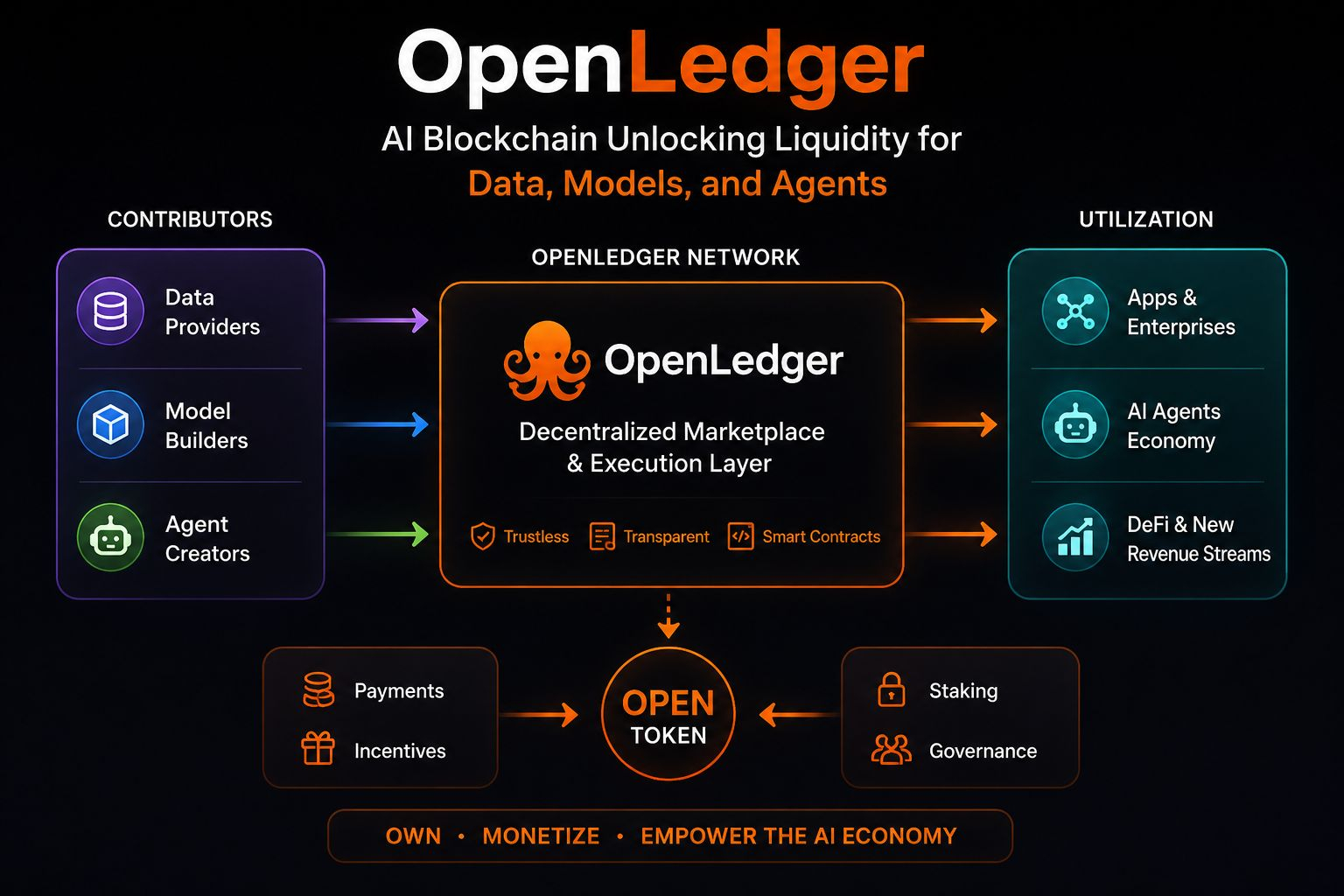
OpenLedger is trying to break that loop by turning AI resources into financial assets people can actually own, track, and monetize.
Data.
Models.
Agents.
Not theory. Actual infrastructure.
Here’s the part most people miss.
The AI race is no longer just about who builds the smartest chatbot. That phase is already overcrowded. The real war now is over the pipes underneath everything. Whoever controls the infrastructure layer controls the economy sitting on top of it.
Cloud giants understand this perfectly.
That’s why companies like Microsoft, Amazon, and Google are spending obscene amounts of money building AI ecosystems that lock developers into their orbit forever. APIs become dependencies. Dependencies become prisons.
Not remotely cheap.
OpenLedger’s pitch is basically the opposite. Instead of one corporation owning the rails, the network itself coordinates value exchange between contributors.
Messy idea.
Potentially explosive one too.
Imagine you spent years collecting specialized medical imaging data. Or financial trading patterns. Or industrial manufacturing logs. Under the current system, giant AI firms vacuum that information into centralized models and monetize it behind closed doors.
OpenLedger says contributors should get paid every time their data helps power something valuable downstream.
Simple concept.
Absolute nightmare to execute.
Because data markets sound elegant until humans show up.
Then comes fraud.
Spam datasets.
Copyright lawsuits.
Privacy disasters.
Bot farms.
Synthetic garbage generated by other AI systems.
Chaos. Pure chaos.
And OpenLedger has to navigate all of it while also surviving crypto volatility and the growing regulatory paranoia surrounding AI.
That combination alone could bury weaker projects.
Still, I understand why people are paying attention.
The protocol is trying to create liquidity around AI itself. Not just tokens attached to AI narratives. Actual economic activity around models, agents, and data contribution.
That distinction matters.
Most AI crypto projects are basically marketing departments stapled onto thin infrastructure. OpenLedger at least appears to understand the ugly operational reality underneath autonomous systems.
Because here’s what Silicon Valley doesn’t advertise loudly enough: AI infrastructure is brutally expensive.
Compute costs are savage.
Bandwidth costs pile up fast.
Inference scaling becomes a money furnace once usage spikes.
Even the largest companies on Earth are struggling to maintain margins while training frontier models that consume electricity like small nations.
OpenLedger’s answer is decentralization.
Spread contribution across networks.
Reward participants directly.
Let market incentives coordinate supply.
Sounds clean in whitepapers.
Real life is uglier.
Distributed systems break constantly. Nodes fail. Incentives drift. Governance turns tribal overnight. Communities split into factions over tiny economic disagreements. I’ve watched enough protocol wars to know human greed scales faster than most blockchains.
And then there’s the agent economy.
This is where things get genuinely weird.
A lot of people still think AI agents are glorified chatbots. They’re not paying attention. We’re moving toward autonomous software capable of executing workflows, coordinating tasks, purchasing services, and eventually interacting economically without humans sitting in the middle pressing buttons.
That changes everything.
Banks were built for humans.
Legal systems were built for humans.
Payment rails were built for humans.
Now imagine millions of autonomous agents negotiating, transacting, and exchanging data across global networks in real time.
Existing infrastructure starts looking ancient very quickly.
OpenLedger wants to become the coordination layer for that machine economy.
Identity systems.
On-chain payments.
Attribution tracking.
Permission management.
Economic settlement.
Basically, the plumbing.
And history shows the companies controlling plumbing usually become terrifyingly powerful.
People forget Amazon started by selling books.
Then it quietly built AWS underneath the modern internet while everyone was distracted by cardboard boxes arriving at their doors.
Infrastructure always wins eventually.
That’s why OpenLedger matters even if the project itself never fully reaches escape velocity.
It reflects where the industry is heading.
Toward programmable ownership.
Toward machine-native economies.
Toward a world where AI systems no longer function as isolated tools but as participants inside financial networks.
And honestly? That future raises uncomfortable questions nobody has answered properly.
Who regulates autonomous agents making economic decisions?
Who gets blamed when AI systems manipulate markets or spread poisoned data across decentralized networks?
What happens when corporate AI giants realize decentralized alternatives threaten their control over distribution and monetization?
They won’t sit quietly.
Neither will governments.
Power never leaves the room voluntarily.
That’s the thing about OpenLedger. Strip away the token charts and crypto branding, and you’re left staring at a much darker, more important fight.
Not a battle over technology.
A battle over ownership.
Who owns intelligence.
Who profits from data.
Who controls the infrastructure beneath the next digital economy.
Because once AI becomes the operating system for modern life, the people controlling its rails won’t just influence markets.
They’ll influence reality itself.
