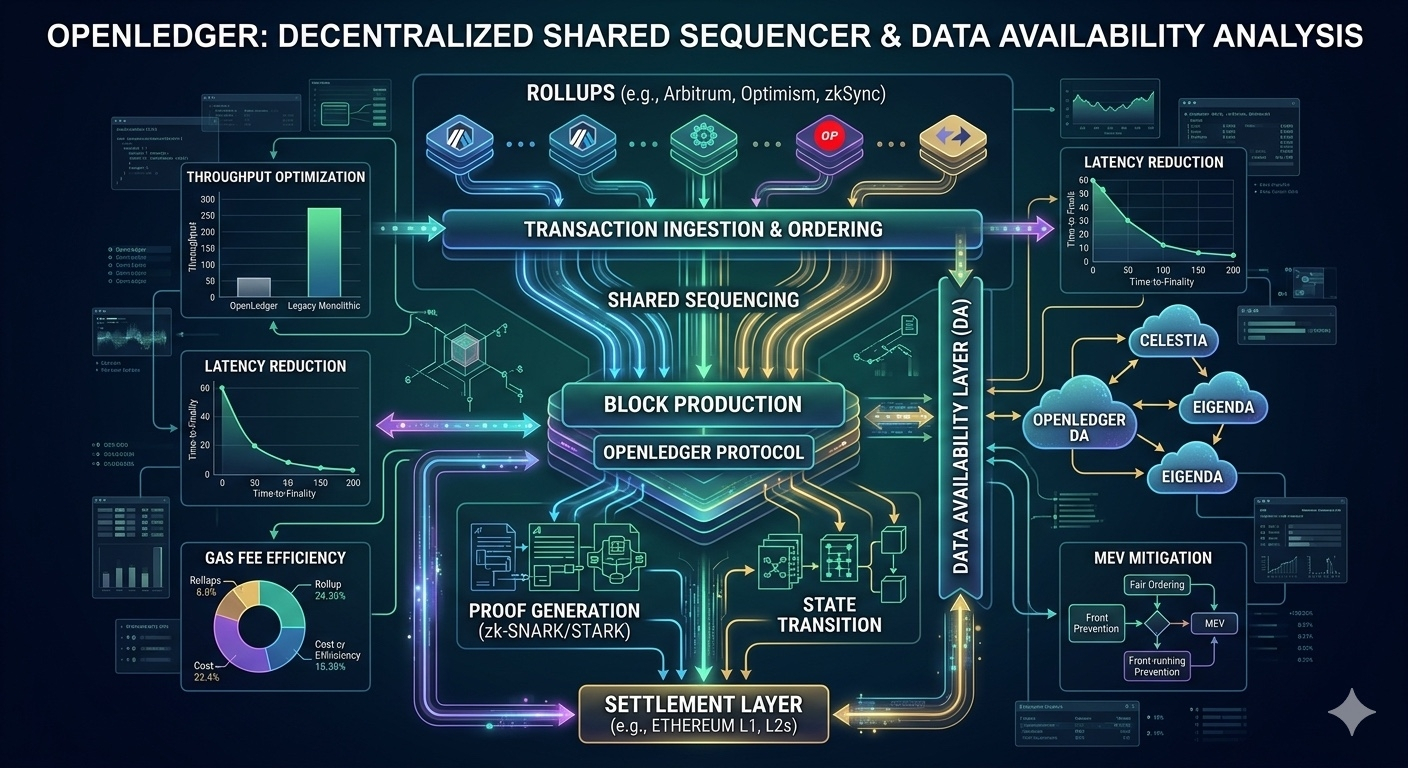
The blockchain landscape is rapidly evolving from monolithic structures (where one chain handles everything) to modular stacks. $OPEN OpenLedger has emerged as a critical infrastructure layer designed to optimize this new modular reality,specifically targeting the challenges of sequencing and data availability (DA).
This analysis breaks down the functional components of the $OPEN OpenLedger protocol based on the latest technical architecture.
1. The Core Problem: The Rollup Bottleneck
While Layer 2 rollups (like Arbitrum, Optimism, and zkSync) have successfully scaled Ethereum’s execution, they face two significant hurdles:
Sequencer Centralization: Most rollups currently rely on a single, centralized sequencer to order transactions.This introduces a single point of failure and risks concerning liveness and censorship.
Data Availability Costs: Posting transaction data back to Layer 1 (Ethereum) remains expensive, accounting for a large portion of rollup user fees.
OpenLedger addresses both issues simultaneously.
2. OpenLedger’s Shared Sequencer Network
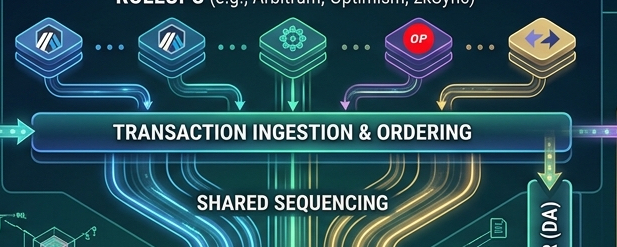
As illustrated in the infographic, OpenLedger provides a Decentralized Shared Sequencer layer. Instead of each rollup managing its own centralized sequencer, they can outsource transaction ingestion and ordering to OpenLedger.
The Functional Flow:
1.An intricate infographic detailing OpenLedger's architecture. It features sections on Transaction Ingestions & Ordering,Block Production, and an OpenLedger Protocol Hub. Surrounding metrics and diagrams analyze Throughput Optimization, Latency Reduction (Time-to-Finality), Gas Fee Efficiency, MEV Mitigation, Proof Generation (zk-SNARK/STARK), and State Transition, all connected to a Settlement Layer. This analysis visualizes how the protocol manages Rollups and acts as a Data Availability Layer (DA) alongside partners like Celestia and EigenDA.$OPEN #open #$9BillionBitcoinOptionsExpireToday #open #SuiNetworkSixHourOutage