
I Have Seen Most technology projects succeed by narrowing their focus.
They identify a single constraint, build around it relentlessly, and spend years refining one layer of the stack. In artificial intelligence, the primary battle has been intelligence itself. In crypto, different protocols have concentrated on specific problems such as interoperability, liquidity movement, data ownership, or incentive design.
This specialization is not accidental. It reflects a basic reality of complex systems: solving one difficult problem is already hard enough.
What makes OpenLedger interesting is that it appears to be approaching the problem from a different direction.
Rather than competing directly within a single category, the project seems to be exploring whether several independent layers of the emerging AI economy can be connected into a coherent economic system. Intelligence, execution, capital mobility, and value distribution are typically discussed as separate markets. OpenLedger's architecture suggests a belief that they may ultimately need to operate as parts of the same system.
Whether that vision succeeds remains uncertain. But the existence of the attempt is worth examining because it touches on a deeper issue that both AI and crypto ecosystems continue to struggle with: coordination.
The Fragmentation Problem
The current AI landscape is increasingly powerful but structurally fragmented.
Large language models have demonstrated that intelligence can be scaled. The market no longer needs convincing that AI can generate value. That question has largely been answered through years of commercial adoption and substantial investment.
Yet intelligence alone does not create an economy.
An AI model may produce insight, analysis, or recommendations, but the moment it needs to interact with the real world, new layers emerge. It must execute tasks. It must access resources. It must move value. It must compensate contributors. It must interact with systems outside its original environment.
Most discussions focus on model quality because intelligence is visible. The less visible challenge is coordination between the systems surrounding intelligence.
This is where many AI narratives become incomplete.
A model can think.
An economy requires more.
From Intelligence to Action
The second phase of AI development has increasingly focused on execution.
The rise of autonomous agents reflects a growing recognition that users often care less about generated outputs and more about completed outcomes.
This distinction matters.
Information is valuable, but execution changes economic behavior.
An agent capable of conducting research, interacting with software interfaces, automating workflows, gathering information, and continuously improving performance operates differently from a model that simply returns text.
The emergence of agent frameworks and autonomous workflow systems reflects this transition.
Within $OPEN Ledger's ecosystem, OctoClaw appears to represent this execution layer.
The significance of such a layer is not simply automation. The deeper implication is economic agency.
Once systems begin acting rather than merely responding, they require infrastructure that extends beyond intelligence itself. They need access to data, capital, permissions, incentives, and payment rails.
Execution transforms AI from a software capability into an economic participant.
That transition introduces an entirely new set of challenges.
The Missing Infrastructure Layer
One of the less discussed realities of decentralized systems is that value creation and value movement are often disconnected.
A protocol may generate activity in one environment while liquidity remains trapped elsewhere.
A contributor may create value while rewards flow to different participants.
An application may achieve adoption while economic benefits concentrate outside the ecosystem.
These disconnects create persistent inefficiencies.
The crypto industry has spent years attempting to solve this through interoperability infrastructure.
Cross-chain systems emerged because isolated liquidity creates friction. Capital naturally seeks efficiency, flexibility, and access to opportunity.
The same principle may apply to autonomous AI systems.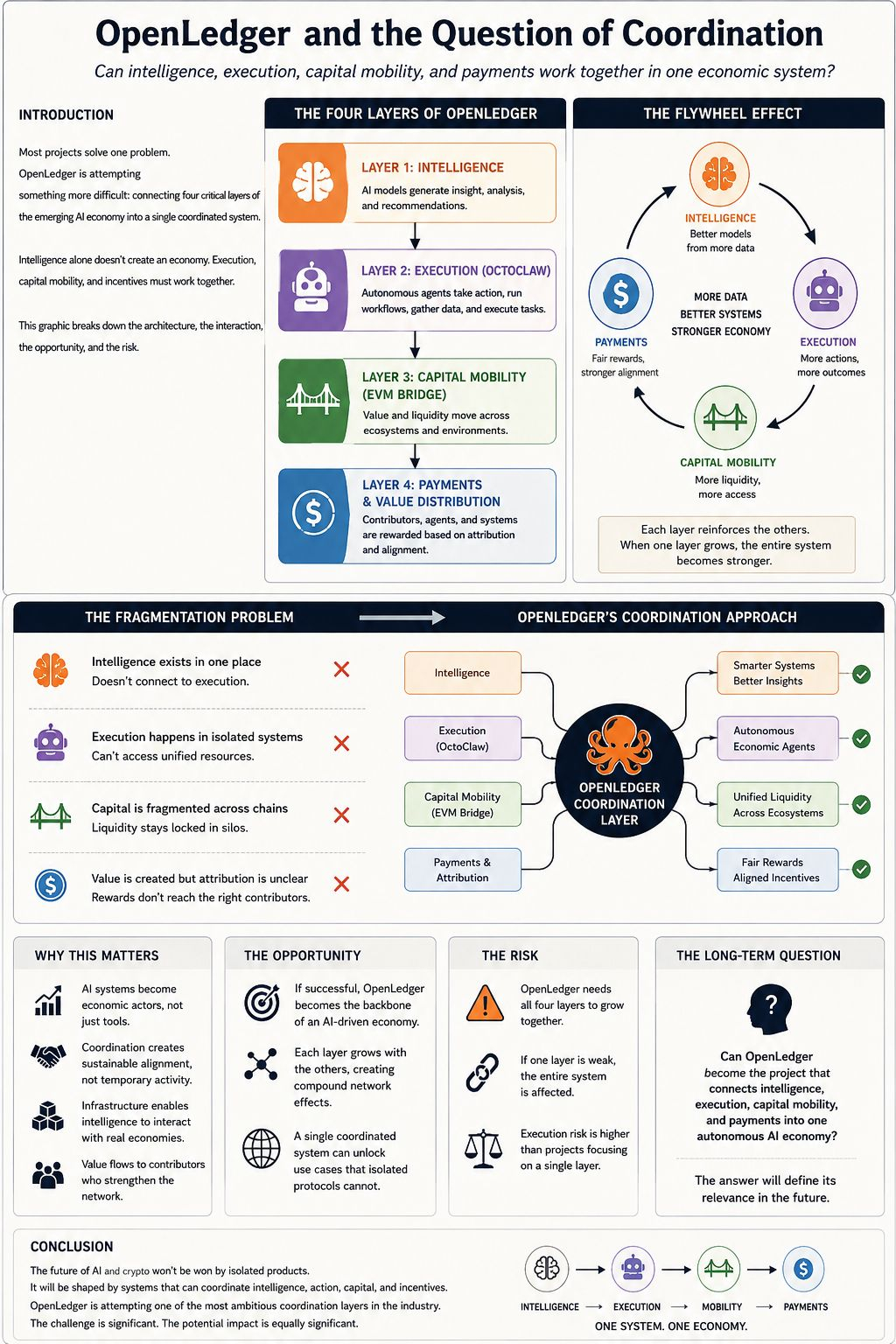
If agents become meaningful participants in digital economies, they will eventually require mechanisms for moving resources across environments rather than operating inside isolated silos.
Viewed from this perspective, OpenLedger's EVM bridge is not merely a technical feature.
It may represent an acknowledgment that intelligent systems cannot function as economic actors if they remain disconnected from the broader capital landscape.
The ability to coordinate value movement becomes increasingly important as execution capabilities expand.
This is not fundamentally a blockchain problem.
It is a coordination problem.
Blockchain infrastructure simply provides one possible solution.
The Incentive Layer Nobody Has Solved
Perhaps the most difficult challenge sits even deeper.
Value attribution.
Every economic system eventually confronts the same question:
Who deserves compensation?
The answer becomes increasingly complicated in AI-driven environments.
Models depend on data.
Agents depend on models.
Applications depend on agents.
Users depend on applications.
Contributors support every layer.
Traditional systems often obscure these relationships. Digital economies expose them.
Projects across the industry have attempted to address pieces of this problem through contributor rewards, data ownership frameworks, decentralized training incentives, and attribution mechanisms.
Yet the broader challenge remains unresolved.
Most ecosystems still rely heavily on short-term incentive programs that attract participation without creating durable alignment.
Liquidity mining demonstrated this problem years ago.
Capital arrived when rewards were high and departed when rewards declined.
Growth appeared substantial but often proved temporary.
The result was a cycle of artificial expansion followed by contraction.
This pattern reveals a structural weakness that is rarely discussed openly.
Many crypto systems optimize for activity rather than sustainability.
They reward participation without necessarily rewarding contribution.
Those are not the same thing.
If OpenLedger is attempting to connect intelligence, execution, capital movement, and payment systems, then incentive design becomes central rather than peripheral.
The system only works if value flows toward participants who strengthen the network over time.
Otherwise the architecture risks becoming another example of reflexive growth unsupported by durable economics.
The Challenge of Building Multiple Layers Simultaneously
This is where the opportunity and the risk converge.
Specialized protocols benefit from clarity.
Their objectives are easier to define.
Their markets are easier to understand.
Their execution paths are generally narrower.
A protocol focused exclusively on intelligence can devote resources toward model development.
A protocol focused exclusively on interoperability can concentrate on capital movement.
A protocol focused exclusively on attribution can spend years refining incentive structures.
OpenLedger appears to be pursuing a broader thesis.
The challenge is not merely building four separate systems.
The challenge is ensuring that all four reinforce one another.
Intelligence must create useful outputs.
Execution must transform outputs into actions.
Infrastructure must enable movement of value.
Payment systems must distribute economic rewards.
Each layer depends on the others.
Failure in one layer weakens the entire cycle.
Success requires coordination across all of them.
Historically, coordination has been one of the most difficult problems in both technology and economics.
The difficulty should not be underestimated.
A Different Way to Think About Network Effects
Most discussions around network effects focus on user growth.
That perspective is often too narrow.
The strongest networks are not necessarily those with the largest number of participants.
They are often those with the strongest alignment between participants.
In financial systems, poorly aligned growth can become fragile.
Capital becomes mercenary.
Governance participation declines.
Communities disengage.
Activity becomes dependent on incentives rather than utility.
The result is governance fatigue, capital inefficiency, and recurring cycles of instability.
A system designed around long-term coordination attempts to solve a different problem.
Instead of asking how to attract participants, it asks how to retain productive relationships between participants.
That distinction matters.
If OpenLedger's architecture ultimately succeeds, its value may come less from any individual component and more from the interaction between components.
The network effect would not emerge from scale alone.
It would emerge from coordination