
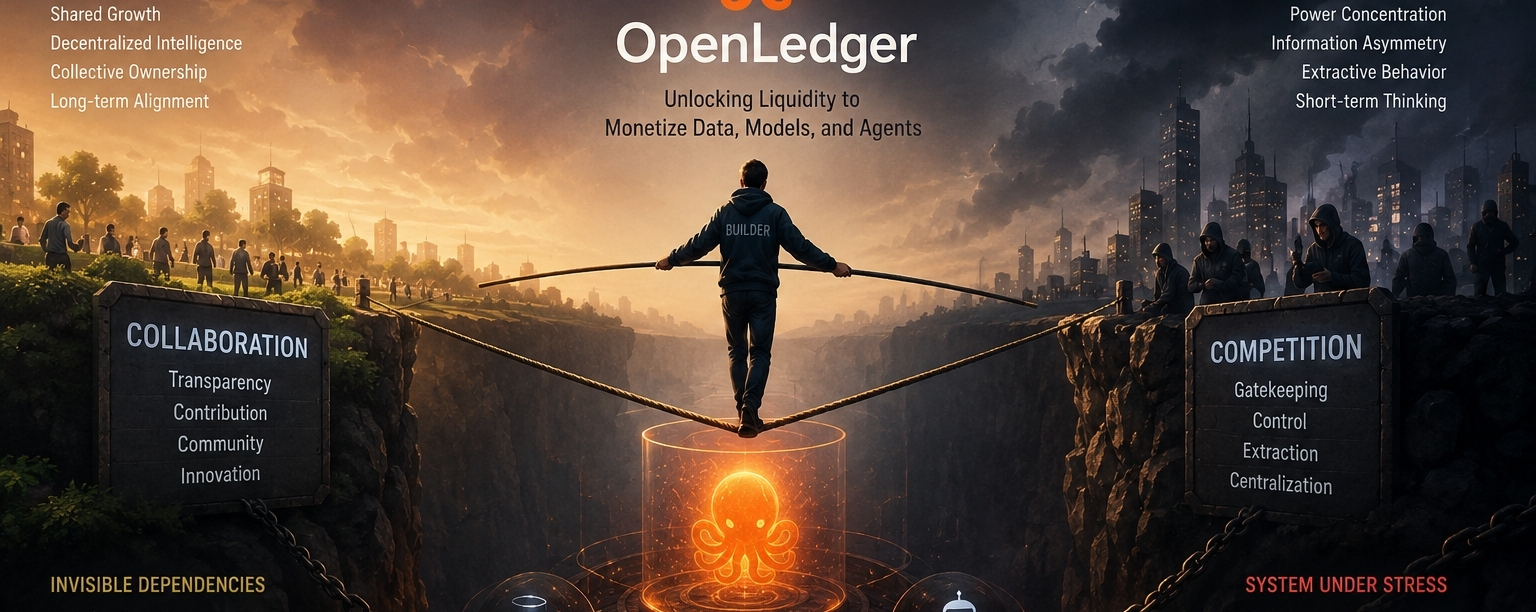
I’m watching OpenLedger carefully because the mood around it feels different from the usual cycle noise. Not louder. If anything, quieter. More calculated. I keep seeing people speak with confidence in public while privately moving with caution. That contrast always catches my attention. In crypto, the loudest conviction usually appears right before uncertainty becomes impossible to ignore. Real pressure shows up in smaller details. In hesitation. In delayed reactions. In how quickly people shift focus once conditions stop feeling easy.
What interests me is not the promise of the system. It’s the behavior forming around it. I’ve noticed that once money, data, and intelligence all start colliding inside the same environment, people change faster than the architecture does. Early participants talk about openness, coordination, shared upside. Then the market tightens and survival instincts slowly take over. You can almost feel the atmosphere changing. Conversations become more strategic. Information stops flowing naturally. Everyone starts measuring risk before they speak, contribute, or commit.
I focus a lot on incentive drift because that’s usually where the real story begins. Most systems don’t break because of one dramatic failure. They slowly bend under pressure. The structure says one thing while participant behavior starts moving another direction entirely. Open participation sounds attractive during growth phases, but once economic value becomes real, people naturally protect what gives them leverage. That’s just human behavior. The more valuable intelligence becomes, the less casually it gets shared.
I keep noticing how fragile alignment actually is when markets become uncertain. At first, everyone appears coordinated because optimism hides friction. But optimism is temporary fuel. Once volatility enters the picture, hidden tensions surface quickly. Some participants want stability. Others want extraction. Some care about long-term structure. Others care about immediate positioning. All of these motivations begin competing quietly beneath the same narrative. From the outside it still looks unified. Underneath, the pressure builds.
There’s also this invisible dependency problem that people rarely discuss honestly. Systems like OpenLedger don’t exist in isolation even when they appear independent. They depend on attention staying alive. They depend on liquidity continuing to circulate. They depend on infrastructure holding steady, participants remaining patient, governance reacting fast enough, and belief not collapsing during difficult periods. The dangerous part is that none of these pressures arrive separately. They stack on top of each other.
I’m tracking how people behave during moments of uncertainty because that reveals more than any announcement ever could. Stress exposes hierarchy fast. You start seeing who actually carries influence, who absorbs losses, who gets protected, and who becomes expendable once conditions tighten. That’s usually the moment where decentralization narratives begin colliding with operational reality. Not because anyone planned deception, but because pressure naturally concentrates authority around whoever can stabilize chaos quickest.
What feels important here is the tension between openness and defensibility. The system depends on participation, but participants also want edge. Those two forces eventually collide in every intelligence-driven environment. The more financially valuable information becomes, the stronger the instinct to protect it. That changes the culture slowly. Builders become operators. Contributors become competitors. Collaboration becomes conditional instead of natural.
I’ve also noticed how perception itself becomes part of the economy in systems like this. Confidence creates momentum. Momentum attracts participation. Participation strengthens liquidity. Then liquidity reinforces confidence again. It becomes a loop. The problem is that reflexive systems can look healthy even while stress quietly accumulates underneath. Most people only notice the fracture once the tension becomes visible publicly. By then, the behavioral shift usually started much earlier.
The thing keeping my attention on OpenLedger is not hype or narrative momentum. It’s the unresolved tension running underneath the structure. I keep seeing a system trying to balance coordination, monetization, openness, and competitive survival all at once. That balance is incredibly difficult to maintain over time because economic pressure eventually forces tradeoffs no matter how ideal the original vision sounded.
I don’t think the most important signals are technical anymore. They’re psychological. You can learn more by watching how participants react to uncertainty than by reading polished statements. Do people become defensive? Do they become transparent? Does governance tighten? Does communication narrow? Does power quietly consolidate around a smaller group during stress? Those patterns matter because they reveal what the system truly prioritizes once conditions stop feeling comfortable.
Right now OpenLedger feels less like a finished structure and more like a live pressure test unfolding in real time. Not collapsing. Not fully stable either. Just exposed to the same forces that reshape every coordination system once expectations meet reality. That’s the part I keep watching. Because eventually every architecture reaches the point where belief alone is no longer enough to hold everything together.