
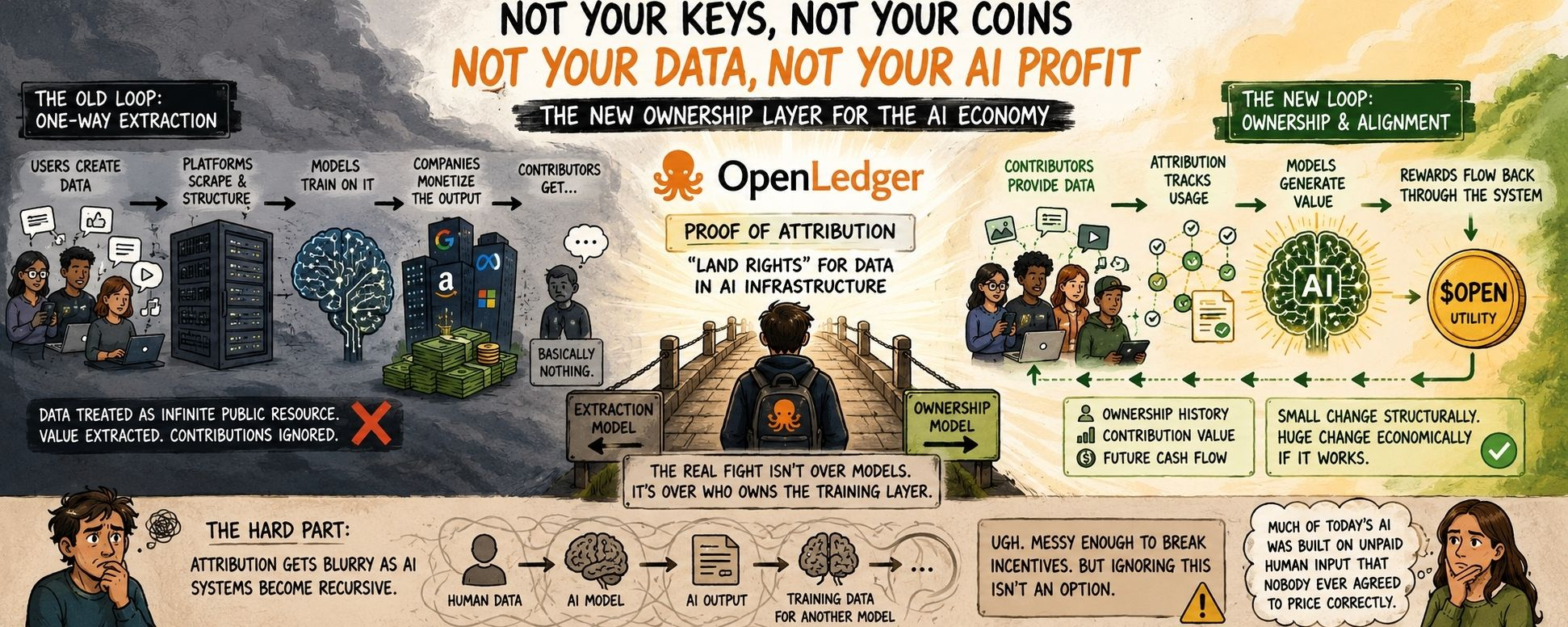
I keep thinking about that old crypto phrase: “not your keys, not your coins.”
Lately it’s starting to feel incomplete.
Because the AI economy quietly created another version of the same problem. Not your data, not your AI profit.
At first, AI training looked almost magical to me. Models improve, products get smarter, everyone benefits. Simple. But the deeper I looked, the weirder the loop became: users create data → platforms scrape and structure it → models train on it → companies monetize the output → the original contributors get... basically nothing.
And honestly, we got so used to this arrangement that people barely question it anymore.
That’s why the idea behind OpenLedger stuck with me more than I expected. Not even because of the AI angle itself, but because of the underlying accounting system. The whole Proof of Attribution thing feels like an attempt to create “land rights” for data inside AI infrastructure.
Which sounds kind of dramatic, maybe. But I don’t know how else to describe it.
Most AI systems today treat data like an infinite public resource. OpenLedger seems to assume the opposite: data has ownership history, contribution value, and future cash flow attached to it. So instead of training becoming a one-way extraction process, the loop changes slightly.
Contributors provide data → attribution tracks usage → models generate value → rewards flow back through the system, potentially through the $OPEN token utility.
Small change structurally. Huge change economically if it actually works.
The weird part is that this shifts the conversation away from models themselves. Everyone’s obsessed with which AI is smartest, fastest, cheapest. But maybe the bigger fight ends up being over who owns the training layer underneath everything.
I remember seeing similar debates during early DeFi. Protocols realized liquidity providers weren’t “users,” they were infrastructure. Maybe data contributors become the same thing for AI.
And yet… the market seems increasingly interested in infrastructure projects solving invisible coordination problems rather than flashy consumer apps. Kind of feels like the AI cycle is drifting in that direction now.
What I can’t fully tell yet is whether OpenLedger is creating a genuinely new economic primitive… or just adding cleaner accounting to a system that still centralizes most of the value upstream.
Which might explain why capital suddenly seems more interested in owning coordination layers around AI than competing on model quality itself.
Still, the entire model depends on attribution remaining provable after AI systems become deeply recursive and compositional. Once models start training on outputs generated by other models, the origin trail gets blurry fast. Ugh. Almost messy enough to break the incentive design entirely.
Feels important either way.
But also slightly uncomfortable once you realize how much of today’s AI was built on unpaid human input that nobody ever agreed to price correctly.
#OpenLedger $OPEN @OpenLedger
