

Look, most of us have seen this movie before.
Some crypto project shows up with a big promise, a shiny website, a few nice words about decentralization, and suddenly everyone is supposed to pretend the mess underneath does not exist.
But the mess is the whole point.
Bad airdrops. Fake users farming every campaign. Bridges that make you nervous every time you click confirm. Gas fees that turn a simple action into a small financial decision. Projects talking about community while rewarding the people with the most wallets, the most scripts, or the most time to game the system.
Honestly, that is the trauma people carry now.
It is not that people hate new infrastructure. They are just tired. Tired of being told something is built for users when it clearly was not. Tired of systems that only work when there is hype around them. Tired of watching value get pulled from real participants and handed to the loudest farmers.
That is why OpenLedger caught my attention in a different way.
Not because it sounds perfect. It does not. This kind of thing is hard to build. Attribution is messy. AI data is messy. Crypto incentives are even messier. Anyone pretending this is simple is probably selling something.
But the idea behind it feels like it is pointing at a real problem.
AI has this strange habit of making everything look clean from the outside. You ask a question, it answers. You give it a task, it performs. You see the output, but you do not see the pile of work under the hood.
The data.
The corrections.
The models.
The people who created useful knowledge.
The communities that produced examples.
The developers who made the thing usable.
All of that disappears.
And then someone else monetizes the final result.
That part feels familiar, because crypto has had its own version of the same problem for years. The people who help create value are not always the people who receive it. The early users, testers, builders, liquidity providers, and actual community members often get mixed in with bots and farmers until nobody can tell who mattered anymore.
Then the rewards come.
And everyone argues.
That is the part nobody likes to admit. A lot of the pain in crypto is not only about losing money. It is about feeling invisible inside systems you helped support.
OpenLedger seems to be built around that feeling.
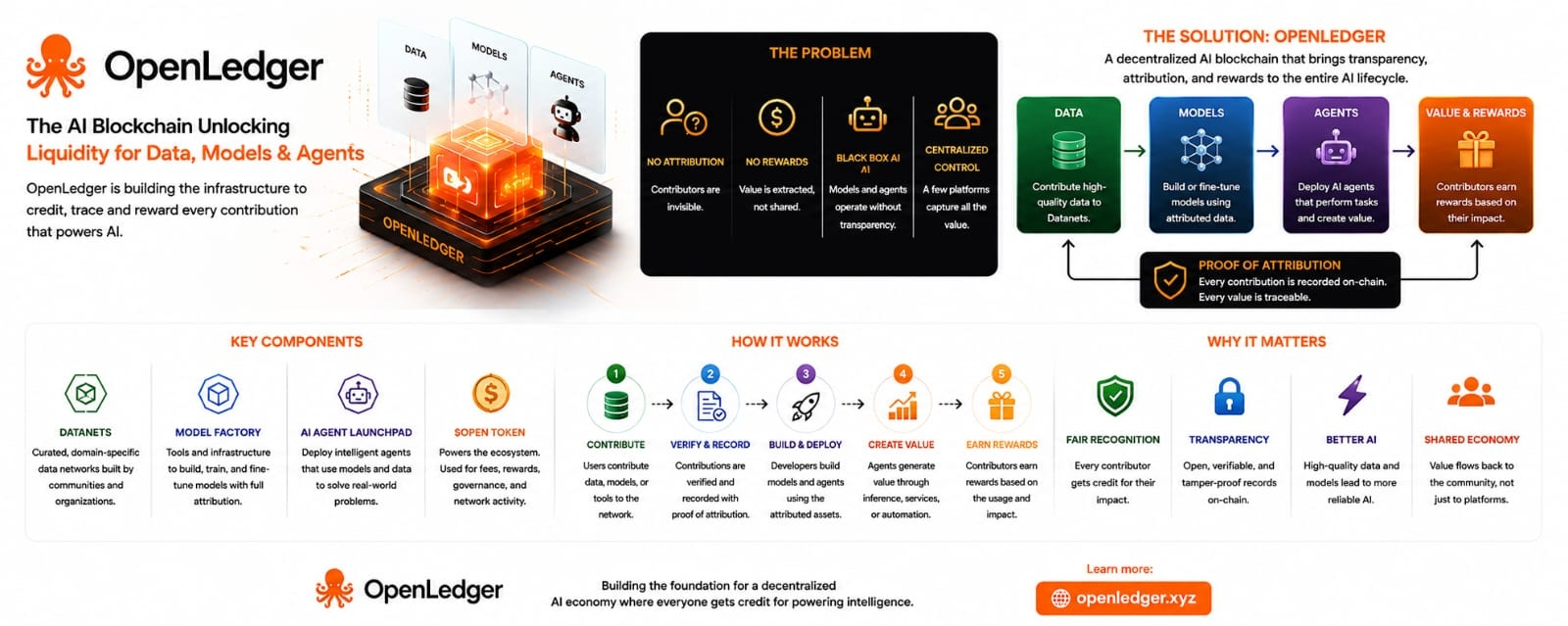
The project is trying to create infrastructure where data, models, and agents can be tracked, valued, and rewarded more fairly. Not in some magical way. More like plumbing. The kind of thing nobody wants to think about when it works, but everybody notices when it breaks.
And right now, attribution in AI is broken.
AI keeps getting more useful, but the sources behind that usefulness are usually blurred. A model may depend on domain data, user behavior, expert writing, community knowledge, or specialized examples, but the final product rarely remembers any of that in a meaningful way.
It just answers.
That is convenient.
Too convenient.
The thing is, data is not just background noise anymore. It is not just something platforms collect quietly and use later. In AI, data becomes the material that shapes intelligence. If the data is good, the model can become useful. If the data is specific, the model can become sharper. If the data is garbage, the model learns garbage with confidence.
So when OpenLedger talks about Datanets, that part actually makes sense.
A Datanet is basically a focused layer of data around a certain purpose. Not a random pile. Not “more data” for the sake of more data. More like a structured place where useful information can live, be connected to models, and hopefully be traced back to the people or systems that contributed it.
That sounds boring.
Good.
A lot of the most important infrastructure is boring.
A good Datanet for cybersecurity would not need hype. It would need real threat data, clean examples, updated patterns, and people who know what they are looking at. A good Datanet for legal work would need careful documents, context, and clean structure. A good Datanet for agriculture would need local knowledge that does not always exist in polished datasets.
This is the part that feels more grounded to me. AI does not need endless noise. It needs better inputs. It needs cleaner pipes.
OpenLedger is also trying to deal with something called attribution, basically figuring out who or what helped create value. If a dataset improves a model, or a model powers an agent, or an agent performs useful work, the system should not just shrug and say, “Nice output.” It should have some way to trace the chain.
That is where the blockchain part becomes less annoying than usual.
Because yes, a normal company can track things in a database. But then you are back to trust. Trust us, we measured it correctly. Trust us, we paid fairly. Trust us, we did not change the rules. Trust us, your contribution counted.
Crypto people have heard “trust us” too many times.
They know how that ends.
So the idea of having a more open record for contribution and reward does not feel random here. It feels like an attempt to fix the part everyone keeps fighting about after the fact.
Who contributed?
Who gets rewarded?
Who was real?
Who was just farming?
Who actually helped the system work?
These questions are not side issues. They are the whole game.
Now, I do not think OpenLedger gets a free pass just because the idea is good. The hard part is still ahead. Measuring contribution in AI is not clean. A model may improve because of thousands of inputs. Some data may matter a lot. Some may matter almost not at all. Some people will try to game the reward system. They always do.
That is not cynicism. That is just crypto.
Build an incentive, and someone will attack it.
So OpenLedger has to be careful. If it rewards quantity over quality, it will get flooded with junk. If attribution feels vague, people will not trust it. If the system becomes too complicated, normal contributors will leave and only professional farmers will remain.
This is hard plumbing.
But that is also why it matters.
The OPEN token sits inside this whole setup as the thing used for fees, rewards, and activity across the network. That part will get most of the attention because tokens always get the attention. People will talk about listings, price, supply, unlocks, and charts.
Fine. That is part of the market.
But it should not be the only lens.
The real question is whether OPEN is attached to actual usage. Are people contributing valuable data? Are developers building models people need? Are agents using those models for real work? Are rewards flowing because something useful happened, or just because a campaign needed engagement?
That difference matters.
A token with no real work underneath is just noise with a ticker.
OpenLedger has a chance to be more than that, but only if the infrastructure becomes useful before the story gets too loud.
And maybe that is the honest way to look at it. Not as a finished solution. Not as some perfect answer to AI and crypto. More like an attempt to fix a very specific wound: the feeling that real contribution keeps getting swallowed by systems that do not remember who helped build them.
That wound exists in AI.
It exists in crypto.
OpenLedger is sitting right where those two frustrations meet.
AI needs better attribution because intelligence does not come from nowhere. Crypto needs better reward systems because communities are tired of fake participation winning. Agents need cleaner records because nobody wants invisible software making decisions without a trail. Data needs a better role because it is becoming too valuable to keep treating it like free dust floating around the internet.
None of this is flashy.
It is infrastructure.
It is pipes, records, incentives, and accountability.
The kind of thing people ignore until it fails.
That is why I find OpenLedger interesting. Not because it promises a perfect future, but because it is working on a problem that already feels painful. The current system is too vague. Too many contributors vanish. Too much value moves upward without memory. Too many rewards go to whoever can manipulate the rules fastest.
If OpenLedger can make even part of that cleaner, it matters.
It might take time. It might be messy. It might need several versions before it really works. And honestly, that would be normal. Anything dealing with AI data, attribution, agents, and crypto incentives is going to be difficult.
But the direction feels right.
Because under all the noise, this is what people actually want: infrastructure that actually works. Systems that remember contribution. Rewards that do not feel random. AI that does not pretend it was born from nothing. Crypto networks where real users are not buried under bots.
OpenLedger is not exciting because it is loud.
It is interesting because it is trying to deal with the part everyone else likes to skip.
The mess under the hood.
And in crypto, that is usually where the real work begins.