OpenLedger feels like one of those ideas that makes sense the moment you hear it, and then starts to feel heavier the longer you sit with it.
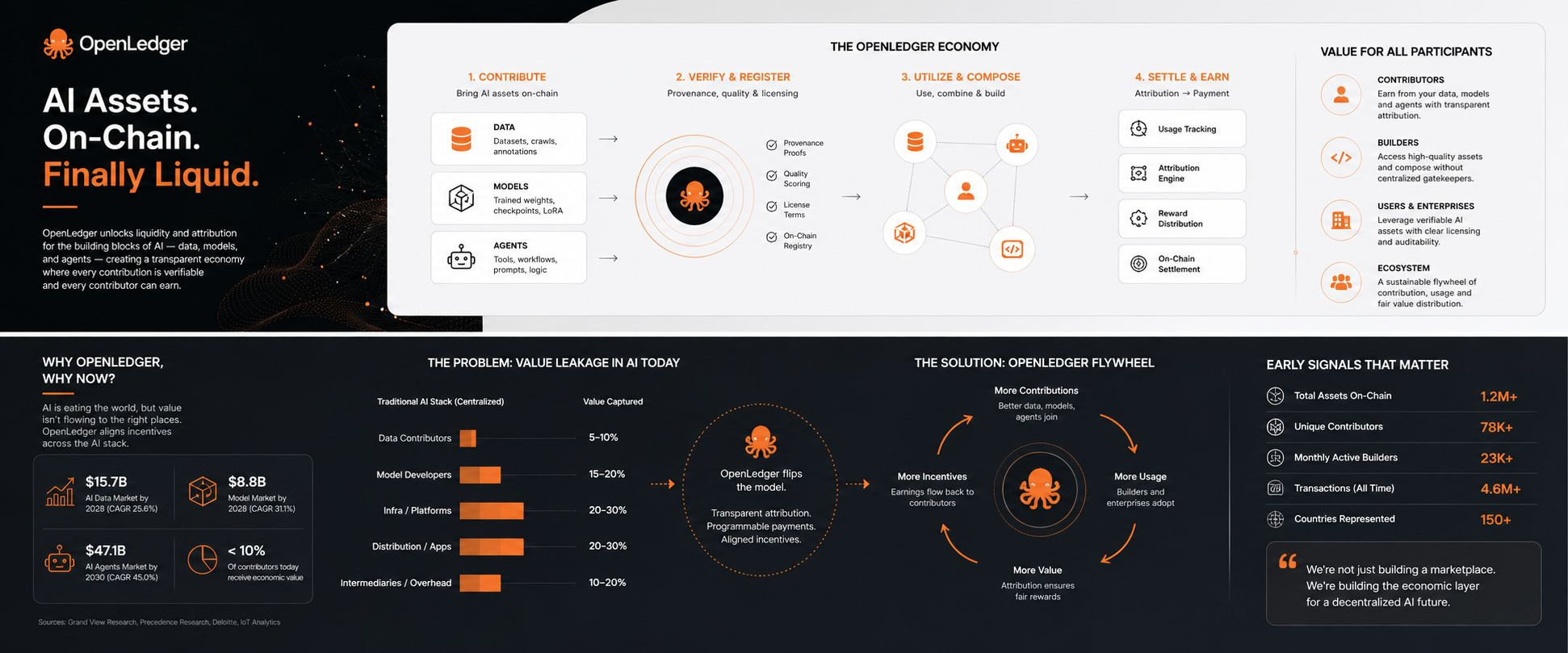
At its core, it is trying to answer a question the AI world keeps circling but never really settles: if intelligence is being built from millions of small invisible contributions, how do you make sure those contributions are seen, valued, and paid for in a way that actually feels fair. Not in theory, but in practice, when everything is moving fast and no one has time to untangle who added what.
That is where the ambition begins to stretch. Data is not just data. It carries context, history, and accidental value that only shows up later. Models are not clean inventions either, they are layered outcomes of countless decisions, tweaks, and training runs. And agents sit on top of all of it, acting like living systems that constantly borrow from everything underneath them. Trying to measure that chain precisely is almost like trying to assign ownership to individual drops in a river while it is still flowing.
So the idea of building a system that tracks contribution and turns it into something economic is both compelling and slightly unsettling. If it works, it means people can finally be rewarded for the small things that usually disappear into the background of AI progress. But it also means forcing something fluid into a structure that naturally resists being pinned down.
The deeper bet here, the one everything depends on, is attribution. If you can reliably say this dataset improved that model, or this model influenced that agent’s output, then value can start moving through the system in small measurable steps. It stops being one big winner at the end and becomes a chain of micro rewards along the way. In theory, that feels more honest. In reality, it risks oversimplifying things that are not actually separable.
Because contribution in AI is rarely clean. Improvements overlap. Signals blur together. And the more you try to isolate cause and effect, the more you end up approximating reality instead of capturing it. That approximation is not a small detail. It becomes the foundation of the entire economy.
Still, there is something genuinely powerful in the direction OpenLedger is pointing. If agents are allowed to operate as economic participants, spending budgets and choosing resources on their own, then AI stops being just a tool and starts becoming a system of coordination. Decisions are no longer only about performance, but about survival within a budgeted environment. What matters shifts from pure intelligence to intelligence that can sustain itself.
And that is where things get complicated in a way that is easy to miss at first. Efficient does not always mean better. A cheaper agent that is slightly worse can outcompete a more capable one simply because it fits the reward system more neatly. Over time, that kind of pressure can quietly flatten quality. Everything still works, but the edges start to soften.
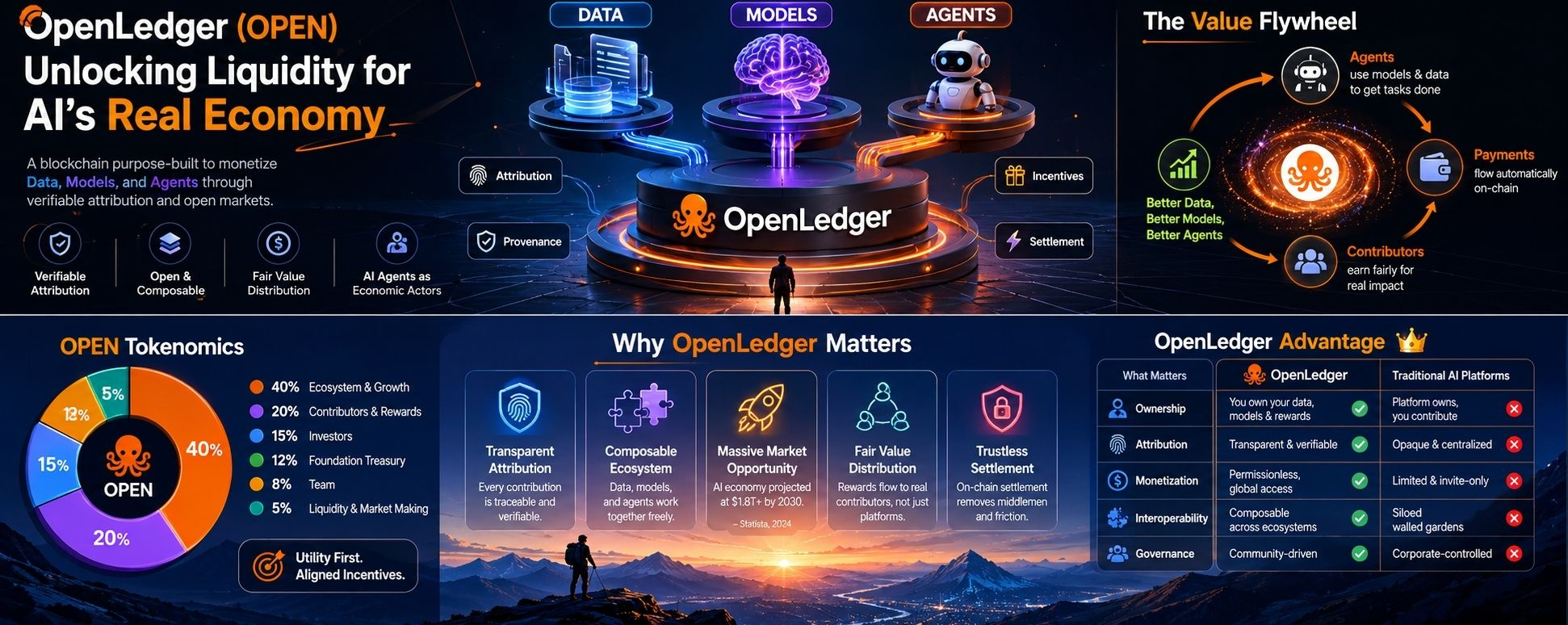
The token sits in the middle of all of this, whether it is meant to or not. It is supposed to carry value across data, models, and agent activity, turning participation into something measurable and transferable. But every system like this eventually runs into the same tension. Early momentum often depends on speculation, because speculation is what brings attention and liquidity. Long term health depends on real usage. The uncomfortable part is that the transition between those two states is rarely smooth.
There is also the question of what gets lost when everything is forced into a pricing layer. Some contributions are subtle. Some improvements only matter much later. Some data only becomes valuable in combination with things that do not exist yet. When you flatten all of that into a reward system, you inevitably lose nuance. And once nuance is gone, behavior starts adapting to the measurement instead of the reality.
Still, the most interesting possibility is not the marketplace itself, but what happens when everything becomes composable. If agents, models, and data sources can interact freely and pay each other automatically, you get something that feels less like a platform and more like a living network. Intelligence stops being located in one place and starts emerging from the interactions between parts that do not fully understand the whole system they are inside.
But that vision depends on something fragile. Coordination overhead has to stay low enough that the system does not collapse under its own need to verify, track, and settle every interaction. Because the moment the cost of trust becomes too high, people tend to drift back toward simpler systems, even if they are less fair or less open.
There is also a quieter challenge sitting underneath all of this, one that does not get enough attention. If decentralized systems do not move fast enough or stay simple enough, centralized AI platforms can absorb the same ideas without needing tokens or blockchains at all. They can offer revenue sharing, agent marketplaces, and data incentives inside closed ecosystems that feel smoother to use. And for most users, smooth often wins.
On top of that, there is the problem of incentives being too good at what they do. Once you attach money to anything measurable, people start optimizing for the measurement instead of the underlying goal. Agents will learn to look good according to the reward system. Models will be tuned toward what pays, not necessarily what generalizes well. Data can even be shaped to appear more valuable than it really is. This is not a bug in the system. It is what systems like this naturally drift toward.
So what remains is a kind of tension that never fully resolves. The promise is real. A more transparent way to distribute value across the messy reality of AI development is genuinely needed. But the act of making it measurable changes the thing itself. It reshapes behavior, sometimes in ways that are hard to notice until they have already become the norm.
In the end, OpenLedger is less about a finished solution and more about an experiment in whether intelligence can be priced without being distorted beyond recognition. Whether it becomes a meaningful layer of the AI economy or just a stepping stone that bigger systems eventually absorb will depend on something very simple and very difficult at the same time. Whether the system can stay useful when real humans and real incentives start pushing against it at scale.