AI is getting smarter… but I think we are asking the wrong question.
Because the real shift is not happening inside the model.
It is happening after the model speaks.
And that part is starting to change everything.
I used to believe AI competition was simple.
Smarter reasoning. Better answers. Faster models.
Whoever builds the strongest intelligence wins.
That was the assumption.
But recently, that idea started to feel incomplete.
Not because models are not improving.
They are.
But because I started noticing what happens to their outputs after they leave the system.
An AI answer looks clean when you see it.
Final. Confident. Complete.
But once it leaves the model, it doesn’t stay still.
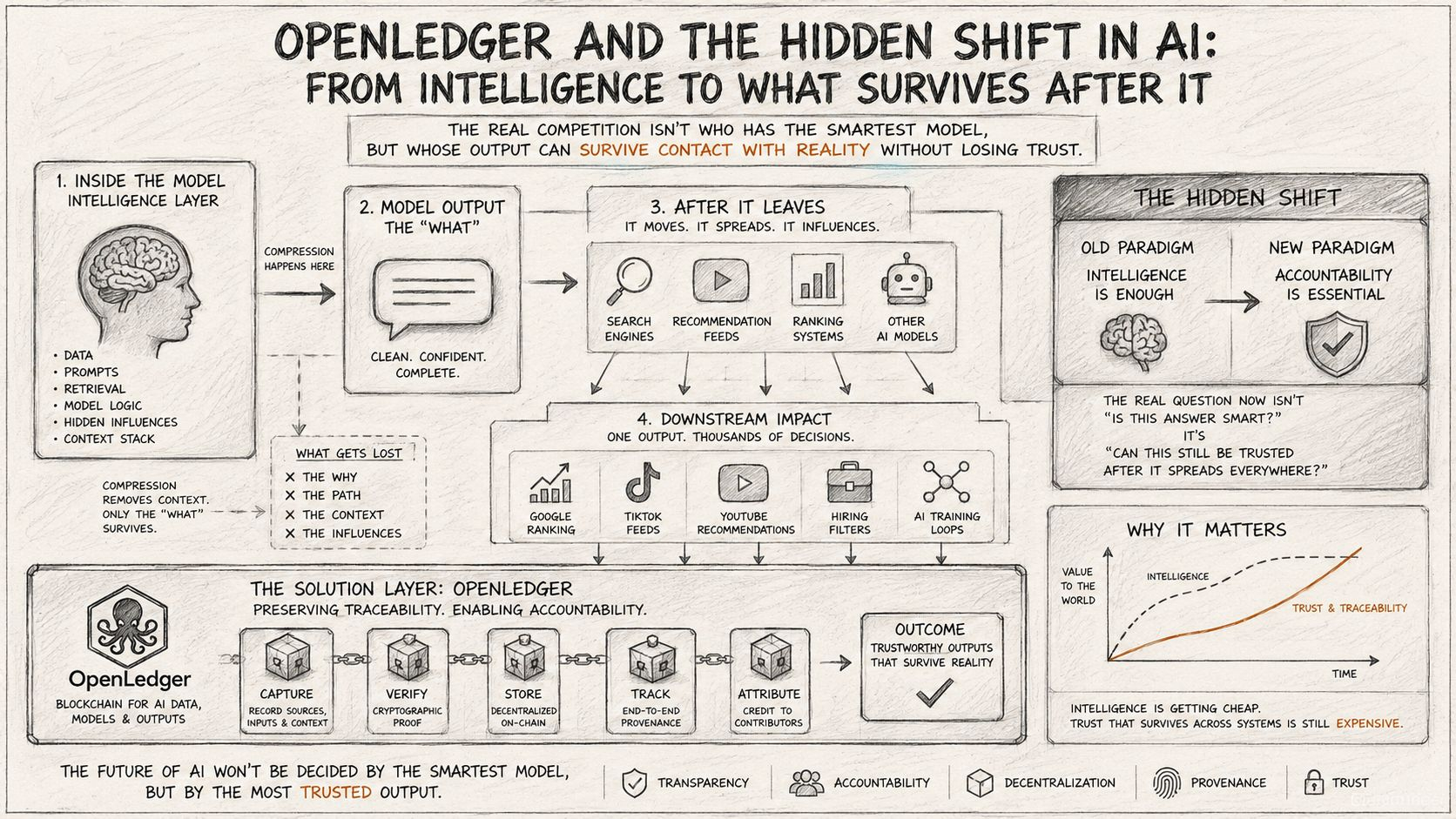
It moves into search engines, recommendation feeds, ranking systems… even other AI models.
And this is where something important gets lost.
Not the answer itself.
But everything that produced it.
The messy path. The hidden influences. The context stack.
All of it disappears.
I kept thinking about systems like OpenLedger and similar ideas…
and it made me realize something uncomfortable:
We have been optimizing only the surface layer of intelligence.
Not what survives underneath it.
Because AI today is basically a compression machine.
It takes: data + prompts + retrieval + hidden model logic
and compresses it into one clean output.
Fast. useful. scalable.
But compression always removes something.
And what gets removed is the “why.”
Only the “what” survives.
And most of the time, we don’t care…
until that output starts affecting real systems.
Because AI outputs don’t stay isolated anymore.
They become inputs everywhere else.
Google ranking. TikTok feeds. YouTube recommendations. Hiring filters. Even other AI training loops.
One answer can quietly influence thousands of downstream decisions.
And that is where the shift hits.
Because at that point, the question is no longer:
Is this answer smart?
It becomes:
Can this still be trusted after it spreads everywhere?
And honestly… most AI systems aren’t built for that question.
Not because they are broken.
But because they were never designed for accountability across environments.
Only for generating outputs in isolation.
That is why ideas like OpenLedger feel interesting to me.
Not as hype.
But as direction.
A shift from better intelligence → to preserved traceability.
Because maybe the real competition isn’t:
Who generates the best answer?
But something more uncomfortable:
Whose answer still makes sense after it has been reused, reshaped, and reranked everywhere else?
This is where intelligence and accountability start pulling in opposite directions.
Intelligence wants to compress complexity into speed.
Accountability wants to preserve enough structure to explain what happened.
One removes context.
The other depends on it.
And that tension is getting more real as AI spreads into everything.
Search. Content. Finance. Hiring. Autonomous agents.
Nothing stays inside the model anymore.
Everything becomes part of a larger system.
So maybe the real competition is quietly changing shape.
Not:
Who has the smartest model?
But:
Whose output can survive contact with reality without losing trust?
Not just correct in isolation.
But stable after reuse.
Traceable after spread.
Still meaningful after everything else builds on top of it.
And maybe that’s the real bottleneck nobody fully talks about yet.
Intelligence is getting cheap.
But trust real trust that survives across systems is still expensive.