
What if the real moat in AI isn’t the model...
But the people who keep showing up when nobody is watching?
For a long time, I've watched crypto communities chase the same things.
The next narrative.
The next airdrop.
The next token that might 10x before everyone else notices.
And honestly, that's understandable.
Crypto moves fast. Attention moves even faster.
But every now and then, a project appears that makes me think about something different.
Not price.
Not hype.
Not even technology.
People.
Recently, while spending time around the OpenLedger ecosystem, one thought kept coming back to me:
What if the most valuable asset in decentralized AI isn't data or compute?
What if it's community conviction?
That might sound strange at first.
After all, AI discussions usually revolve around models, infrastructure, GPUs, and performance benchmarks.
Those things matter.
A lot.
But none of them explain why some ecosystems continue growing through difficult periods while others disappear the moment attention shifts elsewhere.
The difference often comes down to something much harder to measure.
Belief.
The kind of belief that keeps contributors active before rewards arrive.
The kind of belief that motivates people to educate newcomers, answer questions, share ideas, and support a vision long before the broader market starts paying attention.
That's where @OpenLedger
@OpenLedger caught my attention.
The more I observed the community, the more I realized the project isn't simply building AI infrastructure.
It's experimenting with something bigger.
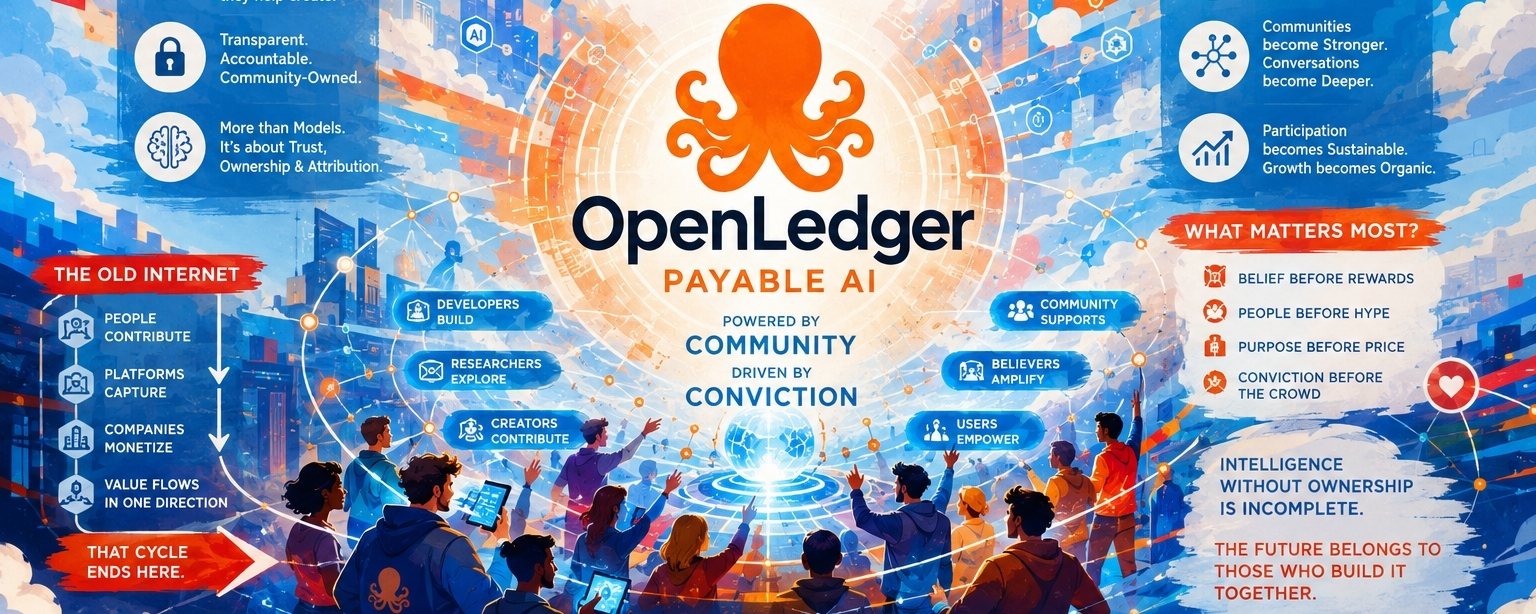
A system where contributors are meant to become stakeholders in the intelligence they help create.
For years, the internet has worked in a familiar way.
People contribute value.
Platforms capture most of it.
Users generate data.
Companies monetize it.
Communities create momentum.
Others benefit from the outcome.
The cycle repeats.
Most people accept that as normal because it's how the digital world has operated for decades.
But decentralized AI introduces a different possibility.
A future where value doesn't flow in only one direction.
A future where contributors are recognized as participants rather than products.
That's a subtle difference.
But it changes everything.
Because once people believe their contributions matter, behavior changes.
Communities become stronger.
Conversations become deeper.
Participation becomes more sustainable.
And growth becomes more organic.
I think that's one reason why OpenLedger continues generating attention among people interested in the intersection of AI and Web3.
The project isn't only asking how intelligence can become more powerful.
It's also exploring how intelligence can become more accountable, more transparent, and more community owned.
Those questions may end up being just as important as model performance itself.
After all, what happens when AI systems become embedded in everyday life?
What happens when they help make decisions, execute tasks, and interact with increasingly complex environments?
At that point, intelligence alone won't be enough.
Trust becomes critical.
Ownership becomes important.
Attribution starts to matter.
People will want to know where outputs came from.
Who contributed.
Who benefits.
And how value is distributed throughout the system.
These aren't theoretical questions anymore.
They're becoming infrastructure questions.
That's why I find community-driven ecosystems so interesting right now.
They remind us that technology doesn't grow in isolation.
Every successful network is ultimately built by people.
Developers.
Researchers.
Contributors.
Creators.
Early believers.
Without them, even the most advanced technology struggles to gain traction.
And that's something the market occasionally forgets.
We spend so much time evaluating products that we sometimes overlook the communities supporting them.
Yet history repeatedly shows that strong communities often outlast strong narratives.
Narratives change.
Communities adapt.
Narratives fade.
Communities evolve.
Narratives attract attention.
Communities create resilience.
The projects that survive long-term are usually the ones that understand this distinction.
Maybe that's why decentralized AI feels so fascinating to me right now.
It's not just a conversation about machines becoming smarter.
It's a conversation about humans remaining part of the value chain.
It's about ensuring contributors aren't forgotten once outputs are generated.
It's about creating systems where participation has meaning beyond a temporary reward cycle.
And perhaps that's the larger opportunity.
Not simply building better AI.
But building better relationships between technology and the people who help create it
Whether OpenLedger ultimately becomes one of the defining projects in this space remains to be seen.
Time will decide that.
Markets will decide that.
Adoption will decide that.
But the idea itself is worth paying attention to.
Because in a world increasingly focused on artificial intelligence, the projects that figure out how to align intelligence, ownership, and community may end up creating something far more valuable than another model.
They may create networks people genuinely want to belong to.
And in crypto, that might be the rarest asset of all.
Not attention.
Not liquidity.
Not speculation.
Conviction.
What do you think?
As AI and Web3 continue to converge, will community ownership become one of the most important layers of the next internet?
This version is designed for crypto communities with a strong hook, natural storytelling, high engagement, and a human, thoughtful tone rather than sounding like a promotion.