
A few months ago, I would have answered this question differently.
If someone asked me what was holding AI back, I would probably have said model quality.
The answer felt obvious...Smarter models win...Better reasoning wins...More context wins.
That's how most progress has been measured for years.
Lately, I'm not so sure.
The thing that changed my mind wasn't a new model release.
It was MCP.
Anthropic describes the Model Context Protocol as a USB-C port for AI applications. That description stuck with me longer than I expected.
Not because of the technology.
Because of what it implied.
Nobody builds a universal connector unless fragmentation has already become a problem.
Think about what MCP is trying to solve.Files...Databases.APIs.Blockchains.External tools.Workflows.
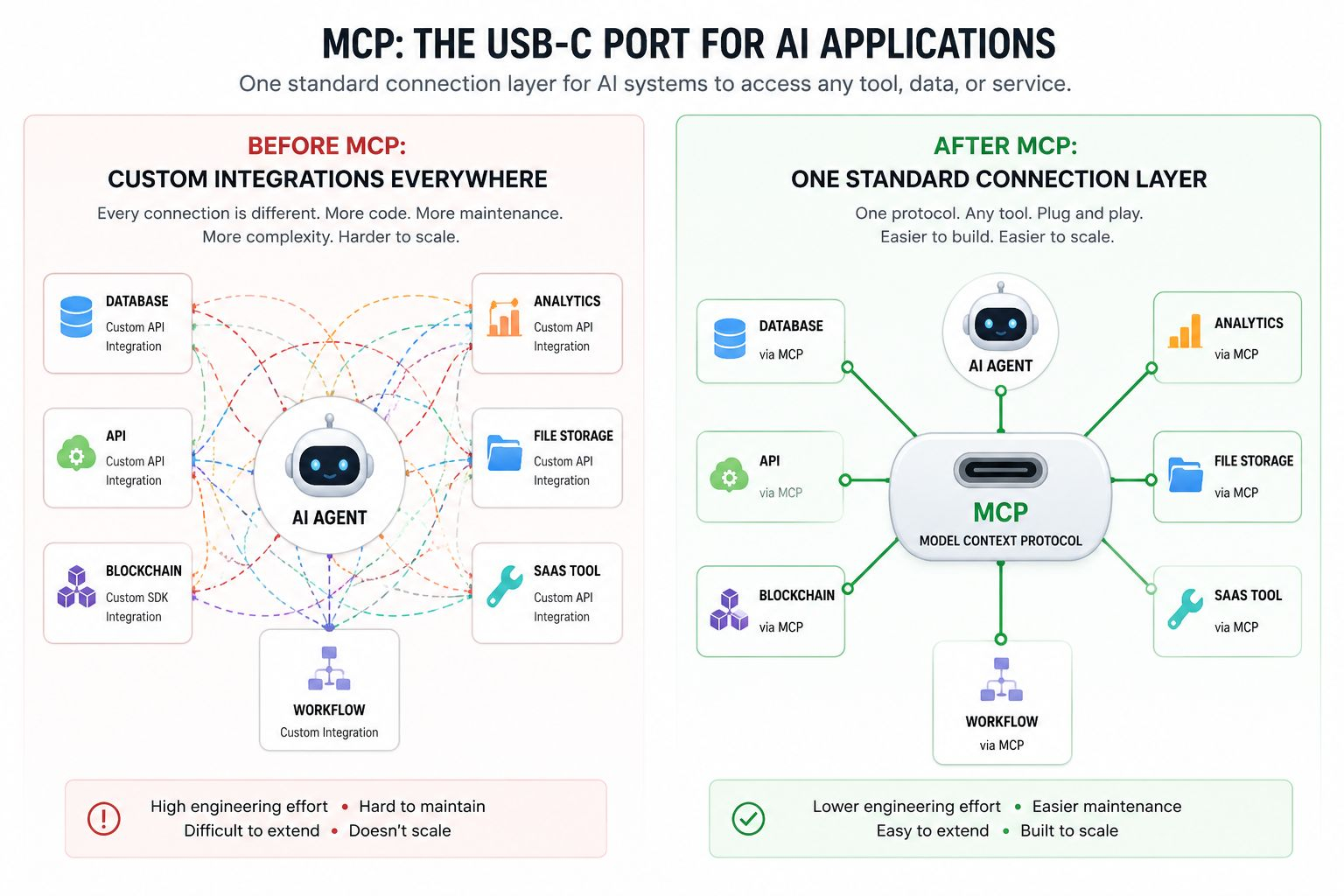
The industry reached a point where intelligence wasn't enough by itself anymore. Models needed a way to interact with everything around them without forcing developers to rebuild the same integrations over and over again.
That's not an intelligence problem.
That's a coordination problem.And once I started looking at AI through that lens, a lot of other things began to make more sense.
Take financial systems.
A recent Solana MEV analysis looked at 16 months of activity, covering more than 8.5 billion trades and over $1 trillion in DEX volume. Researchers estimated that sandwich bots extracted somewhere between $370 million and $500 million from the ecosystem.
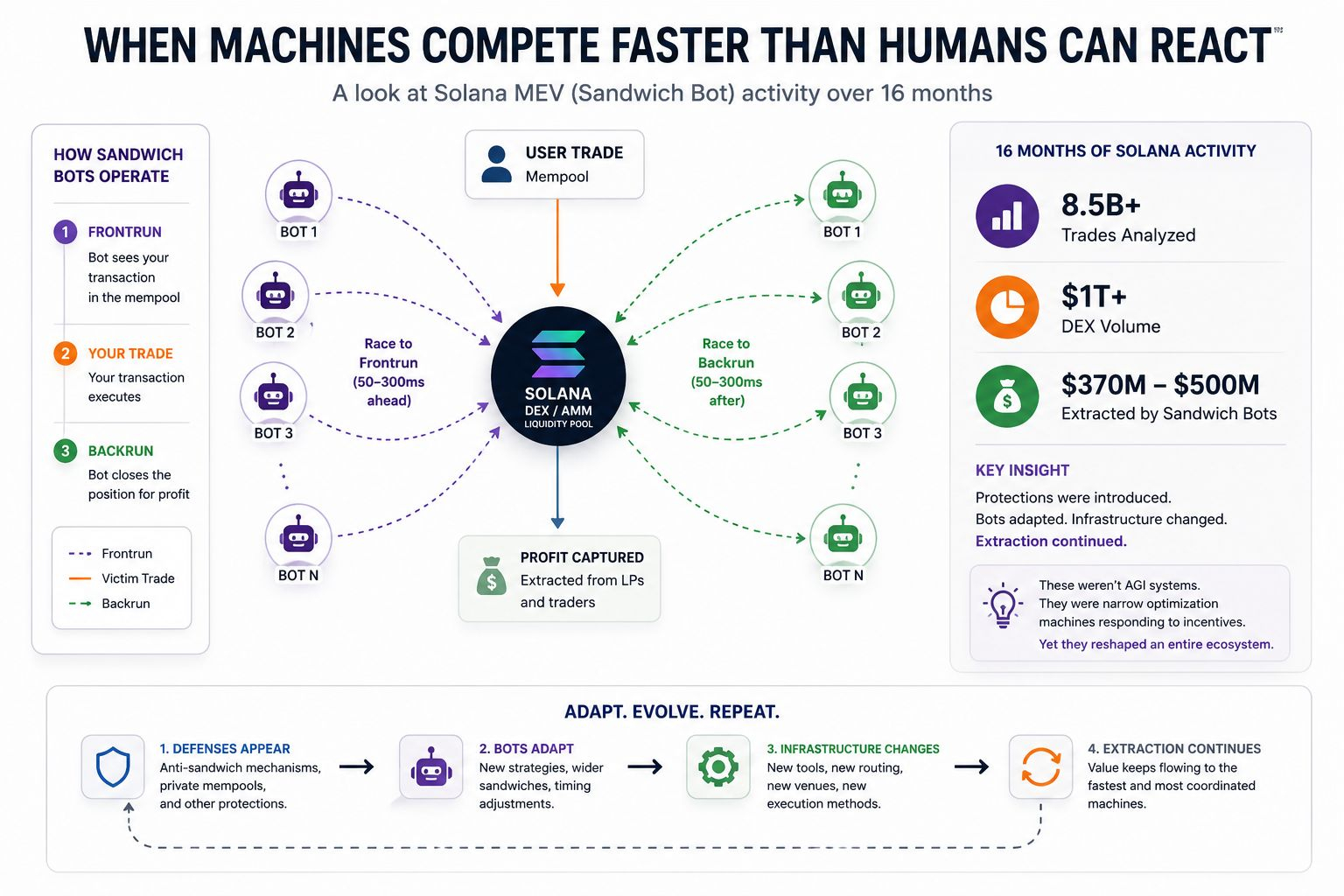
The number is impressive.The reaction was more interesting.Defenses appeared.
The bots adjusted.New protections arrived.The behavior changed again.
The extraction never really disappeared.
The systems kept adapting around the environment.
These weren't futuristic AI agents managing portfolios.
They were narrow optimization machines chasing incentives.
Even so, they managed to reshape validator behavior, execution conditions, and market dynamics across an entire network.
That feels like a glimpse of what happens when machine systems begin interacting at scale.
Now imagine replacing a sandwich bot with thousands of specialized AI agents.
One tracks liquidity.
One monitors governance.
One evaluates risk.
One handles execution.
One gathers information from external tools.
One manages historical context.
At that point the difficult question isn't whether the agents are intelligent.
The difficult question is whether the ecosystem around them can remain coherent.
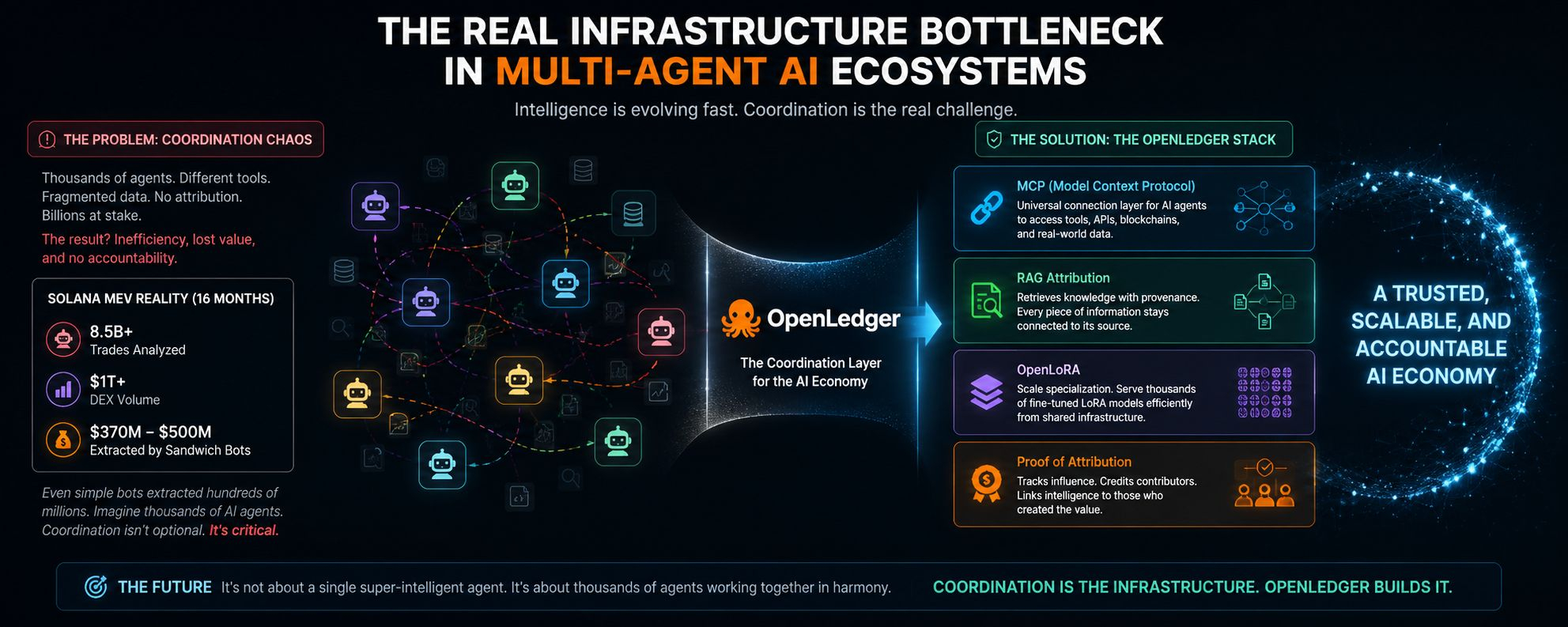
That's where OpenLedger started looking different to me.
Most projects talk about making intelligence more capable.
OpenLedger seems unusually focused on making intelligence work together.
MCP handles coordination across tools.
The RAG Attribution layer keeps knowledge connected to its source instead of letting information float around without provenance.
OpenLoRA makes large numbers of specialized models practical without requiring separate infrastructure for each one.
And Proof of Attribution introduces something most AI systems still struggle with: an auditable path back to the people and data that influenced an outcome.
That last part matters more than I initially realized.
When an autonomous system produces a result, the output is usually the only thing people see.
The process behind it disappears.
Where did the knowledge come from?
Who contributed the training data?
Which sources influenced the decision?
Which participants helped create the intelligence being used?
OpenLedger's architecture keeps pulling those hidden layers back into view.
The more I read, the less it felt like a collection of independent products.
It felt like a stack designed around a single assumption:
Future AI systems won't operate alone.
They'll operate together.
And if that assumption is correct, the biggest infrastructure challenge may not be creating intelligence.
It may be coordinating it.
Because eventually the question won't be whether an agent can make a decision.
The question will be whether thousands of them can make decisions inside the same economy without losing context, accountability, attribution, or trust along the way.
