
I did not expect OpenLedger to stay on my mind.
Most things do not anymore.
That is not because crypto has become boring. If anything, there is more happening than ever. New AI projects appear every week. New narratives fight for attention. New promises arrive faster than anyone can properly evaluate them.
The problem is that after enough years, you stop reacting the way you used to.
I remember when every new idea felt exciting.
I would open ten tabs at once.
Read whitepapers late at night.
Convince myself I might be looking at the beginning of something important.
Sometimes I was right.
Most of the time I was not.
Experience does not make you smarter as much as it makes you more careful with your excitement.
That is where I find myself now.
Watching.
Waiting.
Trying not to confuse noise with signal.
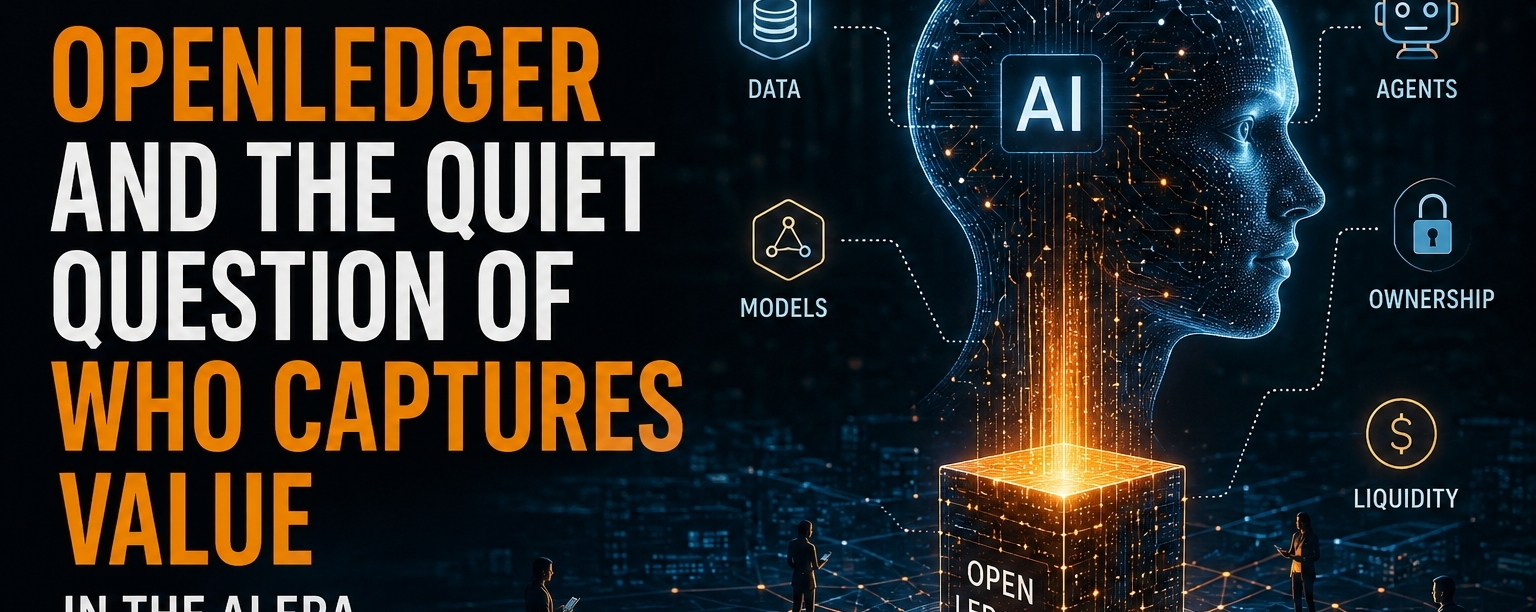
OpenLedger caught my attention because it made me think about something that has been quietly bothering me for a while.
The people creating value are not always the people receiving it.
The more I watch AI evolve, the harder that reality becomes to ignore.
Every breakthrough seems to create another wave of excitement.
Bigger models.
Better outputs.
More powerful systems.
Investors celebrate.
Companies grow.
Markets chase the next opportunity.
Meanwhile, I keep wondering about the invisible people sitting underneath all of it.
The contributors nobody talks about.
The individuals whose knowledge, behavior, feedback, and data helped make these systems possible in the first place.
Maybe that sounds idealistic.
Maybe it is.
But markets are ultimately built on incentives.
And incentives shape behavior far more than technology does.
I have seen communities lose interest when they stop feeling valued.
I have seen users disappear when they realize they are contributing more than they are receiving.
I have seen projects with incredible technology slowly fade because the economic structure underneath them never truly worked.
That is why OpenLedger feels different to me.
Not because I think success is guaranteed.
Nothing in this industry deserves that assumption.
I learned that lesson years ago.
Some of my biggest mistakes came from believing a strong narrative automatically meant a strong future.
It does not.
Reality eventually asks harder questions.
Can people actually use it?
Will they continue showing up?
Does the incentive make sense after the excitement fades?
Those questions matter more than any announcement ever will.
What keeps pulling me back to OpenLedger is the feeling that it is focused on one of the quieter problems inside AI.
Ownership.
Contribution.
Value distribution.
The topics that rarely generate the loudest headlines but often determine whether systems survive.
The internet trained us to give things away for free.
Our attention.
Our preferences.
Our behavior.
Our knowledge.
Most of us never thought much about it.
I certainly did not.
The exchange felt invisible.
Convenience came first.
Questions came later.
Now AI is turning those invisible contributions into something much larger.
And suddenly the economics feel impossible to ignore.
I think that is why this idea keeps lingering in my mind.
Not because I know where it leads.
Honestly, I do not.
The older I get in crypto, the more comfortable I become admitting uncertainty.
Some of the people who sounded most confident in previous cycles ended up being the most wrong.
I would rather stay curious.
Curiosity has saved me more money than confidence ever did.
Maybe OpenLedger succeeds.
Maybe it struggles.
Maybe the market is not ready for this kind of model.
All of those outcomes remain possible.
But every once in a while a project appears that makes me stop thinking about price for a moment and start thinking about behavior instead.
Those moments are rare.
And when they happen, I pay attention.
Because beneath every technological shift, beneath every chart, every narrative, every trend, there are still people.
People responding to incentives.
People looking for ownership.
People trying to find their place in systems that are becoming more complex every year.
That feels like the real story.
Not the AI race.
Not the token.
Not the headline.
The question of who creates value and who gets to share in it.
That question feels much bigger than any single project.
And it is one of the few questions lately that I cannot seem to stop thinking about.